Moon Closer to Earth: Half as Far, About 8x the Tidal Force
The What-If Observatory Published
Halve the Moon's distance and 2³ = 8: its tidal force on Earth rises about 8 times. That force falls with the cube of distance, while the plain pull rises only 4 times, and the Moon would also look about twice as wide, 1.04 degrees against 0.52 from Earth's center. How high the tides would run is a different question, because basin shape, depth and Earth's spin decide it, and we have no tide model to say.
Steps in this reading (6)
- Suppose:
- the Moon orbits at half its present distance, about 192,000 kilometers.
- Hold fixed:
- the Moon's mass, Earth's mass, Earth's spin (for now), a circular orbit.
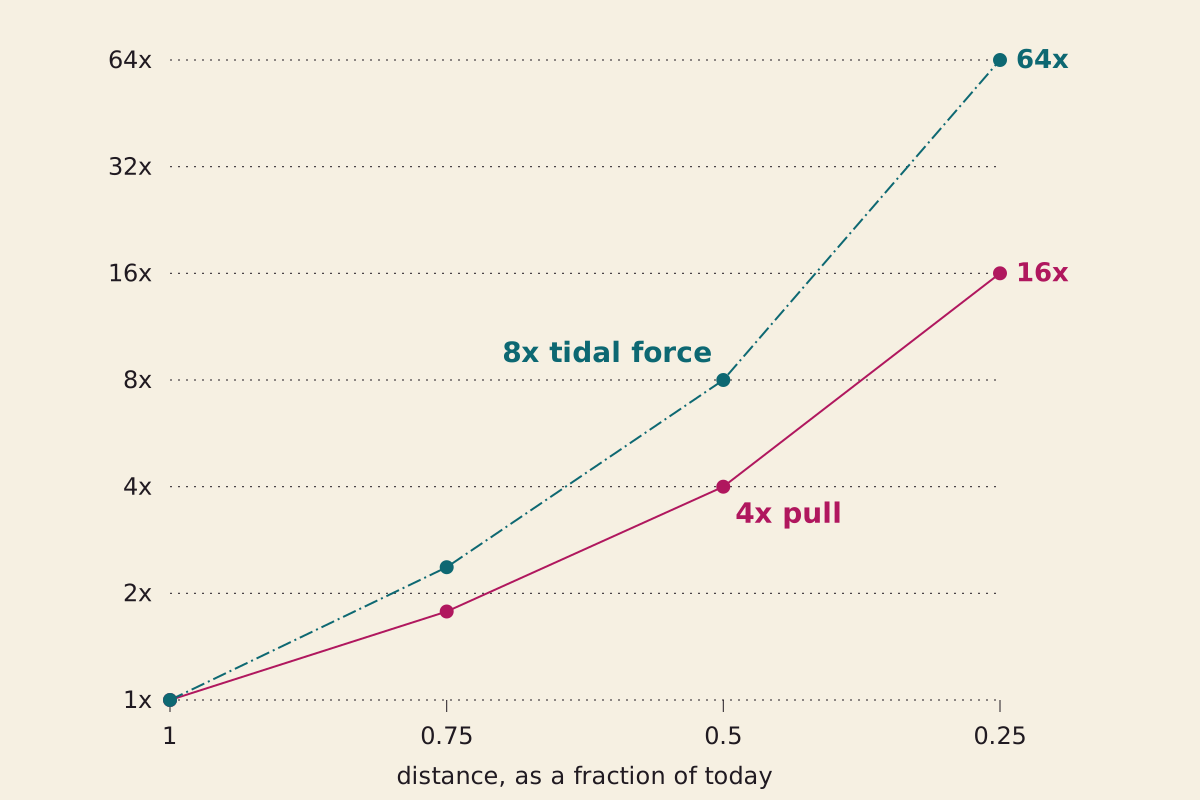
Pull and tidal force at four distances, on a log scale where each gridline doubles the last. The tidal line is the first-order cube law. These are forces on Earth, not tide heights.
"Pull and tidal force as the Moon comes closer" by The What-If Observatory, https://whatifobservatory.com/what-if/moon-closer-to-earth/, licensed under CC BY 4.0 (https://creativecommons.org/licenses/by/4.0/)
Data: NOAA tides tutorial (distance laws); multiples are our arithmetic
We get there one step at a time. Each step carries a Seeing mark, a label borrowed from astronomy, where still air gives a sharper picture, and it rates how much weight the step can bear: clear, hazy or overcast. Whether the arithmetic is right is a separate column in the table at the end.
Why 8 times, not 4?
Because tides come from a difference in pull, not from the pull itself.
Step 1: the distance. A 2013 review of lunar laser ranging by T. W. Murphy Jr. gives the semi-major axis of the Moon's orbit as 384,402 kilometers, center to center, so half of that is 192,201 kilometers. The real orbit is an ellipse that runs from about 356,500 to 406,700 kilometers, and we treat the new orbit as a circle to keep one number in play. Seeing: hazy, because the review quotes that figure and we did not trace it to the ranging data.
Step 2: the two laws. NOAA's tides tutorial says gravity weakens with the square of the distance, so half the distance means 2², or 4 times the pull. Tidal force comes from the difference in pull across Earth, and the same tutorial says tide-generating force weakens with the cube of the distance, so half the distance means 2³, or 8 times. Seeing: hazy, because the subtraction below uses a quoted distance and a quoted mass ratio, though it only moves the 8 between 7.81 and 8.21.
You can check that with plain subtraction, no trust in the cube law required. With an Earth/Moon mass ratio of 81.300570 and the International Astronomical Union's nominal values for Earth, the Moon's pull today runs from 34.3 millionths of a meter per second squared on the near side to 32.1 on the far side. The gap is 2.20.
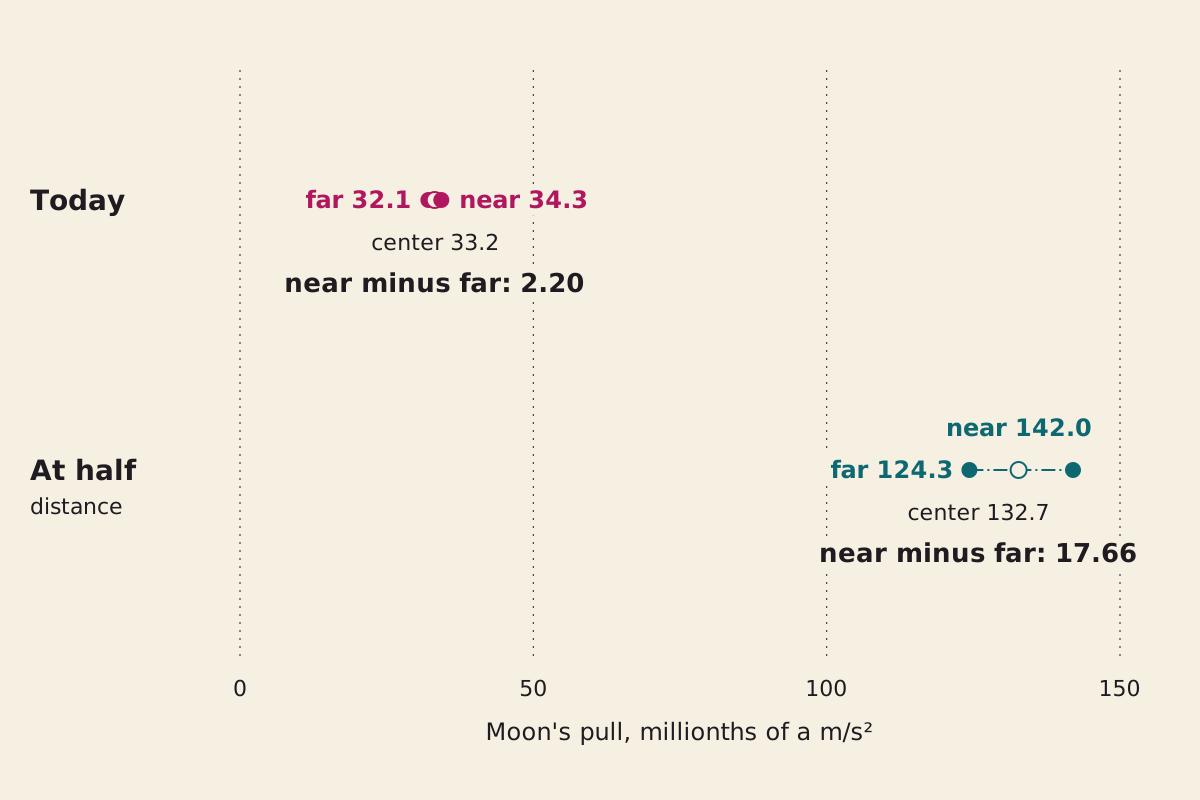
The Moon's pull at Earth's far side, center and near side, in millionths of a meter per second squared. The dots move right by about 4 times, and the gap between them widens by about 8.
"The Moon's pull across Earth, today and at half the distance" by The What-If Observatory, https://whatifobservatory.com/what-if/moon-closer-to-earth/, licensed under CC BY 4.0 (https://creativecommons.org/licenses/by/4.0/)
Data: Murphy 2013 (lunar semi-major axis); Williams, Turyshev & Boggs (mass ratio); IAU 2015 Resolution B3 (Earth values)
The extra power of distance has a plain source. The gap is roughly the pull multiplied by the share of the distance that Earth's width takes up. At half the distance that share doubles, so 4 times the pull and 2 times the share make 8.
At half the distance the same three readings are 142.0, 132.7 and 124.3. The center has risen 4 times. The gap of 17.66 is 8.01 times the old one, which is the cube law showing up in ordinary subtraction.
One side at a time, the 8 turns out to be a rounding. The near-side gap grows 8.21 times and the far-side gap 7.81 times, because Earth's radius is not quite negligible next to the distance, so “about 8” is the honest wording.
The force stays small either way. Measured from Earth's center to the point directly under the Moon, the first-order formula takes it from about 1.10 to about 8.81 millionths of a meter per second squared, roughly half the near-to-far gap. Plain subtraction at that point gives 1.13 and 9.27. Earth's own pull is about 9.80 meters per second squared, so the first-order figures come to about one part in 8.9 million today and one part in 1.1 million at half the distance.
NOAA describes the result as two bulges of water, one on the side facing the Moon and one on the far side. The cube law tells you how hard those bulges are being driven. It does not tell you how tall they get.
How big would it look?
About twice as wide: 1.04 degrees across instead of 0.52.
Step 3: the width. With the 1,737.4-kilometer reference radius that US Geological Survey lunar data standards take from an International Astronomical Union working group, the Moon spans 0.52 degrees from Earth's center today and 1.04 at half the distance. Someone with the Moon directly overhead stands one Earth radius closer to it, which adds about 1.7 percent today and about 3.4 percent at half the distance. Seeing: hazy, because the radius and the distance are quoted figures, and we did not read the working group's report.
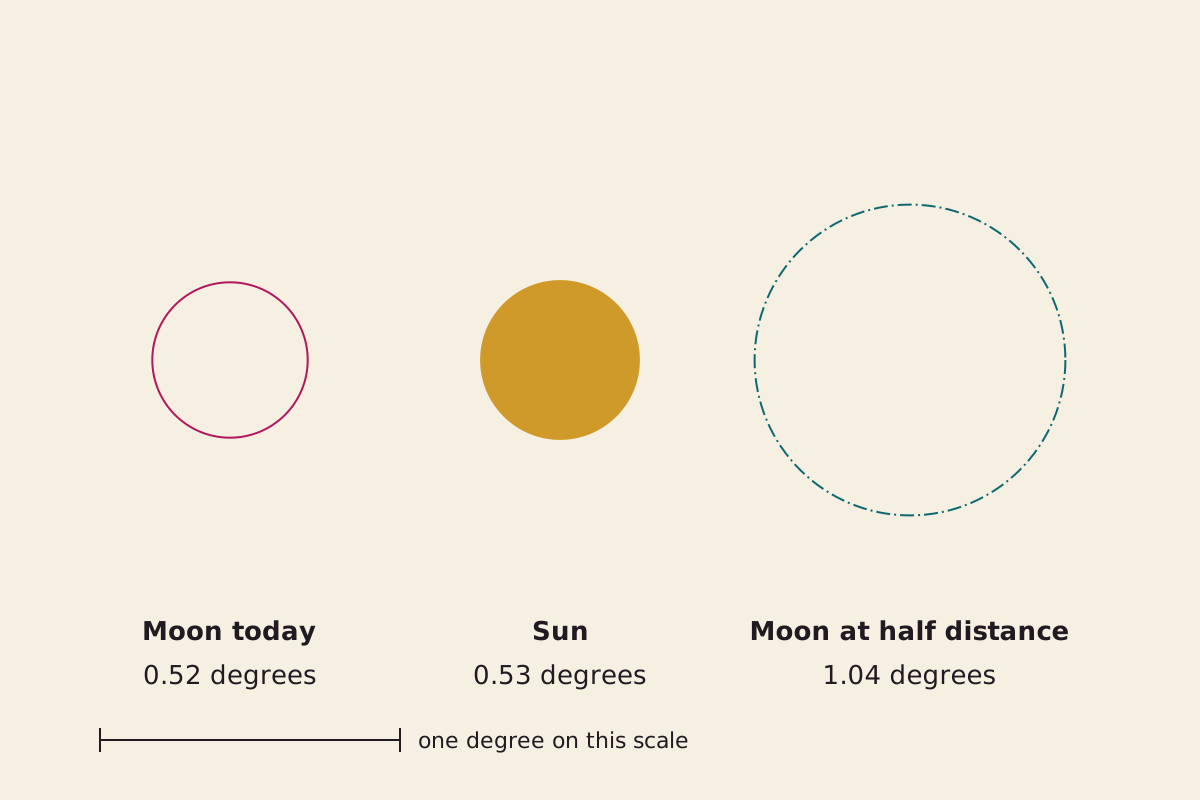
The Moon and the Sun on one angular scale, with the Moon's width taken from Earth's center. The Sun's width uses the nominal solar radius at one astronomical unit.
"Apparent width of the Moon and the Sun" by The What-If Observatory, https://whatifobservatory.com/what-if/moon-closer-to-earth/, licensed under CC BY 4.0 (https://creativecommons.org/licenses/by/4.0/)
Data: Murphy 2013 (distance, astronomical unit); USGS lunar data standards (Moon radius); IAU 2015 Resolution B3 (solar radius)
The Sun comes out at 0.53 degrees, using the IAU's nominal solar radius and the astronomical unit listed in Murphy's review. So the Moon at its average orbit is about 0.97 Sun widths across today, and it would be about 1.94 at half the distance.
The calendar in the sky would speed up too. Full Moons would come about every 9.92 days instead of about every 29.53, which is roughly three for each one you see now, so the phases would run about three times as fast.
Twice the width means four times the sky area. Since each square kilometer of the Moon would catch the same sunlight as before, we would expect a full Moon to send down about four times the light, without looking any brighter per patch of sky. That is our inference from the geometry. No source we read states it.
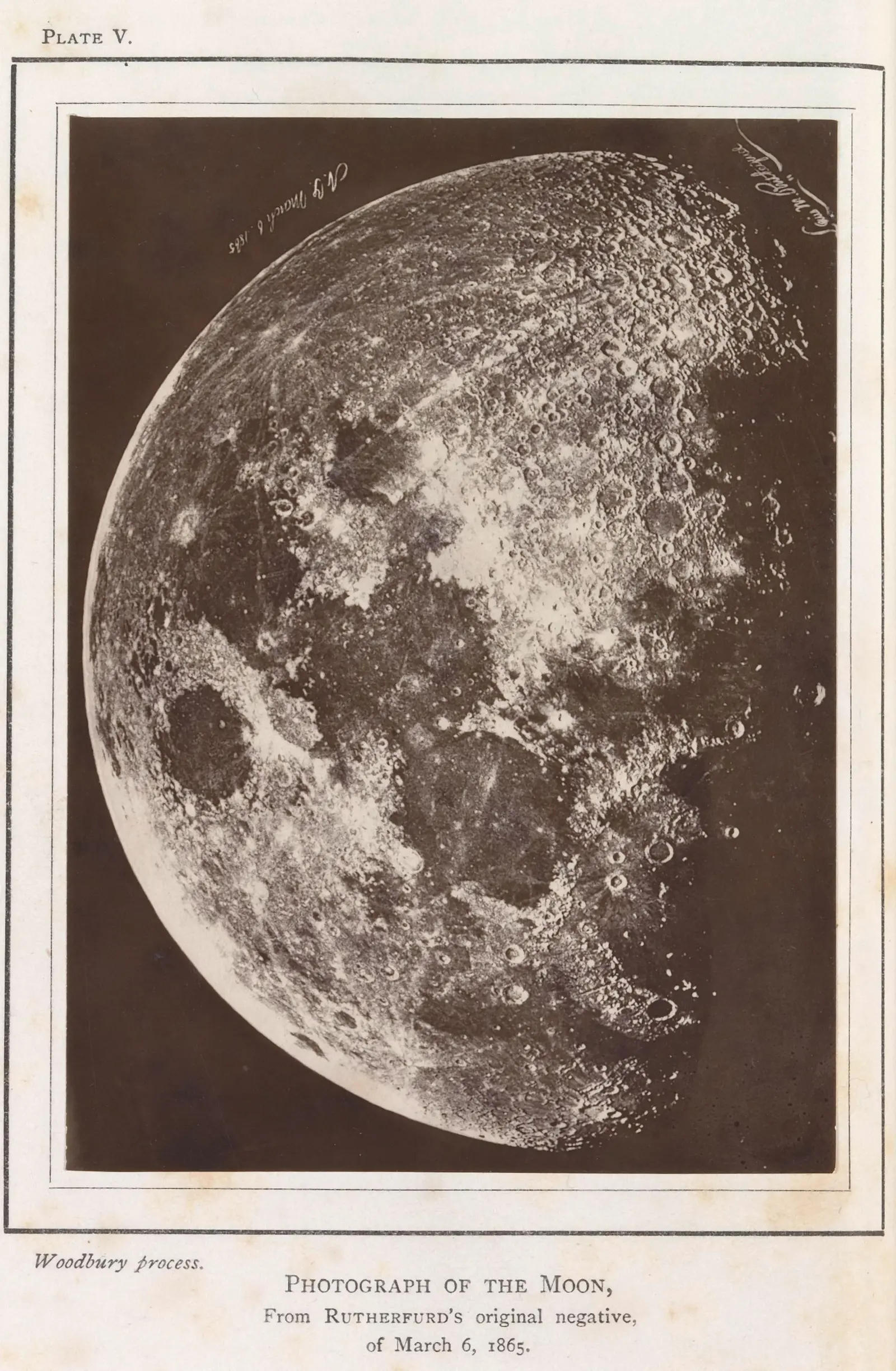
The Moon, photographed by Lewis M. Rutherfurd on March 6, 1865.
"Maan. Photograph of the Moon" by Lewis M. Rutherfurd — https://commons.wikimedia.org/wiki/File:Maan_Photograph_of_the_Moon_(titel_op_object),_RP-F-2001-7-1093-2.jpg — Public domain in the US (published before 1931) and in the EU (author died 1892, life+70); modified: cropped from a photograph of the open book to the plate and its printed caption, film grain removed with a 3 px median, card view cropped to 16:9

Every crater on that face would also look twice as wide. James Nasmyth and James Carpenter wanted pictures as faithful to the lunar surface as they could make, and their book The Moon explains how they made one: they turned their drawings into models, set the models in sunlight and photographed them.
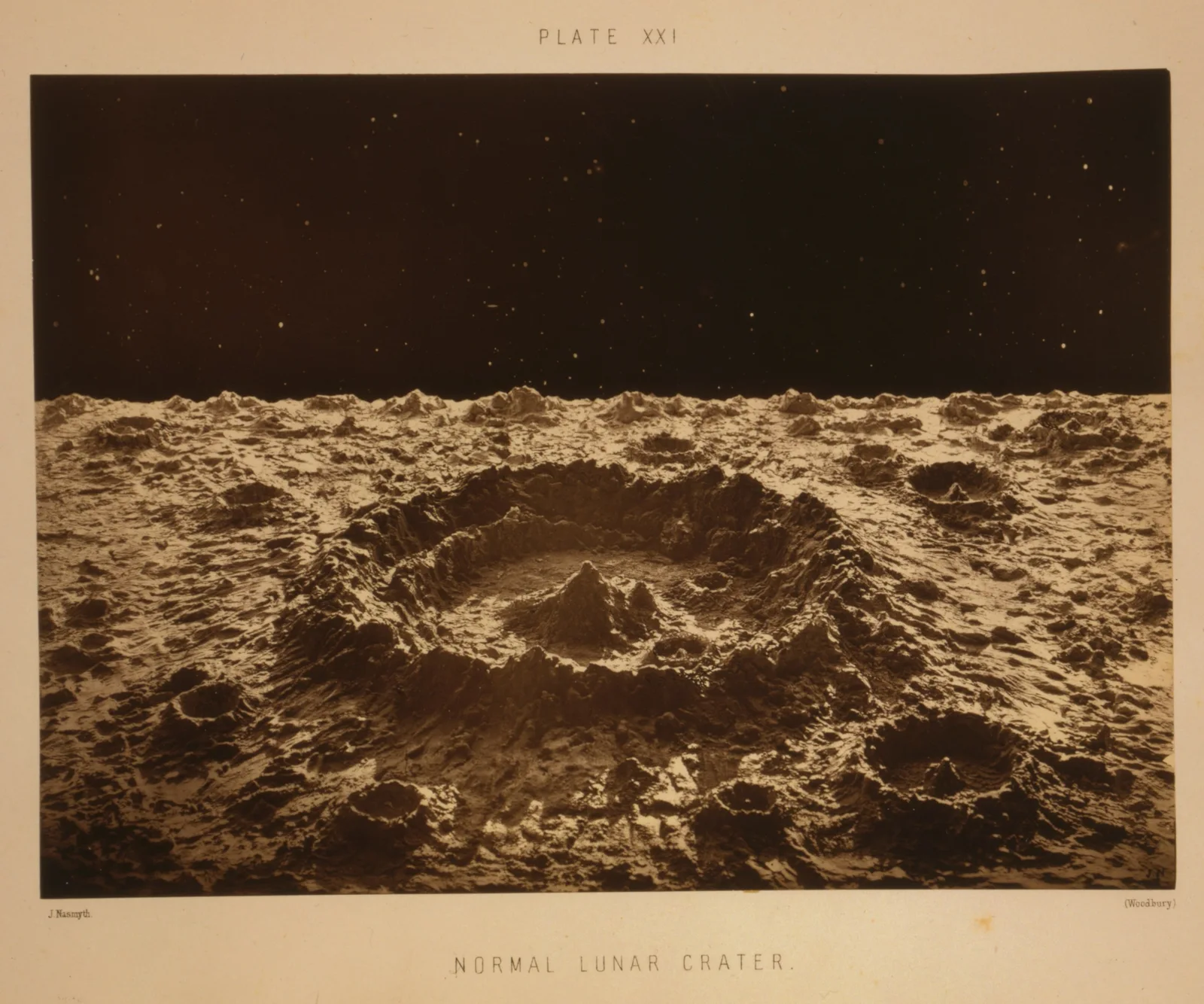
“Normal lunar crater,” a plate from Nasmyth and Carpenter's book, dated 1874 in its library record. Their book says plates like this were photographed from models, so this is not a view of the Moon itself.
"Normal lunar crater" by James Nasmyth — https://commons.wikimedia.org/wiki/File:Normal_lunar_crater_-_J._Nasmyth._LCCN2001700463.jpg — Public domain in the US (published 1874) and in the EU (author died 1890, life+70); modified: cropped to the plate; color card and film edge removed

What happens to eclipses?
In a straight-line eclipse, the Moon's full shadow would reach the ground easily, with a cross-section there about 1,749 kilometers wide. This page covers geometry only and is not a viewing guide. Never look at the Sun without proper eye protection.
Step 4: the shadow. The Moon's full shadow is a cone that narrows to a tip, and with the Sun at one astronomical unit that cone is about 373,575 kilometers long today. From the Moon's center to the ground directly below is 378,024 kilometers at the semi-major axis, so the tip stops about 4,449 kilometers short. At the closest range in Murphy's figures, 356,500 kilometers, the same sum gives a shadow about 219 kilometers wide.
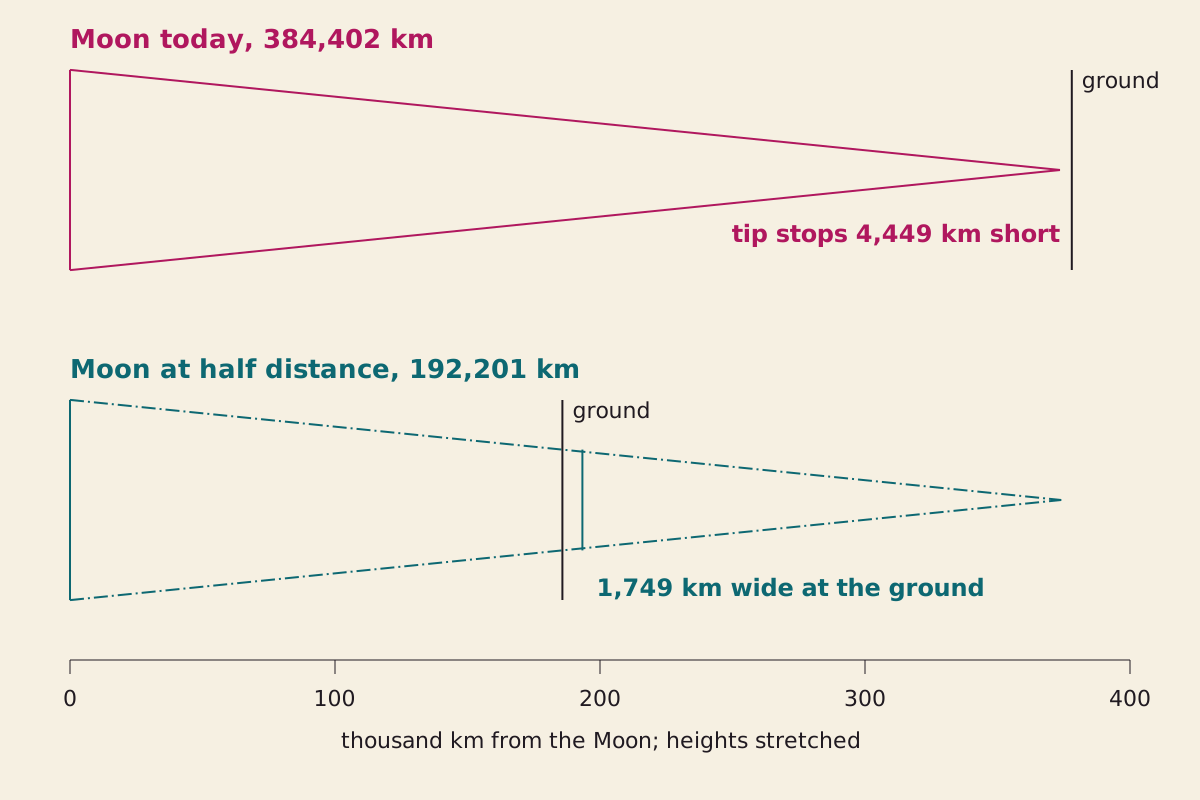
The cone of full shadow in side view, with heights stretched so the cones can be seen. Lengths along the bottom are to scale. Today's cone is drawn at the semi-major axis.
"The Moon's shadow cone against the ground" by The What-If Observatory, https://whatifobservatory.com/what-if/moon-closer-to-earth/, licensed under CC BY 4.0 (https://creativecommons.org/licenses/by/4.0/)
Data: Murphy 2013 (distance, astronomical unit); USGS lunar data standards (Moon radius); IAU 2015 Resolution B3 (solar and Earth radii)
At half the distance, the cone is about 374,056 kilometers long and the ground is only 185,823 kilometers away, so the cross-section there is about 1,749 kilometers wide, roughly 8 times the 219. Seeing: hazy, because we took a straight-line eclipse, a flat cross-section and the Sun at a fixed distance, and a real shadow falling at a slant would run wider.
A Moon 1.94 Sun widths across would also never leave a ring of Sun showing around its edge, as long as the new orbit stays close to a circle. Today's Moon, at 0.97 Sun widths at its average orbit, can.
We can count the chances but not the eclipses. New Moons would come every 9.92 days, about 36.8 a year against about 12.4 today, but how many of those line up with the Sun depends on the tilt of the orbit, and we did not compute that.
Would the orbit even stay there?
Yes. Nothing in this sum makes the Moon fall, and a Moon at half the distance would orbit in about 9.66 days.
Step 5: the clock. First comes a calibration, because a formula ought to reproduce a known number before anyone leans on it. Kepler's third law, with the semi-major axis, the IAU's value for Earth and the mass ratio, gives 27.28 days for today's orbit, and NOAA's tide glossary gives the sidereal month, the time for one lap against the stars, as 27.321661 days. That is a miss of 0.13 percent, so scaling the stated period by 0.5 to the power 1.5 and getting 9.66 days looks safe. Seeing: hazy, because the period comes from a glossary and the check runs on quoted figures.
That also changes the rhythm of the water. NOAA gives a lunar day, the time for one spot on Earth to come back under the Moon, as 24 hours and 50 minutes, and with a 24-hour day we get 24.84 hours, a 0.03 percent miss. At half the distance, with Earth's spin held fixed, we get 26.69 hours. On a coast with two high tides per lunar day, which NOAA says is the case for most coasts, that puts them about 13.34 hours apart instead of about 12.42.
The Moon's familiar face would not stay put either, at least at first. Murphy's review notes that the Moon is tidally locked to Earth, turning once per orbit, but a Moon moved inward with its old spin would finish its 9.66-day lap well before its 27.32-day turn. On that assumption its face would appear to rotate once every 14.94 days, until tides locked it again on a schedule we did not compute.
How close before it breaks up?
Step 6: the breakup limit. A Roche limit is the distance inside which tidal force can pull apart a body held together only by its own gravity. A 2013 paper by Saul Rappaport and colleagues gives the classic fluid form as 2.44 times the larger body's radius, times the cube root of the density ratio, and a 2026 paper by Harrison Agrusa and Patrick Michel gives the rigid form for a sphere with no spin, which works out to about 1.26 in place of 2.44.
From the mass ratio and radii, Earth is about 1.64 times as dense as the Moon, which puts the fluid limit near 18,365 kilometers and the rigid limit near 9,483. The half-distance orbit sits about 10.5 times outside the fluid limit, and even a quarter of today's distance sits about 5.2 times outside. Seeing: hazy, because the Moon is neither a fluid nor a perfectly rigid sphere.
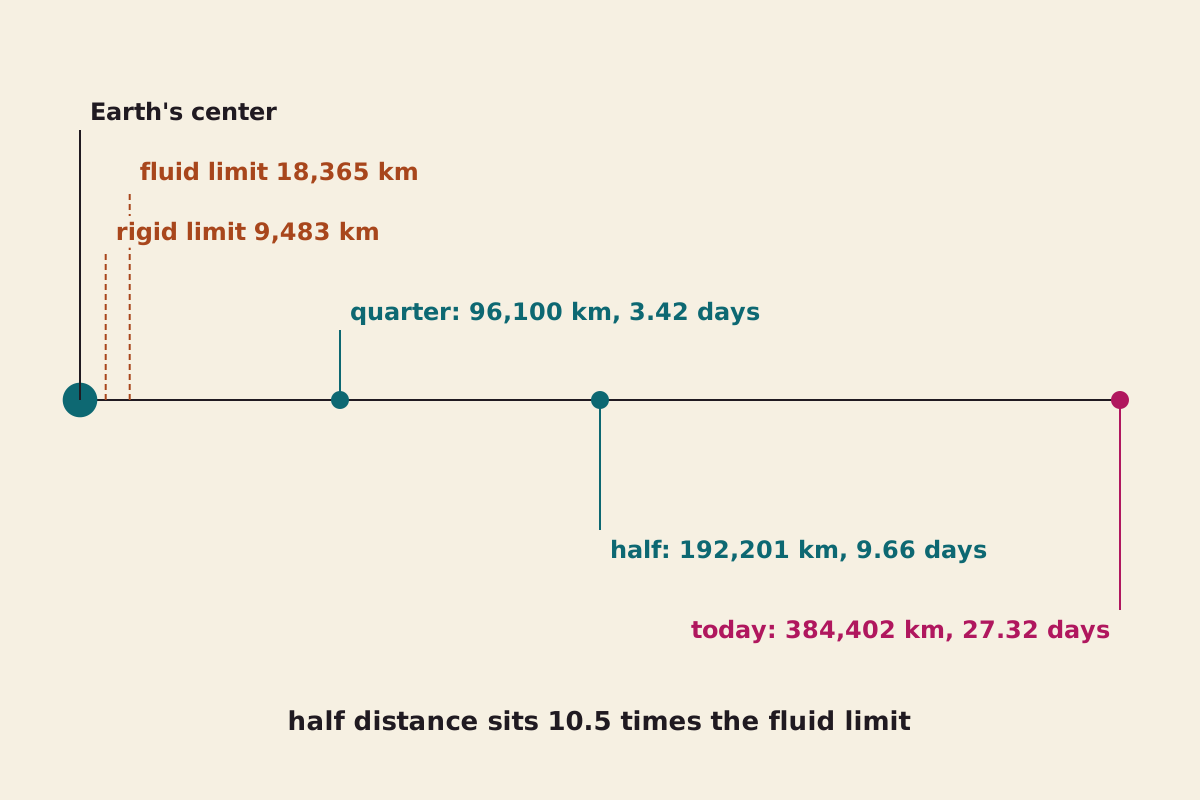
Distances from Earth's center on one linear scale, with the orbit period at each. The two limits are classic idealizations, the rigid one with no spin, not measured values for the Moon.
"Moon distances against the Roche limits" by The What-If Observatory, https://whatifobservatory.com/what-if/moon-closer-to-earth/, licensed under CC BY 4.0 (https://creativecommons.org/licenses/by/4.0/)
Data: Murphy 2013 (distance); Williams, Turyshev & Boggs (mass ratio); IAU 2015 Resolution B3 (Earth radius); USGS lunar data standards (Moon radius); NOAA Tides and Currents Glossary (period); Rappaport et al. 2013 and Agrusa & Michel 2026 (limit forms)
Would the day get longer?
It already does. A closer Moon would speed that up, which is why Earth's spin was held fixed only “for now.”
Step 7: the drift. In the opening paragraph of their 2022 paper, Mohammad Farhat and colleagues wrote that Earth's spin “brakes with time” while the Earth-Moon distance grows, now at 3.830 ± 0.008 centimeters a year by lunar laser ranging. How much faster a closer Moon would do this is where the sums get soft. A classical model, which R. Caimmi updated in 2018, ties the drift to the distance raised to the power −11/2, by our reading of its equations. At half the distance that means about 45 times, or about 173 centimeters a year.
Caimmi also reports, citing P. M. Mathews and S. B. Lambert, that tidal friction in the solid Earth and ocean lengthens the day by 2.50 milliseconds a century. Caimmi's equation for the day, with Earth's spin held at today's rate, gives about 53 times that at half the distance, or about 132 milliseconds a century, because the Moon's share of the braking rises 64 times while the Sun's share stays put. That is still a slow change against any human lifetime.
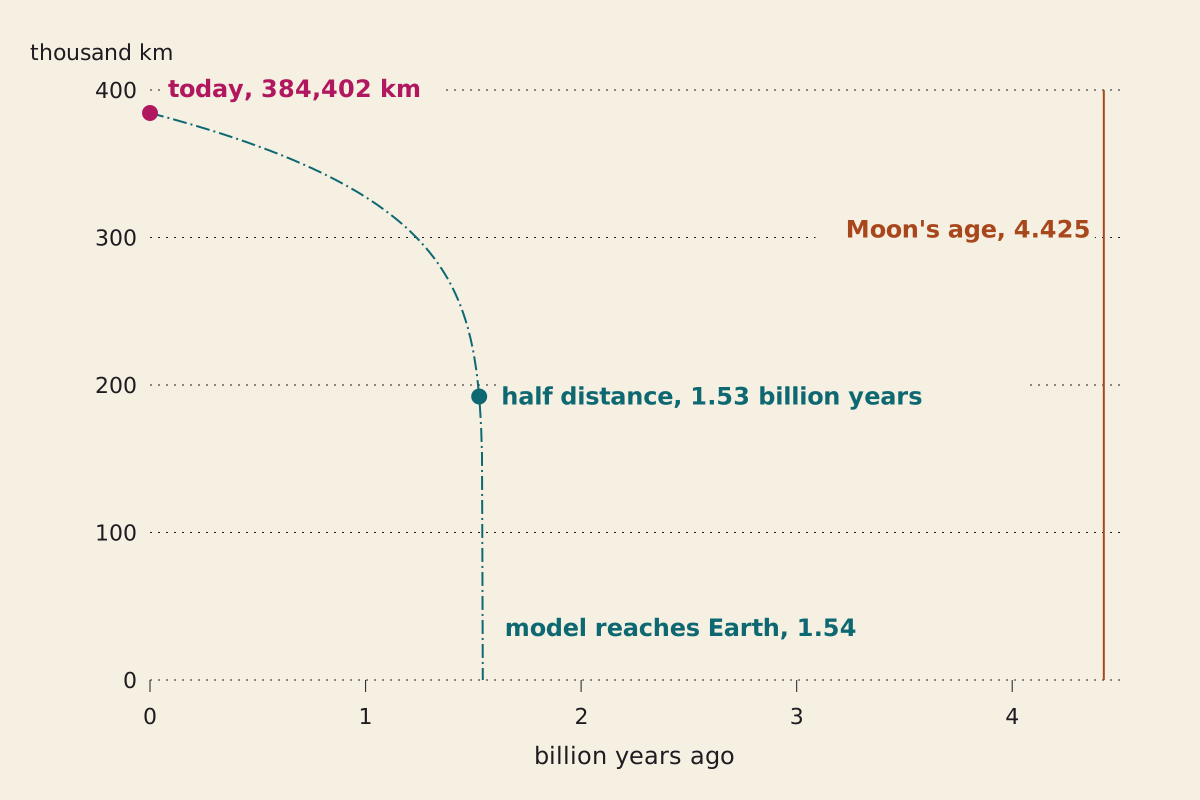
The simple model run backward from today's distance and drift, shown because it fails. It is not a history of the Moon. The Moon's age is the estimate given by Farhat and colleagues, 4.425 ± 0.025 billion years.
"A simple tide model run backward" by The What-If Observatory, https://whatifobservatory.com/what-if/moon-closer-to-earth/, licensed under CC BY 4.0 (https://creativecommons.org/licenses/by/4.0/)
Data: Murphy 2013 (distance); Caimmi 2018 (model form); Farhat et al. 2022 (drift, Moon age)
Now the catch.
Run that same model backward from today and the Moon passes half its present distance about 1.53 billion years ago and reaches Earth about 1.54 billion years ago. Farhat's group says in that same paragraph that simple models predict a close encounter “within less than 1.6 billion years,” which does not fit a Moon they put at about 4.425 billion years old, give or take 0.025 billion, and their own fix runs through ocean resonances. So 45 and 53 are what the simple model says, and that model has a known fault. Seeing: hazy.
Over shorter spans the drift hardly matters. At today's rate, 10,000 years adds about 383 meters, or about 0.0001 percent of the distance. Anyone born in that stretch, the most recent part of our count of everyone who has ever lived, saw about the same Moon as anyone alive now.
Why we stop at tide height
The tempting sum is today's tide times 8. We are not going to do it.
The same Moon already raises very different tides in different places. NOAA says mid-ocean islands away from continental margins typically see very small tides, while wide margins can magnify them and a funnel-shaped bay can alter them dramatically. Its example is the Bay of Fundy in Nova Scotia, which it says has the highest tides in the world, so one force already gives many answers, and the sea floor and the shoreline make the difference.
The second problem is timing. Farhat's group describes tidal dissipation in the ocean as dependent on tidal frequency, with high-dissipation resonant states, and in their model today's torque sits around a resonance peak. Our closer Moon changes the force and also the rhythm, from about 12.42 hours between high tides to about 13.34, and an ocean basin answering at a new period is not today's ocean scaled up.
Where the water would reach, we do not know. We have no model of the basins, depths and shelves at that period. A water budget like the one in our Atlantropa what-if would not supply one. Any shoreline figure on this page would be made up, so there isn't one.
The dotted line falls after step 7. Up to there, every reading has a named source or a stated assumption, and the sums were checked against a stated orbit period and a stated lunar day. Step 8 asks how high the water would climb on a real coast at a new period, and nothing we read turns the force into a height. From here on, we are guessing.
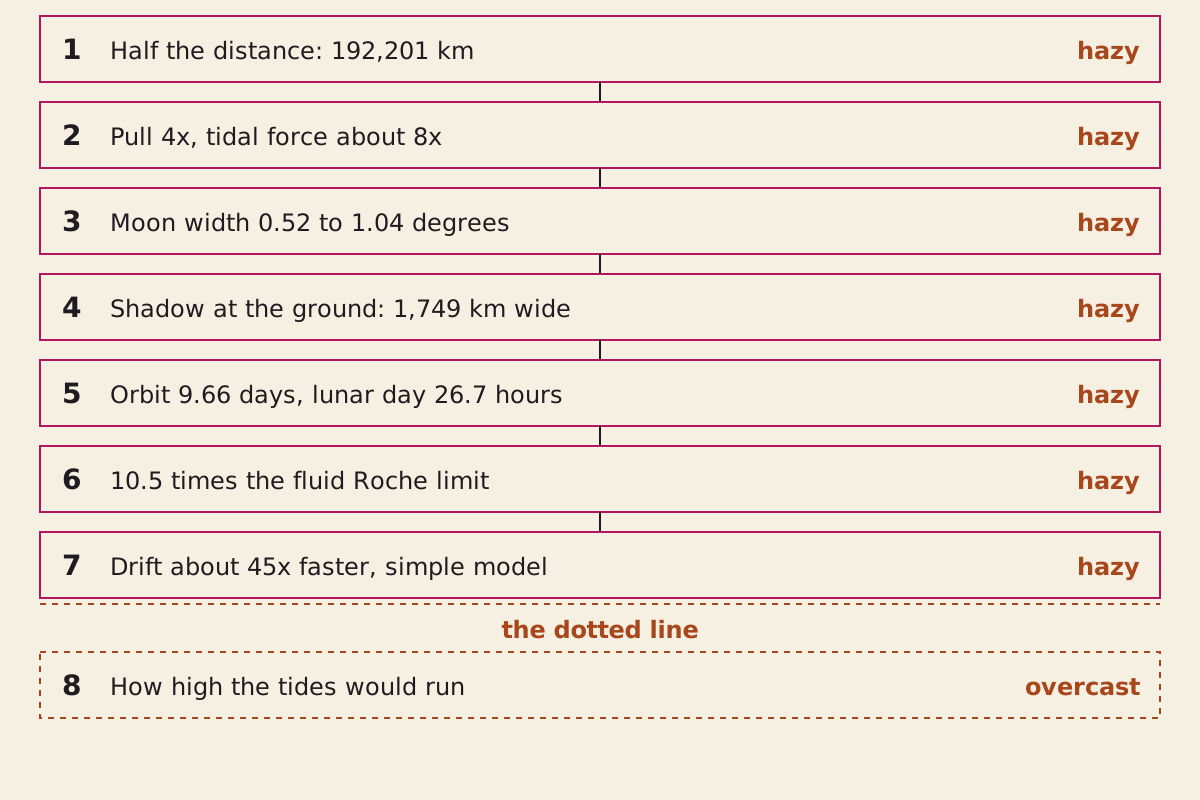
The chain behind this page. Steps 1 to 7 rest on published inputs and stated assumptions. Step 8, tide height, sits past the dotted line.
"The chain behind the Moon at half its distance" by The What-If Observatory, https://whatifobservatory.com/what-if/moon-closer-to-earth/, licensed under CC BY 4.0 (https://creativecommons.org/licenses/by/4.0/)
So the force sits above that line, and the height of the water sits below it. Seeing: overcast.
Check my math:
| Step | Input | Value | Unit | Source no. | Source | Recomputed | Seeing |
|---|---|---|---|---|---|---|---|
| 1 | Semi-major axis of the lunar orbit | 384,402 | km | 1 | secondary | no | hazy |
| 1 | Half the distance | 192,201 | km | 1 | site assumption | yes | hazy |
| 2 | Pull at half the distance: 2² | 4 | times | 1, 2, 3 | secondary | yes | hazy |
| 2 | Tidal force at half the distance: 2³ | 8 | times | 1, 2, 3 | secondary | yes | hazy |
| 2 | Earth/Moon mass ratio | 81.300570 | ratio | 2 | secondary | no | hazy |
| 2 | Earth's mass parameter | 3.986004 × 10¹⁴ | m³/s² | 3 | primary | no | clear |
| 2 | Earth's nominal equatorial radius | 6,378.1 | km | 3 | primary | no | clear |
| 2 | Tidal force today, first order | 1.101 × 10⁻⁶ | m/s² | 1, 2, 3 | secondary | yes | hazy |
| 2 | Tidal force at half the distance, first order | 8.808 × 10⁻⁶ | m/s² | 1, 2, 3 | secondary | yes | hazy |
| 2 | Near-side gap today, plain subtraction | 1.129 × 10⁻⁶ | m/s² | 1, 2, 3 | secondary | yes | hazy |
| 2 | Near-side gap at half the distance, plain subtraction | 9.267 × 10⁻⁶ | m/s² | 1, 2, 3 | secondary | yes | hazy |
| 2 | Near-side gap, half against today | 8.21 | times | 1, 2, 3 | secondary | yes | hazy |
| 2 | Far-side gap, half against today | 7.81 | times | 1, 2, 3 | secondary | yes | hazy |
| 2 | Earth's own pull, no spin correction | 9.798 | m/s² | 3 | primary | yes | clear |
| 3 | Moon's radius | 1,737.4 | km | 4 | secondary | no | hazy |
| 3 | Moon's width today, from Earth's center | 0.518 | degrees | 1, 4 | secondary | yes | hazy |
| 3 | Moon's width at half the distance, from Earth's center | 1.036 | degrees | 1, 4 | secondary | yes | hazy |
| 3 | Sun's nominal radius | 695,700 | km | 3 | primary | no | clear |
| 3 | Astronomical unit, rounded | 1.496 × 10⁸ | km | 1 | secondary | no | hazy |
| 3 | Sun's width | 0.533 | degrees | 1, 3 | secondary | yes | hazy |
| 4 | Shadow cone today | 373,575 | km | 1, 3, 4 | secondary | yes | hazy |
| 4 | Moon's center to ground today | 378,024 | km | 1, 3 | secondary | yes | hazy |
| 4 | Tip short of the ground today | 4,449 | km | 1, 3, 4 | secondary | yes | hazy |
| 4 | Shadow width at 356,500 km | 219 | km | 1, 3, 4 | secondary | yes | hazy |
| 4 | Shadow width at half the distance | 1,749 | km | 1, 3, 4 | secondary | yes | hazy |
| 5 | Orbit period from Kepler's law, today | 27.28 | days | 1, 2, 3 | secondary | yes | hazy |
| 5 | Stated sidereal period | 27.321661 | days | 14 | secondary | no | hazy |
| 5 | Orbit period at half the distance | 9.66 | days | 14 | secondary | yes | hazy |
| 5 | New Moon to new Moon at half the distance | 9.92 | days | 14 | secondary | yes | hazy |
| 5 | Lunar day today | 24.84 | hours | 14 | secondary | yes | hazy |
| 5 | Lunar day at half the distance | 26.69 | hours | 14 | secondary | yes | hazy |
| 5 | Apparent turn of the Moon's face, old spin kept | 14.94 | days | 14 | site assumption | yes | hazy |
| 6 | Earth-to-Moon density ratio | 1.643 | ratio | 2, 3, 4 | secondary | yes | hazy |
| 6 | Fluid Roche limit | 18,365 | km | 2, 3, 4, 9 | secondary | yes | hazy |
| 6 | Rigid Roche limit, no spin | 9,483 | km | 2, 3, 4, 10 | secondary | yes | hazy |
| 6 | Half distance over the fluid limit | 10.5 | times | 1, 2, 3, 4, 9 | secondary | yes | hazy |
| 7 | Recession rate today | 3.830 ± 0.008 | cm/yr | 12 | secondary | no | hazy |
| 7 | Recession at half the distance, simple model | 173 | cm/yr | 11, 12 | site assumption | yes | hazy |
| 7 | Day lengthening today | 2.50 | ms per century | 11 | secondary | no | hazy |
| 7 | Day lengthening at half the distance, simple model | 132 | ms per century | 11 | site assumption | yes | hazy |
| 7 | Backward clock from today, simple model | 1.54 | billion years | 1, 11, 12 | site assumption | yes | hazy |
| 7 | Passing half the distance, same backward clock | 1.53 | billion years | 1, 11, 12 | site assumption | yes | hazy |
| 7 | Moon's age, as Farhat's group gives it | 4.425 ± 0.025 | billion years | 12 | secondary | no | hazy |
| 8 | Tide height at half the distance | — | — | — | site assumption | no | overcast |
Download moon-closer-check-my-math.csv (where its values come from)
Download moon-closer-scenarios.csv (where its values come from)
One number changed, the distance, with masses and Earth's spin still fixed. Tidal force here is the first-order cube law, and the Moon's width is taken from Earth's center:
| Distance | Pull | Tidal force | Moon's width | Orbit | Lunar day | Shadow at the ground |
|---|---|---|---|---|---|---|
| 384,402 km (today) | 1x | 1x | 0.52 degrees | 27.32 days | 24.84 hours | tip falls short |
| 288,302 km (0.75) | 1.78x | 2.37x | 0.69 degrees | 17.75 days | 25.36 hours | 854 km |
| 192,201 km (0.5) | 4x | 8x | 1.04 degrees | 9.66 days | 26.69 hours | 1,749 km |
| 96,100 km (0.25) | 16x | 64x | 2.07 degrees | 3.42 days | 33.81 hours | 2,642 km |
Units were checked, and the computed numbers in the text were compared with the CSV.
Next question:
- What if the Sun repeated 1859? The Carrington event
- How many g would a cannon launch take? Verne's Moon gun
Sources
- T. W. Murphy Jr. (2013). “Lunar laser ranging: the millimeter challenge.” arXiv:1309.6294. Original Read: preprint, introduction, list of abbreviations and the sentence on tidal locking.
- James G. Williams, Slava G. Turyshev, Dale H. Boggs. “Lunar Laser Ranging Tests of the Equivalence Principle with the Earth and Moon.” arXiv:gr-qc/0507083. Original Read: preprint, one value, quoted there from Konopliv et al..
- E. E. Mamajek, A. Prša, G. Torres et al. (2015). “IAU 2015 Resolution B3 on Recommended Nominal Conversion Constants for Selected Solar and Planetary Properties.” arXiv:1510.07674. Original Read: full text of the resolution.
- U.S. Geological Survey, Planetary Spatial Data Infrastructure. “Lunar Data Interoperability Standards.” Original Read: full page; the working group report it cites (Archinal et al. 2018) was not read.
- NOAA National Ocean Service. “What Causes Tides.” Tides and Water Levels tutorial. Original Read: full page.
- NOAA National Ocean Service. “The Frequency of Tides: The Lunar Day.” Tides and Water Levels tutorial. Original Read: full page.
- NOAA National Ocean Service. “What Affects Tides in Addition to the Sun and Moon?” Tides and Water Levels tutorial. Original Read: full page.
- NOAA National Ocean Service. “Gravity, Inertia, and the Two Bulges.” Tides and Water Levels tutorial. Original Read: full page.
- Saul Rappaport, Roberto Sanchis-Ojeda, Leslie A. Rogers, Alan Levine, Joshua N. Winn (2013). “The Roche limit for close-orbiting planets: Minimum density, composition constraints, and application to the 4.2-hour planet KOI 1843.03.” arXiv:1307.4080. Original Read: preprint, section 2.
- Harrison Agrusa, Patrick Michel (2026). “Tidal disruptions of rubble piles: The case of Phobos.” Astronomy & Astrophysics. arXiv:2602.21912. Original Read: preprint, section on the rigid-body limit. Text license: CC BY 4.0.
- R. Caimmi (2018). “Updating a simple model of lunar recession.” arXiv:1801.08729. Original Read: preprint, sections 1 and 2 with the model equations, and the comparison of day-length rates.
- Mohammad Farhat, Pierre Auclair-Desrotour, Gwenaël Boué, Jacques Laskar (2022). “The Resonant Tidal Evolution of the Earth-Moon Distance.” arXiv:2207.00438. Original Read: preprint, abstract, introduction and results. Text license: CC BY 4.0.
- James Nasmyth, James Carpenter. The Moon: Considered as a Planet, a World, and a Satellite. Original Read: full text searched; preface passage on the models and the plate title read.
- NOAA Center for Operational Oceanographic Products and Services. “Tides and Currents Glossary.” Original Read: full page searched; the entry for sidereal month read.
Cite this page
The What-If Observatory. "Moon Closer to Earth: Half as Far, About 8x the Tidal Force." Published 2026-11-09. https://whatifobservatory.com/what-if/moon-closer-to-earth/. Add the date you read it.
Corrections
None so far.