From the Earth to the Moon: Verne’s Gun, 22,000 g or More
The What-If Observatory Published
“Douze mille yards par seconde”: Barbicane demands 12,000 yards per second in Jules Verne's 1865 novel From the Earth to the Moon. Over the cannon's full 900 feet, that speed averages about 22,000 g, where 1 g is the pull you feel standing still. Three men did circle the Moon in December 1968, but they left on a rocket, so his crew was right and his gun was not.
Steps in this reading (6)
- Suppose:
- it is 1865 and you read this.
- Hold fixed:
- Verne's own figures for the gun and the shot.
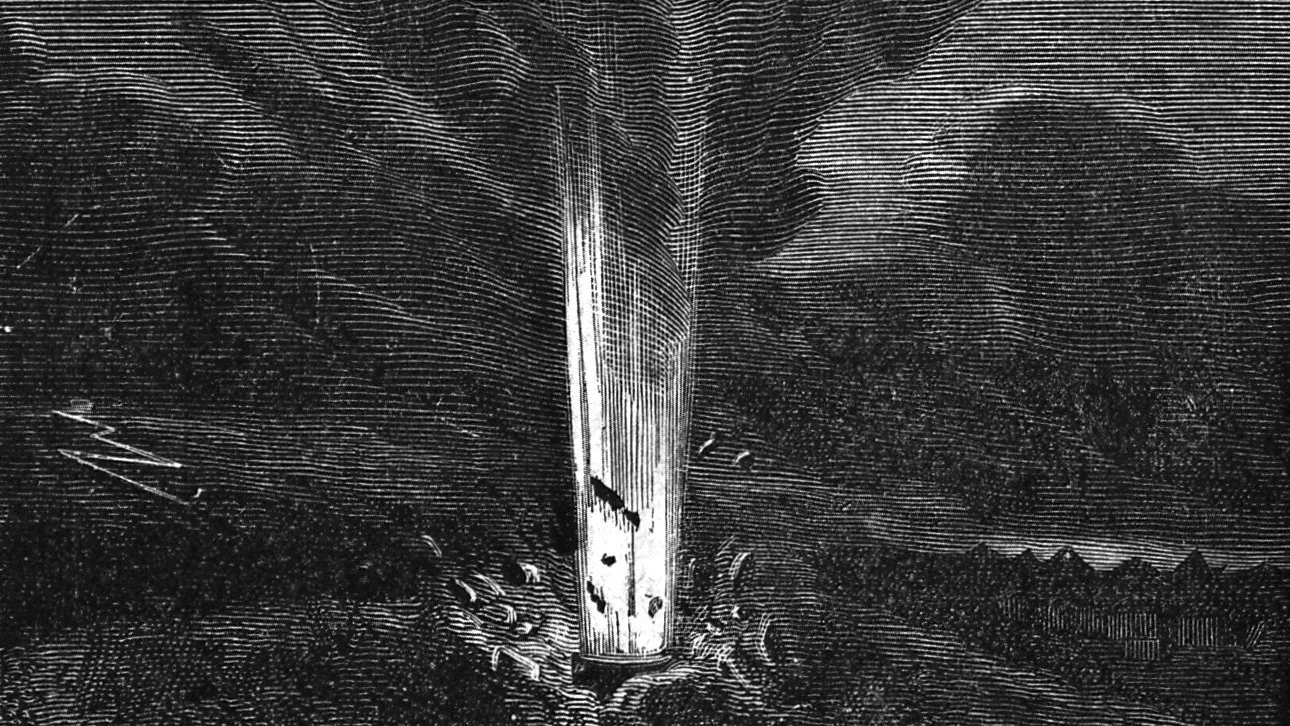
The gun's mouth and its column of fire, in an engraving after Henri de Montaut from an 1874 Italian edition of Verne's novel. The shell is higher on the plate, out of this crop.
From the Earth to the Moon (151481126), Henri de Montaut (Public Domain Mark 1.0)
"From the Earth to the Moon (151481126)" by Henri de Montaut — https://commons.wikimedia.org/wiki/File:From_the_Earth_to_the_Moon_(151481126).jpg — Public domain in the US (published 1874) and in the EU (artist died 1900 at the latest, life+70; no engraver named on the plate, published more than 70 years ago); modified: cropped to 16:9 for the page and the card view, keeping the gun's mouth and the column of fire; the shell at the top of the plate, the upper smoke and the tiny figures at the foot are cut

The gun earns a grade of its own, the costume error: the right need, delivered by hardware that never arrived. Each step below also carries a Seeing mark, a word borrowed from astronomy for how steady the air is, which here rates how much weight a step can bear: clear, hazy or overcast (how we rate a reading). Whether the arithmetic itself is correct has a separate column at the end.
What did Verne actually specify?
Numbers, and plenty of them, because the novel treats its engineering as the main attraction. Barbicane, president of the Gun Club in Baltimore, opens with the promise that sets everything else: “tout projectile doué d'une vitesse initiale de douze mille yards par seconde, et dirigé vers la Lune, arrivera nécessairement jusqu'à elle” (ch. II). Any projectile given that starting speed and aimed at the Moon, he says, will necessarily reach it. The translations on this page are our own.
| Item | Verne's figure | Chapter |
|---|---|---|
| Length of the gun, the Columbiad | 900 feet | VIII |
| Starting speed | 12,000 yards per second | II, IV |
| Bore left above the charge | more than 700 feet | IX |
| Water under the crew's raft | 3 feet deep | XXIII |
| Launch site, Stone's Hill | 27°7′ north | XIII |
| Flight time | 97 hours 13 minutes 20 seconds | IV |
| Crew | Barbicane, Nicholl, Ardan | XXI, XXVIII |
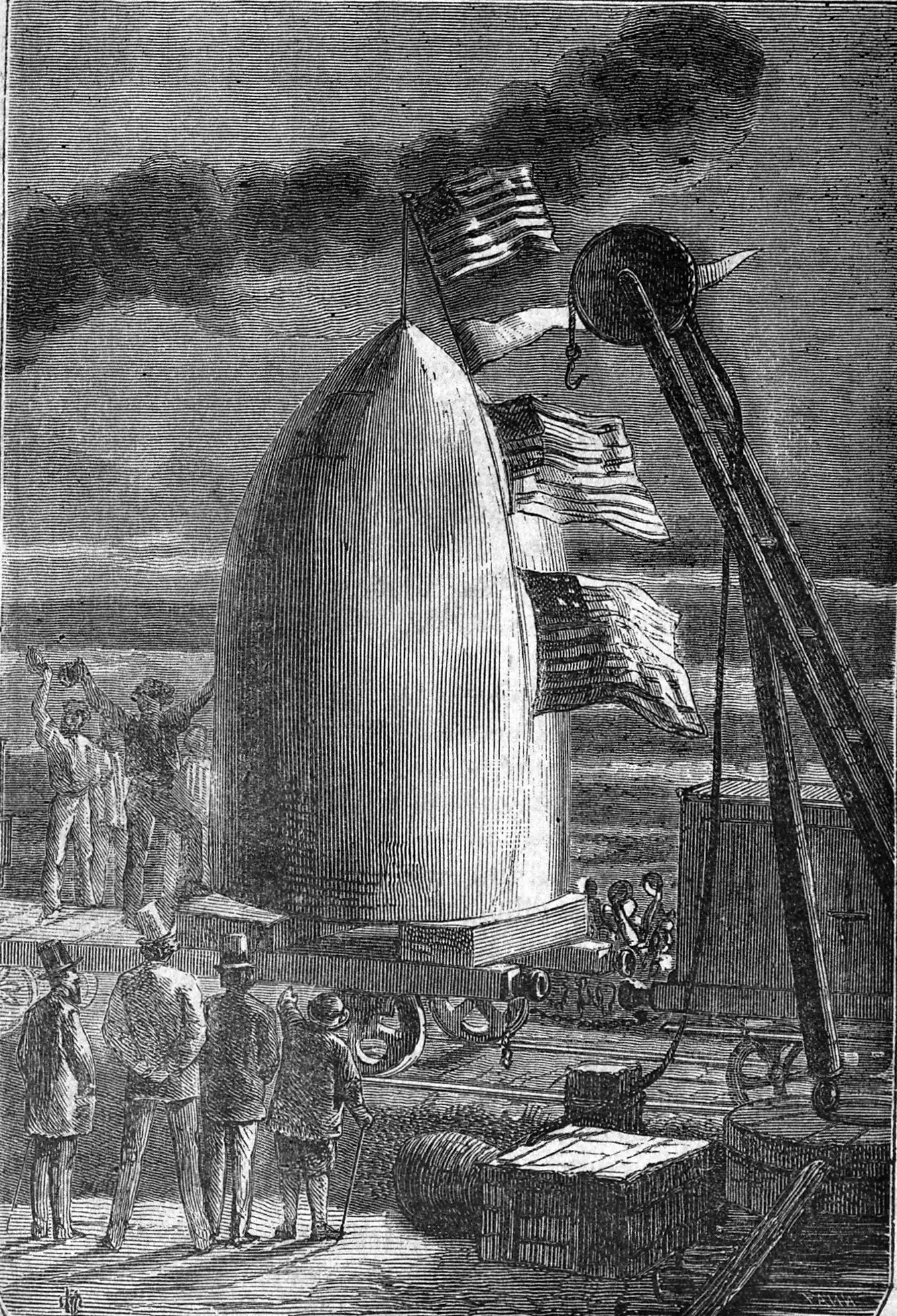
The finished shell reaching Stone's Hill by rail, in an engraving from the same 1874 Italian edition.
"From the Earth to the Moon (151481087)" by Henri de Montaut — https://commons.wikimedia.org/wiki/File:From_the_Earth_to_the_Moon_(151481087).jpg — Public domain in the US (published 1874) and in the EU (artist and engraver died 1900 at the latest, life+70)

Step 1: the units. We read the feet and yards as English units, since a footnote in the novel puts the yard at 91 centimeters, close to the exact 0.9144 meters that the National Institute of Standards and Technology (NIST) lists today. That makes the Columbiad, a name Verne's footnote gives to these enormous American guns, 274.32 meters long, and the projectile leaves at 10,972.8 meters per second. Seeing: clear.
How hard is 22,000 g?
About 22 tonnes of force pressing on every kilogram you carry, for about one twentieth of a second if the push stays steady.
Step 2: the average. Starting speed squared, divided by twice the distance traveled, gives an acceleration of 219,456 meters per second squared. Divide by NIST's standard gravity of 9.80665 and the full gun averages 22,378 g over 0.05 seconds, a time that assumes a steady push. That figure is an average over distance, so a realistic pressure curve could only push the peak higher. Seeing: clear, for an average calculated from Verne's own figures.
Step 3: the shorter run. Verne shortens the distance himself, because the explosive charge fills the bottom of the bore and leaves the shell “plus de sept cents pieds d'âme à parcourir,” more than 700 feet to travel (ch. IX). Over exactly 700 feet, the average climbs to 28,772 g, which makes our headline figure of about 22,000 the low end of the range. Seeing: hazy, because he says only “more than.”
| Length of run | Average g | Time in the gun at a steady push |
|---|---|---|
| 225 feet, the length first reached by proportion | 89,513 | 0.013 s |
| 700 feet, after the charge, his lower limit | 28,772 | 0.039 s |
| 900 feet, the whole gun | 22,378 | 0.050 s |
| 903 feet, the gun plus the water | 22,304 | 0.050 s |
| 2,640 feet, Maston's half-mile gun | 7,629 | 0.147 s |
| 614 kilometers, for a round 10 g | 10 | 112 s |
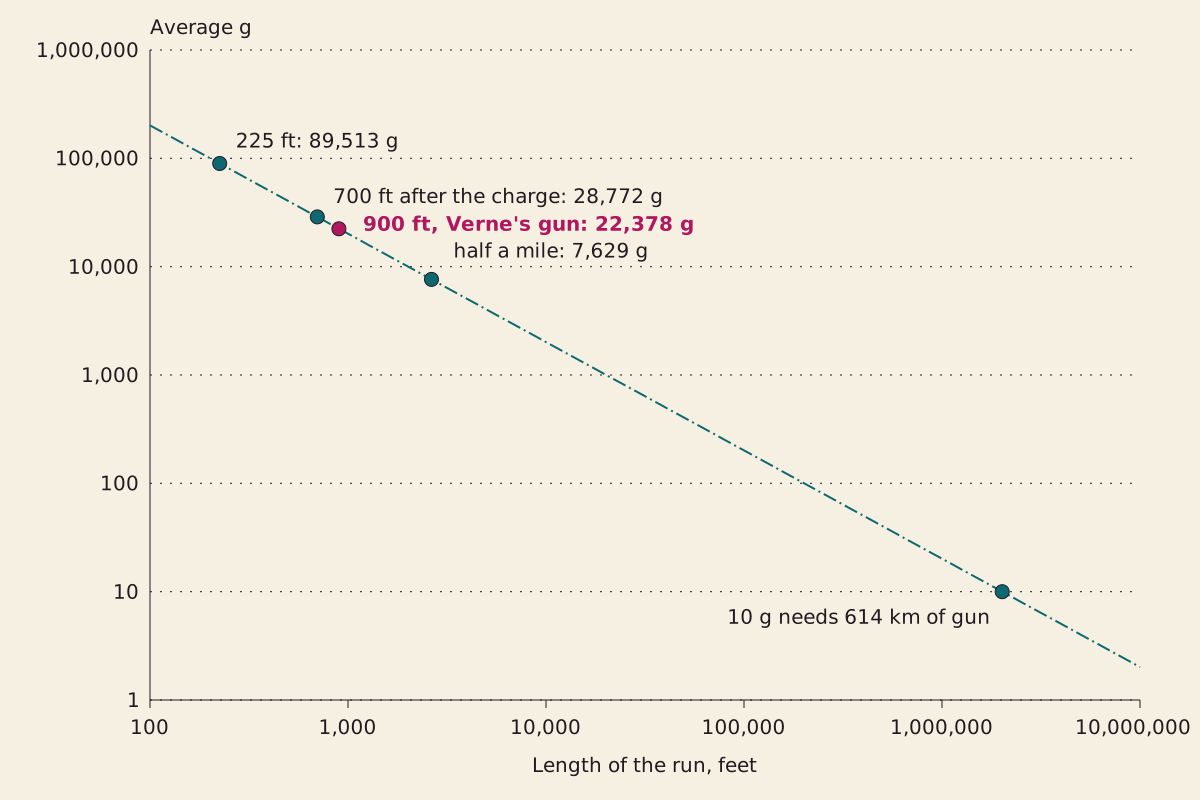
Average g against the length of the run, at Verne's starting speed. Both scales are logarithmic. The marked lengths come from the novel, except the last, a round 10 g used for scale.
"Average g against the length of the run" by The What-If Observatory, https://whatifobservatory.com/old-forecasts/from-the-earth-to-the-moon/, licensed under CC BY 4.0 (https://creativecommons.org/licenses/by/4.0/)
Data: Verne 1865 (lengths, speed); NIST SP 811 (units, standard g)
Verne recognized the problem. At a public meeting in Tampa, an opponent warns the French adventurer Michel Ardan that “l'épouvantable contrecoup vous mettra en pièces au départ,” that the dreadful recoil will tear him to pieces at departure (ch. XX). Ardan replies that the objection touches “la véritable et la seule difficulté,” the real and only difficulty, and trusts American ingenuity to solve it.
The solution arrives a chapter later (ch. XXI), when Barbicane announces “de l'eau simple qui fera ressort,” plain water acting as a spring. In the finished shell, the crew ride a wooden raft on a layer of water 3 feet deep, divided by partitions that break in sequence, and the narrator says the first shock is “presque entièrement amorti,” almost entirely absorbed, though he grants a violent recoil once the water has gone (ch. XXIII).
The novel also stages a rehearsal. A padded mortar shell carrying a cat and a squirrel lands in the bay, and the cat emerges alive, having eaten its companion. That demonstration involves an ordinary mortar, though. It tells us nothing about the Columbiad.
Step 4: the water. If the shell speeds up steadily, the most the raft can do is add 3 feet to the crew's run, which lowers the average over 903 feet to 22,304 g. Over Verne's 700-foot run, the same 3 feet would take off 0.43 percent. Seeing: hazy, because that share depends on the pressure curve.
Another curve can do better, though not by much. The kindest one saves the last kick for the muzzle, and by our sum it still leaves the crew a peak of about 20,000 g. None of this tests the first instant alone, the part the narrator singles out. He also says the blow expels the water in under a second, an upper limit that cannot be set against the 0.05 seconds of a steady shot.
At a steady push, three feet of water buys a third of one percent.
An average of 10 g, a round number used for scale and not a limit of any kind, would take a gun 614 kilometers, or 381 miles, long.
Was 12,000 yards per second enough?
Not quite. Our airless sum leaves it about 1 percent short, and Verne's own sequel also finds the speed too low.
Step 5: the climb. For this calculation we hold Earth and Moon still and ignore both the atmosphere and the Sun. A projectile only has to reach the neutral point, where the two gravitational pulls balance, because the Moon's attraction takes over from there.
Verne places that point 47/52 of the way to the Moon, or 90.4 percent of the distance. The Earth/Moon mass ratio of 81.30057, quoted by James Williams and colleagues, gives 90.0 percent, which makes his figure respectable for 1865. The same two bodies drive our separate calculation for the Moon at half its distance.
Reaching the neutral point from Earth's surface takes about 11,066 meters per second, using the International Astronomical Union's nominal radius and mass parameter and a separation of 384,402 kilometers. Verne's projectile falls 93 meters per second short, or 0.8 percent, and in this simplified model it climbs only 45 percent of the way from Earth's center toward the Moon's before falling back.
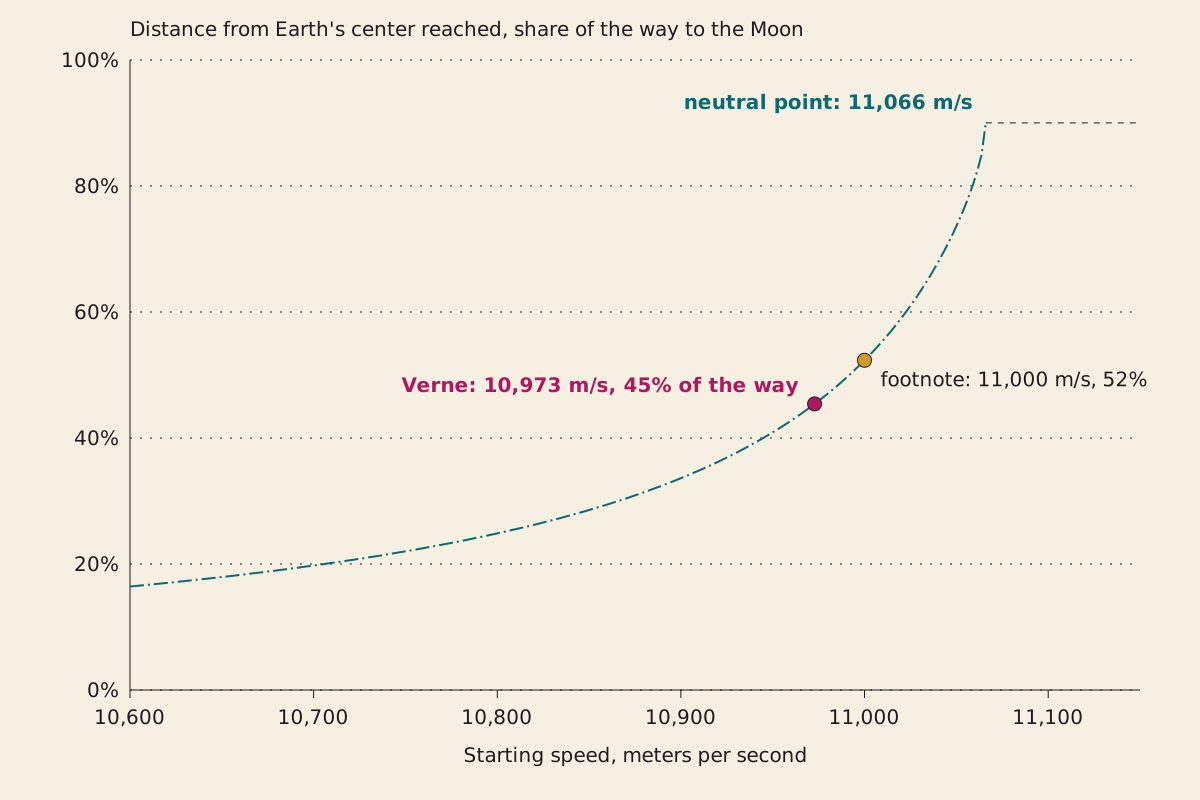
How far from Earth's center a straight-up shot climbs for each starting speed, with Earth and Moon held still and no air or Sun. The curve steepens because Earth's pull weakens with distance.
"Height reached against starting speed" by The What-If Observatory, https://whatifobservatory.com/old-forecasts/from-the-earth-to-the-moon/, licensed under CC BY 4.0 (https://creativecommons.org/licenses/by/4.0/)
Data: Verne 1865 (speed); NIST SP 811 (units); Prša et al. 2016 (Earth radius, mass parameter); Williams, Turyshev & Boggs (mass ratio); Murphy 2013 (distance)
A tiny shortage costs so much because Earth's gravity weakens with distance, so the final fraction of the required speed buys an enormous stretch of altitude. Verne's own footnote rounds the speed to about 11,000 meters per second, which reaches 52 percent, and air resistance would only widen the gap. Seeing: hazy, because the model leaves out air, and a moving Moon and the Sun would also shift these figures slightly.
Verne reached the same verdict five years later. In the 1870 sequel, Autour de la Lune, Captain Nicholl works the sum inside the shell and gets “onze mille cinquante et un mètres,” 11,051 meters per second at the top of the atmosphere (ch. IV), which is 0.14 percent below our figure. Once Barbicane allows a third of the speed for friction, the requirement jumps to 16,576. The 11,000 promised by the Cambridge astronomers, he cries, “sera insuffisante,” will not be enough.
The shell keeps climbing anyway, because the narrator decides its real starting speed was higher than advertised. He still adds that Cambridge “ne s'en était pas moins trompé,” was wrong all the same (ch. V).
Which predictions hit?
Two of seven, according to the grades below, and one of those two is a sum rather than a forecast. We grade an item only when a source we have read covers it, and each row is meant to stand alone.
| Item | Verne wrote | Compared with | Grade |
|---|---|---|---|
| Three men circle the Moon | Three men in a shell end up orbiting the Moon | Apollo 8: Borman, Lovell and Anders circled the Moon, 1968 | hit |
| A neutral point at 47/52 of the way | 90.4 percent of the distance | Our sum from the mass ratio: 90.0 percent, Sun ignored | hit |
| Leaving Earth by a 900-foot gun | The Columbiad fires the crew off | Apollo 8 launched on a Saturn V rocket | costume error |
| Half of Earth on the Moon within 20 years | Ardan's boast: “Avant vingt ans, la moitié de la Terre aura visité la Lune!” (ch. XIX) | First men left Earth orbit in 1968, by the National Archives account | miss |
| 12,000 yards per second is enough | Any shot at that speed reaches the Moon; the 1870 sequel says 11,000 meters per second falls short | Our sum: about 11,066 meters per second needed, in a simplified model; Nicholl's sum in the sequel: 11,051 | miss |
| Water nearly cancels the blow | The plans almost wipe out the recoil; the first shock is almost entirely absorbed | Our sum: 0.33 percent off the 900-foot average at a steady push, 0.43 percent over 700 feet; no pressure curve takes the crew's peak below about 20,000 g | miss |
| The crew lives through the shot | Ardan comes to in the sequel and reports himself whole | We read no record of a shot like this and no source on a limit | untestable |
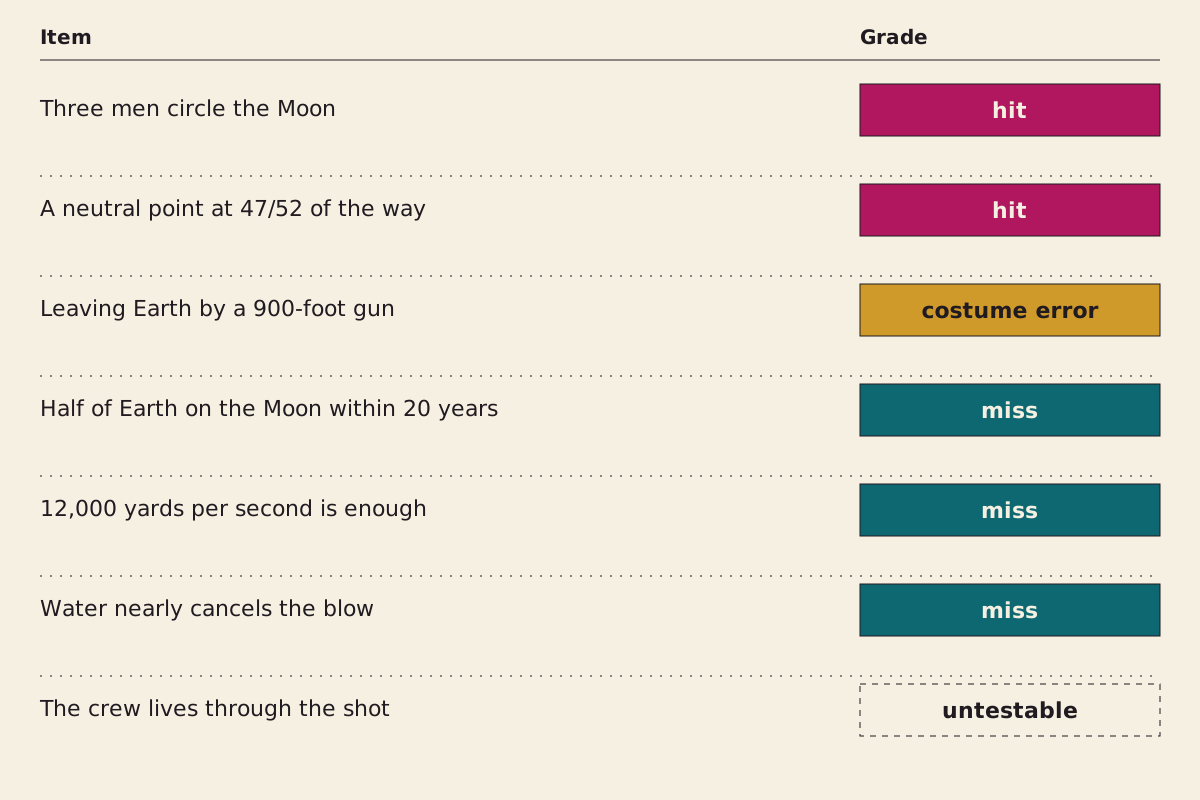
The seven items and their grades. The table above says what each one was compared with.
"Seven items from Verne, graded" by The What-If Observatory, https://whatifobservatory.com/old-forecasts/from-the-earth-to-the-moon/, licensed under CC BY 4.0 (https://creativecommons.org/licenses/by/4.0/)
Download verne-predictions-graded.csv (where its values come from)
The three-man crew is the one true forecast among the hits, and it comes from a quarrel: Ardan talks the feuding Barbicane and Nicholl into joining him, and the novel closes with all three orbiting the Moon. The National Archives says Frank Borman, Jim Lovell and Bill Anders “became the first men to leave Earth's orbit and circle the Moon” after launching on December 21, 1968.
Ardan's boast misses outright. He tells the Tampa crowd that trains of projectiles will soon make the journey comfortable, and that half of Earth will have visited the Moon within twenty years. Counted from 1865, that deadline falls in 1885, which is 83 years before anyone left Earth's orbit, by the National Archives account.
Some items stay out of the seven. Like the untestable row, they are things the sources we read cannot settle, so they earn no hit or miss. The flight time is one: Verne's astronomers require a launch 97 hours 13 minutes 20 seconds before the Moon reaches the target point, or about 4.05 days. Apollo 8 launched on December 21 and photographed Earthrise on December 24, which puts it at the Moon within four calendar days, but we read no record of its arrival, so those dates cannot match or fault his figure.
The novel launches from Florida and the sequel comes down in the Pacific, but we have read no source on where Apollo 8 launched or landed. Both flights also depart in December, which we call luck, since Verne's date follows from where his story needs the Moon.
The return deserves a mention anyway. In the sequel, the shell misses, loops around the Moon, and approaches the neutral point, where the crew ignite rockets, hoping to use “la force de recul renfermée dans nos fusées,” the recoil stored in their rockets, to drop onto the lunar surface (ch. XIX of the sequel).
The rockets fail, and the shell falls back toward Earth. It plunges into the Pacific beside an American navy ship, floats back to the surface because it is relatively light, and the crew are recovered alive, playing dominoes.
So the story that launches by cannon does carry rockets, packed as brakes and fired to steer.
Why Florida?
The zenith, according to Verne's own explanation. His Cambridge astronomers want the gun pointed straight up, and they state that the Moon climbs directly overhead only between 0° and 28° of latitude, which leaves southern Texas and Florida as the American candidates. Stone's Hill sits at 27°7′.
We have not checked his 28° against a source we read, so it stands as his figure. Seeing: clear, for what the book says.
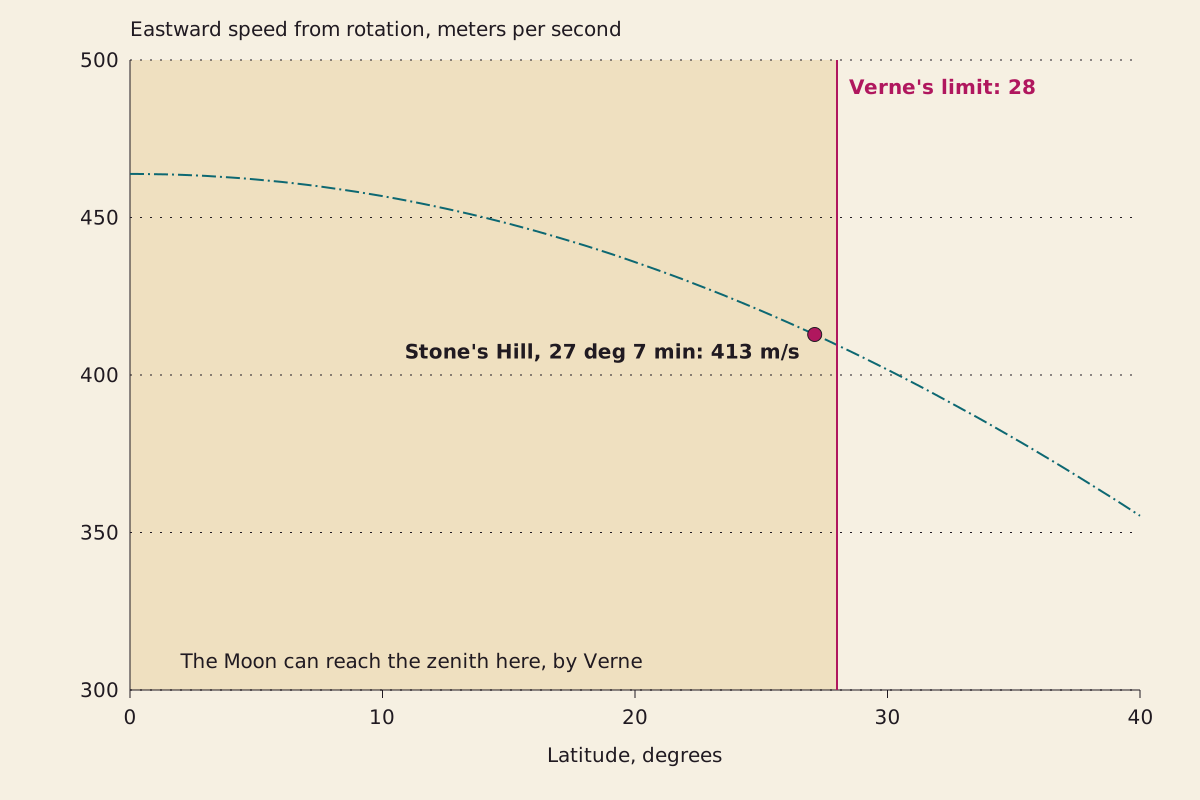
Verne's limit is the shaded band, set by the zenith. The curve is Earth's rotation, which we added: it is not his reason for choosing Florida.
"Rotation speed against latitude, with Verne's limit" by The What-If Observatory, https://whatifobservatory.com/old-forecasts/from-the-earth-to-the-moon/, licensed under CC BY 4.0 (https://creativecommons.org/licenses/by/4.0/)
Data: Verne 1865 (latitudes); Prša et al. 2016 (Earth radius)
Step 6: rotation. Earth's rotation is the tempting explanation, but it is not Verne's stated reason. Assuming one turn in a round 24 hours, the ground at Stone's Hill travels east at about 413 meters per second, or 3.8 percent of the projectile's speed.
A straight-up shot takes that motion as sideways speed, so its total speed rises by only about 8 meters per second, far less than the 93 it lacks. Seeing: hazy.
What is the costume error in this forecast?
The cannon.
Step 7: the grades. A costume error means that this prediction identified the function correctly and dressed it in a technology of its own day that never arrived. The crewed voyage around the Moon came 103 years after the novel, and the National Archives says the astronauts were “launched into space on the massive Saturn V rocket.” Seeing: hazy, since the grades are our judgment.
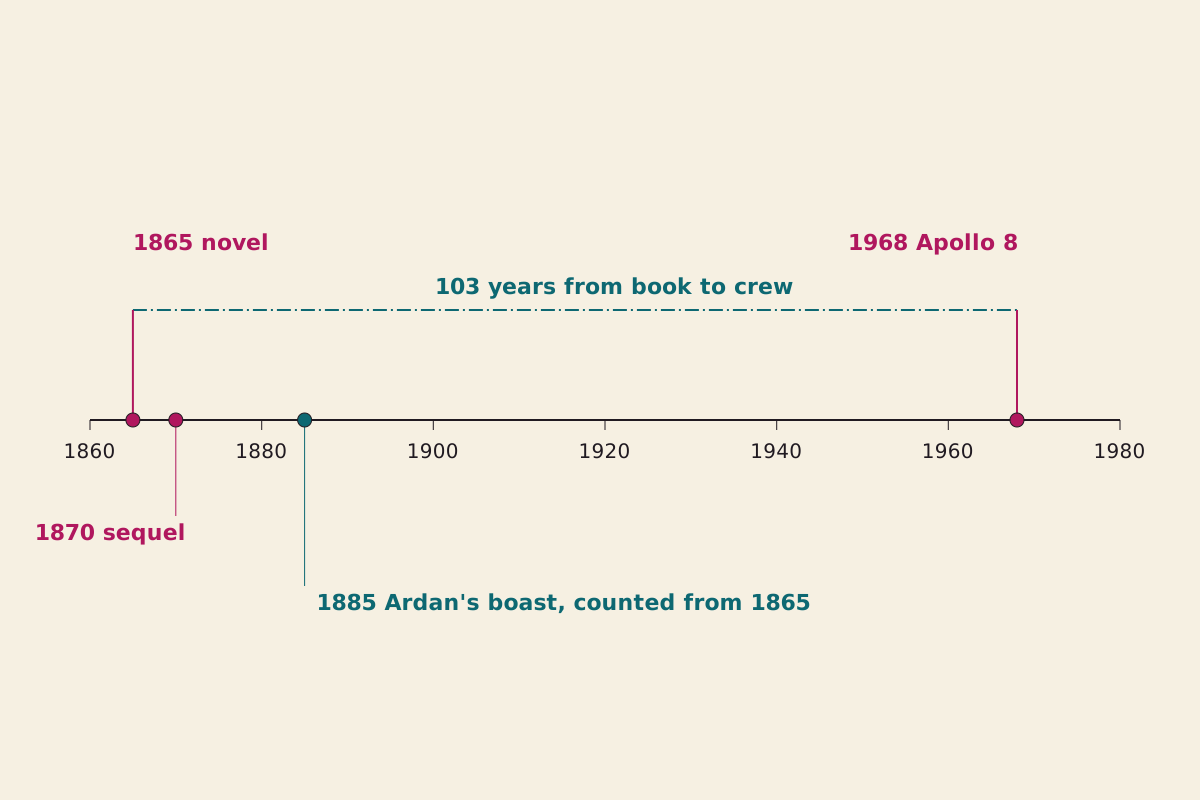
From the novel to the crew. The 1885 mark is our own count from Ardan's “before twenty years.”
"From the novel to Apollo 8" by The What-If Observatory, https://whatifobservatory.com/old-forecasts/from-the-earth-to-the-moon/, licensed under CC BY 4.0 (https://creativecommons.org/licenses/by/4.0/)
This is one forecast, not a historical rule. Other files on this shelf examine a number rather than a machine, among them Malthus and Moore's law, and either could earn a different grade.
The dotted line falls after step 7. Up to there, every reading rests on Verne's printed figures, a named constant or a model described on this page.
Step 8 asks whether any barrel could contain such a shot and whether anyone inside could survive it. We read nothing that sets those limits, and this page offers no medical guidance. From here on, we are guessing.
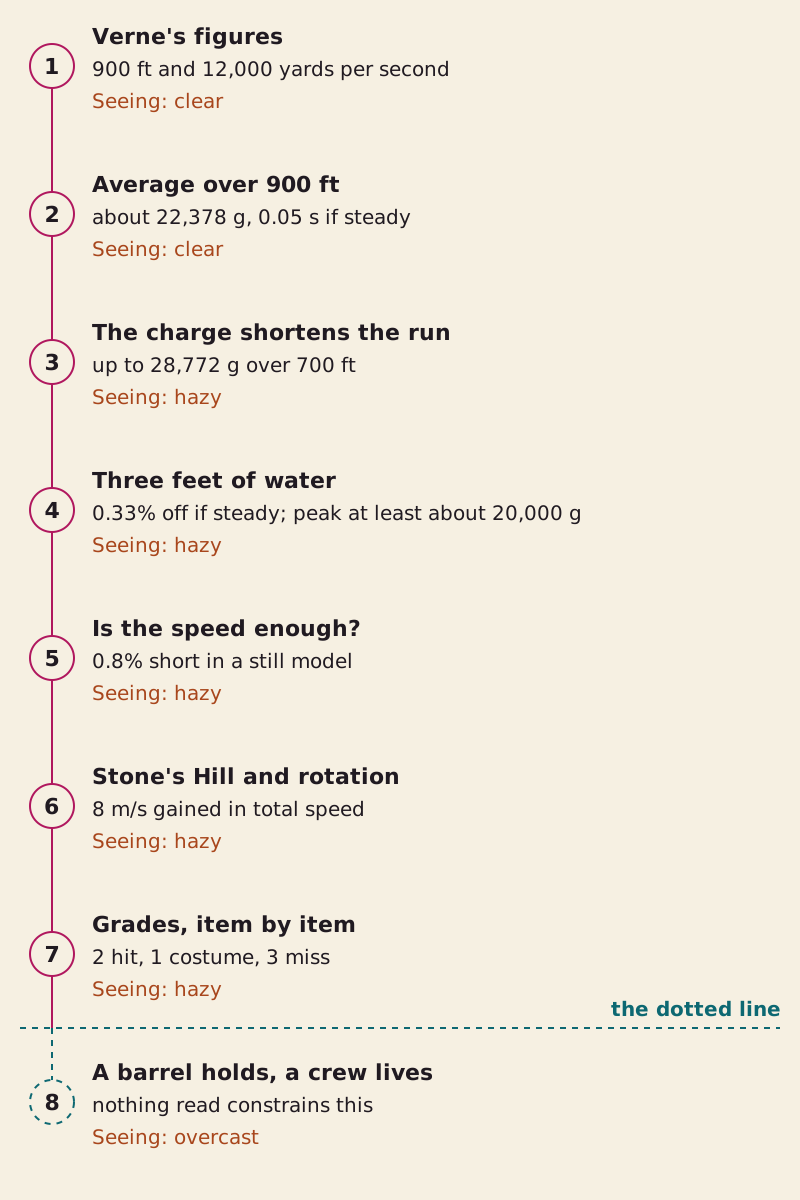
The chain behind this page. Steps 1 to 7 rest on Verne's printed figures, named constants and models stated here. Step 8 sits past the dotted line.
"The chain behind the Verne gun sums" by The What-If Observatory, https://whatifobservatory.com/old-forecasts/from-the-earth-to-the-moon/, licensed under CC BY 4.0 (https://creativecommons.org/licenses/by/4.0/)
The gun's arithmetic sits above that line, on Verne's own page, and whether anyone walks away from it sits below. Seeing: overcast.
Check my math:
| Step | Input | Value | Unit | Source no. | Source | Recomputed | Seeing |
|---|---|---|---|---|---|---|---|
| 1 | Length of the gun | 900 | ft | 1 | primary | no | clear |
| 1 | Length of the gun in meters | 274.32 | m | 1, 5 | primary | yes | clear |
| 1 | Starting speed | 12,000 | yd/s | 1 | primary | no | clear |
| 1 | Starting speed in meters per second | 10,973 | m/s | 1, 5 | primary | yes | clear |
| 2 | Standard g | 9.80665 | m/s2 | 5 | primary | no | clear |
| 2 | Average acceleration over the full 900 ft | 219,456 | m/s2 | 1, 5 | primary | yes | clear |
| 2 | Average g over the full 900 ft | 22,378 | g | 1, 5 | primary | yes | clear |
| 2 | Time in the bore at a steady push | 0.05 | s | 1, 5 | primary | yes | hazy |
| 3 | Verne's lower limit for the run after the charge | 700 | ft | 1 | primary | no | hazy |
| 3 | Average g over a 700-ft run | 28,772 | g | 1, 5 | primary | yes | hazy |
| 4 | Water layer under the raft | 3 | ft | 1 | primary | no | clear |
| 4 | Average g with the raft giving the full 3 ft | 22,304 | g | 1, 5 | primary | yes | hazy |
| 4 | Share of the average removed by the water | 0.33 | percent | 1, 5 | primary | yes | hazy |
| 4 | Share removed by the water over a 700-ft run | 0.43 | percent | 1, 5 | primary | yes | hazy |
| 4 | Lowest crew peak the 3 ft allow, any pressure curve | 20,002 | g | 1, 5 | site assumption | yes | hazy |
| 4 | Gun length for an average of 10 g | 614 | km | 1, 5 | site assumption | yes | hazy |
| 5 | Earth mass parameter | 3.986004 × 10^14 | m3/s2 | 6 | primary | no | clear |
| 5 | Earth equatorial radius | 6.3781 × 10^6 | m | 6 | primary | no | clear |
| 5 | Earth to Moon mass ratio | 81.30057 | ratio | 7 | secondary | no | hazy |
| 5 | Earth to Moon distance | 384,402 | km | 8 | secondary | no | hazy |
| 5 | Neutral point as a share of the distance | 0.9002 | share | 7 | secondary | yes | hazy |
| 5 | Verne's neutral point | 0.9038 | share | 1 | primary | yes | clear |
| 5 | Speed needed to reach the neutral point | 11,066 | m/s | 6, 7, 8 | site assumption | yes | hazy |
| 5 | Shortfall of Verne's speed | 93 | m/s | 1, 5, 6, 7, 8 | site assumption | yes | hazy |
| 5 | Distance reached at Verne's speed, share of the way from Earth's center | 0.454 | share | 1, 5, 6, 7, 8 | site assumption | yes | hazy |
| 5 | Speed Nicholl gets in the sequel, at the top of the air | 11,051 | m/s | 2 | primary | no | hazy |
| 5 | Speed the sequel then needs, with a third lost to friction | 16,576 | m/s | 2 | primary | no | hazy |
| 5 | Gap between our speed and Nicholl's | 0.14 | percent | 2, 6, 7, 8 | site assumption | yes | hazy |
| 6 | Verne's northern limit for the zenith shot | 28 | deg | 1 | primary | no | clear |
| 6 | Latitude of Stone's Hill | 27.117 | deg | 1 | primary | no | clear |
| 6 | Rotation speed at Stone's Hill | 413 | m/s | 1, 6 | site assumption | yes | hazy |
| 6 | Gain in total speed from rotation | 7.8 | m/s | 1, 5, 6 | site assumption | yes | hazy |
| 7 | Years from the novel to Apollo 8 | 103 | years | 3, 4 | secondary | yes | hazy |
| 7 | Items graded | 7 | items | 1, 2, 4 | site assumption | no | hazy |
| 8 | Could any barrel hold, and could anyone inside live? | — | — | 1, 2 | site assumption | no | overcast |
Download verne-gun-check-my-math.csv (where its values come from)
Units were checked, and the computed numbers in the text were compared with the CSV.
Next question:
- What if the Moon came closer? The Moon at half its distance
- How many doublings did 1965 promise? Moore's law, graded
Sources
- Jules Verne. De la Terre à la Lune: trajet direct en 97 heures 20 minutes. First published by Hetzel, 1865. Read as Project Gutenberg eBook 799, a transcription that names no source edition. Original Read: full text in French, a transcription, chapters cited by number.
- Jules Verne. Autour de la Lune. First published by Hetzel, 1870. Read as Project Gutenberg eBook 4717, a transcription that names no source edition. Original Read: full text in French, a transcription, passages cited by chapter.
- Jacques Crovisier (2009). “Astronomy and astronomers in Jules Verne's novels.” arXiv:0906.1052. Original Read: preprint, Table 1.
- Michael Hancock, National History Office. “Two Generations of Flight and One Historic Mission.” Pieces of History, US National Archives, November 30, 2018. Original Read: full post.
- National Institute of Standards and Technology. NIST Guide to the SI, Appendix B.8: Factors for Units Listed Alphabetically (Special Publication 811). Original Read: single value via the appendix table: foot, yard, standard acceleration of free fall.
- A. Prša et al. (2016). “Nominal values for selected solar and planetary quantities: IAU 2015 Resolution B3.” The Astronomical Journal 152:41. arXiv:1605.09788. Original Read: preprint, table of conversion constants.
- James G. Williams, Slava G. Turyshev, Dale H. Boggs. “Lunar Laser Ranging Tests of the Equivalence Principle with the Earth and Moon.” arXiv:gr-qc/0507083. Original Read: preprint, one value, quoted there from Konopliv et al..
- T. W. Murphy Jr. (2013). “Lunar laser ranging: the millimeter challenge.” arXiv:1309.6294. Original Read: preprint, introduction, list of abbreviations and the sentence on tidal locking.
Cite this page
The What-If Observatory. "From the Earth to the Moon: Verne’s Gun, 22,000 g or More." Published 2026-11-09. https://whatifobservatory.com/old-forecasts/from-the-earth-to-the-moon/. Add the date you read it.
Corrections
None so far.