Brook Farm: By Swift’s List, Hawthorne Subscribed $1,000
The What-If Observatory Published
Nathaniel Hawthorne put about $1,000 into Brook Farm, the Massachusetts commune of 1841 to 1847, then wanted it back. An early biographer could not learn whether he got it, and one biographical dictionary reports a lawsuit. The books show the odds: about $4,000 paid in, $14,500 in mortgages by 1845, an uninsured building that had cost about $7,000 burned in 1846, and, by Lindsay Swift's figures, $1,704 left for all other claims at the 1849 sale.
Steps in this reading (6)
- Suppose:
- you buy one share in Brook Farm in 1841.
- Hold fixed:
- the prices and wages in the farm's own records.
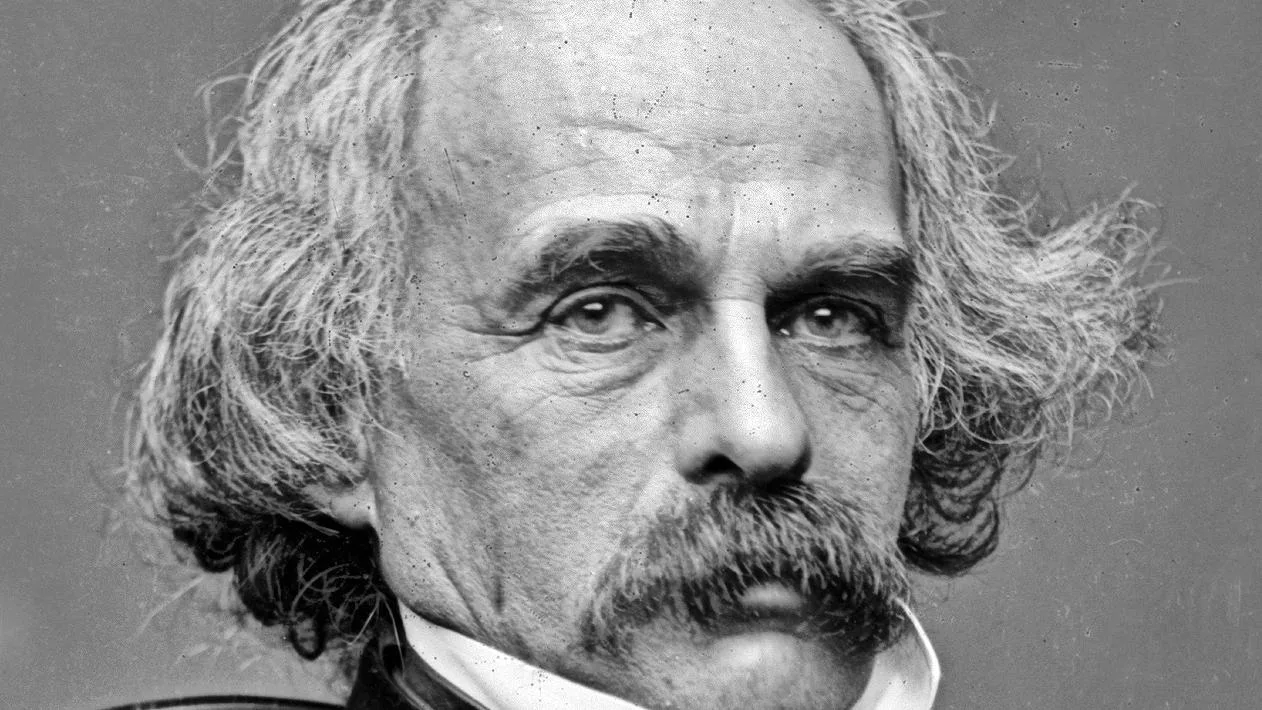
Nathaniel Hawthorne in a portrait from Mathew Brady's studio, about 1860 to 1864, some 20 years after Brook Farm.
"Nathaniel Hawthorne by Brady, 1860-64" by Mathew Brady — https://commons.wikimedia.org/wiki/File:Nathaniel_Hawthorne_by_Brady,_1860-64.jpg — Public domain in the US (made about 1860 to 1864, Brady died 1896, life+70) and in the EU (Brady died 1896, life+70); modified: cropped to 16:9 for the card and page, forehead to chin; the Commons file is already cropped and cleaned from the Library of Congress negative

Each step below ends in a Seeing mark, a term borrowed from astronomy for how cleanly the air passes a view, and here it rates how much weight a step can bear: clear, hazy or overcast. Whether the arithmetic holds is a separate check, in the table at the end.
Who paid in?
Brook Farm was a farm and boarding school at West Roxbury, about nine miles from Boston, which George Ripley, a former Unitarian minister, settled in April 1841 with about 20 people. Ripley belonged to the Transcendentalists, a New England circle of writers and ministers, yet John Thomas Codman's 1894 memoir says only Hawthorne and John S. Dwight of their club joined him, and that Ralph Waldo Emerson declined when asked.
The stock came that September, when the Articles of Association, printed in O. B. Frothingham's 1882 life of Ripley, set a capital “divided into shares of Five Hundred Dollars each” (Frothingham, chapter III).
What did one share buy?
Suppose you are the buyer. Your $500 brings a guaranteed $25 a year and one vote on matters touching the funds, however many shares you hold. In place of the interest you may take tuition for one pupil for each share, or tuition worth up to 20 percent of your investment, which on one share comes to $100 a year.
Nobody can charge you more later. The trustees are forbidden to make you personally answerable for the farm's debts. If you want out, you owe them twelve months' notice, and that last clause is where this story ends up.
Step 1: the subscription. Ten people took 24 shares, or $12,000, of which Hawthorne took numbers 18 and 19, for $1,000. Three Ripleys held eight shares between them, a third of the whole. Lindsay Swift's 1900 history gives the same list. Seeing: clear, as a reading of the list, which records promises and not cash.
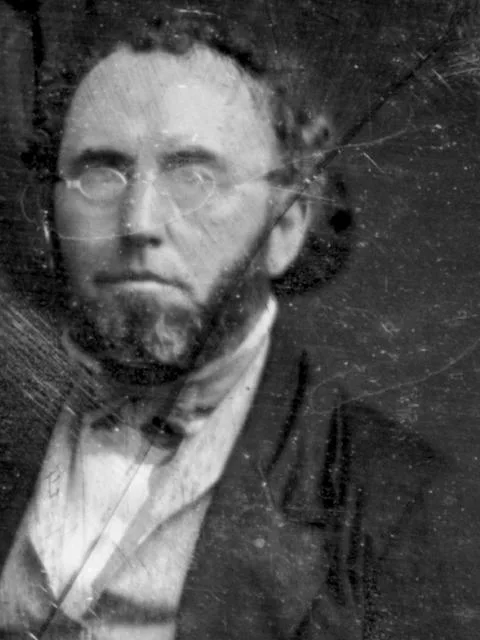
George Ripley, in a scratched daguerreotype from Mathew Brady's studio, made between 1844 and 1860. It is cut from a larger plate, and the farm may already have ended when it was taken.
"George Ripley" by Mathew Brady — https://commons.wikimedia.org/wiki/File:George_Ripley.jpg — Public domain in the US (made 1844 to 1860, Brady died 1896, life+70) and in the EU (Brady died 1896, life+70); modified: cropped to head and shoulders, removing most of the neighbor's clothing at left; scratches on the plate left as they are

Step 2: the money paid in. Both books say one third was actually paid in, with Ripley's library pledged for $400 of his part, which makes about $4,000, and neither says how much of that was cash.
George Parsons Lathrop, in his 1883 sketch of Hawthorne, says he “contributed a thousand dollars,” the chief part of his savings from the Custom House (section III). If so, one subscriber brought a quarter of the money paid in, though no book we read lists payments share by share, so that 25 percent joins two accounts. Seeing: hazy.
Step 3: the mortgage. The farm cost $10,500. On October 11, 1841, Swift says, the trustees mortgaged it for $11,000: $6,000 to the sinking fund of the Western Railroad, $1,500 each to three men and $500 to Lucy Cabot. They “succeeded, at the start, in mortgaging their property for $500 more than it cost them” (page 20).
On these figures lenders supplied about 73 percent of the money. Seeing: hazy, because the deeds reach us through Swift's summary and we did not read the registry.
Plato's ditch in Atlantis comes with a work order and no payer. Here the payers have names, and one of the people spending their money was also a shareholder and a trustee.
Who chaired the money?
Hawthorne told his fiancée about it on September 29. He had been elected “to be a Trustee of the Brook Farm estate, and Chairman of the Committee of Finance!!!!” with “the chief direction of all the money affairs of the community.” The joke in the letter is that she thought him unfit to make a bargain, and the same letter says he told Ripley he could not spend the winter there.
So the man who later wanted his money back had himself mortgaged the farm as a trustee.
Swift lists him among the four trustees on that deed, and has him passing on his trustee's interest in December 1842. What he actually did in the chair, we could not find.
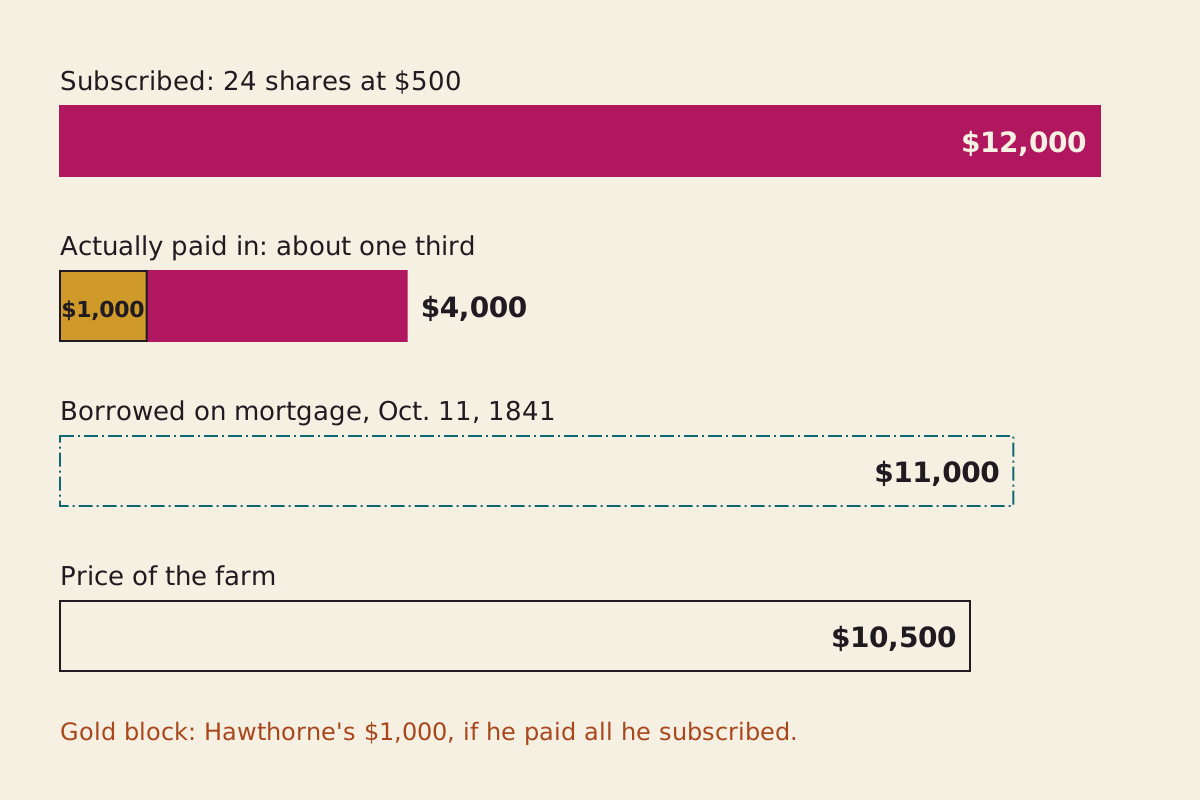
The first year's money. The gold block is Hawthorne's $1,000, on the assumption that he paid all he subscribed.
"Brook Farm's first money" by The What-If Observatory, https://whatifobservatory.com/utopias/brook-farm/, licensed under CC BY 4.0 (https://creativecommons.org/licenses/by/4.0/)
Data: Swift; Frothingham (shares, one third paid, farm price); Swift (mortgages); Lathrop (the thousand dollars)
How did the labor credit work?
Emerson, in a newspaper report of a lecture that John Humphrey Noyes reprints, gave the principle as members who were stockholders, where “while some deposited money others should be allowed to give their labor in different kinds as an equivalent for money” (Noyes, chapter XI).
A second set of articles, printed by Codman and signed by Hawthorne, covers how that worked. Members were paid “at a fixed and equal rate, both for men and women,” a rate that “shall not exceed one dollar per day,” with no more than ten hours to the day (Codman, first chapter).
John Van der Zee Sears, a pupil there, recalled earning “the maximum wage, ten cents an hour” at about age twelve (chapter VII). The articles capped a child's labor at 50 cents a day, which at that rate is five paid hours, so memory and rule can both stand.
Swift adds the other side of the account: board cost $4 a week for those who did not work, with rent, fuel, light and washing included. He sums up the rule as “a year's labor for a year's board,” and counts 300 days as a labor year (page 20). Prices also moved with the deal, since he has the young Isaac Hecker paying four dollars a week as a part-time baker and five and a half as a full boarder.
Step 4: a share in days. At the top rate, one $500 share equals 500 ten-hour days, and Hawthorne's $1,000 equals 1,000 days, or 3.33 labor years. He stayed about seven months. A share's interest was $25 a year, worth 25 days of top pay or 6.25 weeks of board. Seeing: hazy, because $1 was a ceiling, so the true count of days could only be higher.
That interest could be paid in stock certificates, and the 1844 finance report argued for the same treatment of work: “If a hundred dollars in money is invested in our stock, we issue certificates for that amount, and why must we not do the same with an investment of a hundred dollars' worth of labor?” (Codman, chapter VI)
Paper of this kind grows the claims on a farm without growing its cash, a small cousin of the race between doubling and adding in Malthus.
The rules do not form one tidy system. Three hundred ten-hour days make 3,000 hours, while Swift's 60-hour week from May through October and 48-hour week from November through April come to about 2,808 hours in 52 weeks, half at each rate. And $300 of top pay against $208 of board leaves $92, a gain that “a year's labor for a year's board” does not mention.
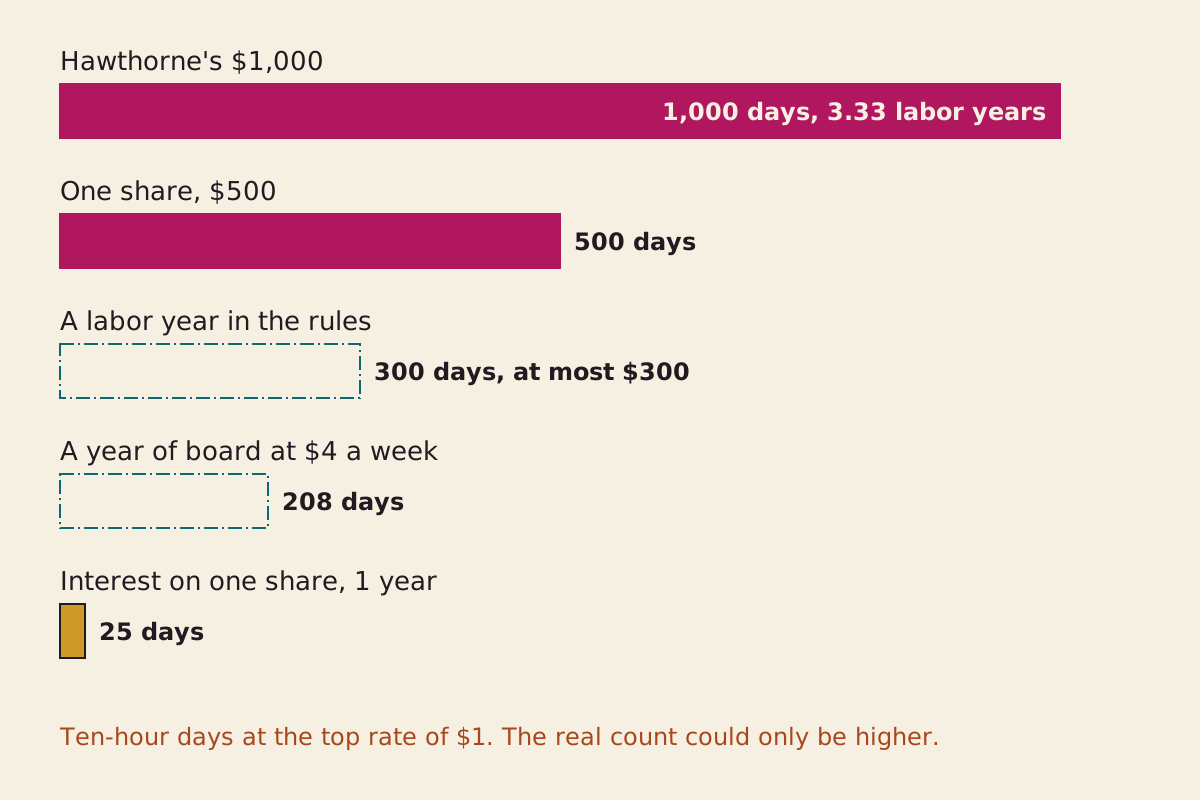
Sums from the records, turned into ten-hour days at the top rate.
"Brook Farm sums in days of labor" by The What-If Observatory, https://whatifobservatory.com/utopias/brook-farm/, licensed under CC BY 4.0 (https://creativecommons.org/licenses/by/4.0/)
Data: Codman (top rate); Swift (300 days, board); conversion by this site
Who washed the dishes?
The records name the jobs and not the totals. Codman says each group's chief recorded its hours, and the 1844 finance report refers to schedules of the time each associate worked, but the books we read do not print them. We can say who shows up in the stories, not who did most of the work.
After the farm reorganized in 1844 as a Fourierist phalanx, following Charles Fourier's plan for cooperative communities, its Domestic Series held Dormitory, Consistory, Kitchen, Washing, Ironing and Mending Groups. The Dictionary of Unitarian and Universalist Biography says pay and status at Brook Farm nearly matched between men and women, though only because nobody had a separate household to run, and it puts men at about 60 percent of residents.
The memoirs give the same picture in small scenes. Owing to “the disproportion of female help,” Codman writes, young men wiped while one young woman washed, and the wipers raced to keep up (chapter III). At dinner the waiters “were of the masculine gender solely” (chapter X).
Swift has the men helping with the laundry, where the work was hard because, in Codman's words, there was “not even a dish washer or a clothes wringer,” only a “pounding barrel” (Codman, chapter XII). Women ran the day nursery so that mothers could work.
 Illustration
In Codman's memory the wipers raced to keep up with one washer. Illustration, not a record of the scene. Not to scale.
Illustration: The What-If Observatory. Generated schematic illustration — not a photograph or historical record. © The What-If Observatory, all rights reserved.
Hawthorne's own letters put him in the barn and on the manure pile, which they call the “gold mine,” and on June 1, 1841, he wrote that “a man's soul may be buried and perish under a dung-heap or in a furrow of the field, just as well as under a pile of money.” In Bentham's Panopticon, prisoners were to work for a contractor. Here the workers kept their own accounts and chose their own jobs.
What did Hawthorne get back?
The rules disagree before the witnesses do. Article X lets a shareholder withdraw his stock and interest “by giving twelve months' notice” (Frothingham, chapter III). Yet the 1844 finance report says of the same kind of stock, “Its joint stock, which it is not bound to pay” (Codman, chapter VI), and Lathrop thought the farm's leaders were “not, I believe, bound” to repay him (section III).
Step 5: the claim. Lathrop says an effort was made to return the sum: “Whether or not they ever carried out this purpose has not been learned” (section III). Codman recalls “an amount due to Hawthorne at one time, probably his original investment, which he growled about” (chapter XIV). A 2022 article from the House of the Seven Gables, the Hawthorne museum in Salem, says he never recovered all of it.
Codman also says Ripley spent later years clearing the community's debts, “The old score of debt was wiped out and paid,” while admitting of those debts, “I do not know all of them” (chapter XIV).
Ripley's New York Tribune pay, as Codman prints it, was $5 for a week in May 1849 and $25 a week by September 1851, so $1,000 meant 200 weeks of the first rate or 40 of the second. That gives the sum a scale for Ripley without showing that any of it moved.
One biographical dictionary reports a lawsuit. Aaron McEmry's 2006 entry says Hawthorne sued Ripley before the end of 1845 to recover his investment, that Ripley admitted the claim, that there was no money, and that repayment was unlikely.
That is a single source. We found no lawsuit in Codman, Lathrop, Sears, Noyes or Hawthorne's 1841 letters, or in the scanned text of Swift and Frothingham, and silence does not disprove it. This page prints no sum and no verdict, because no source we could read has one. Seeing: hazy for the claim, while repayment stays open and we do not pick a winner.
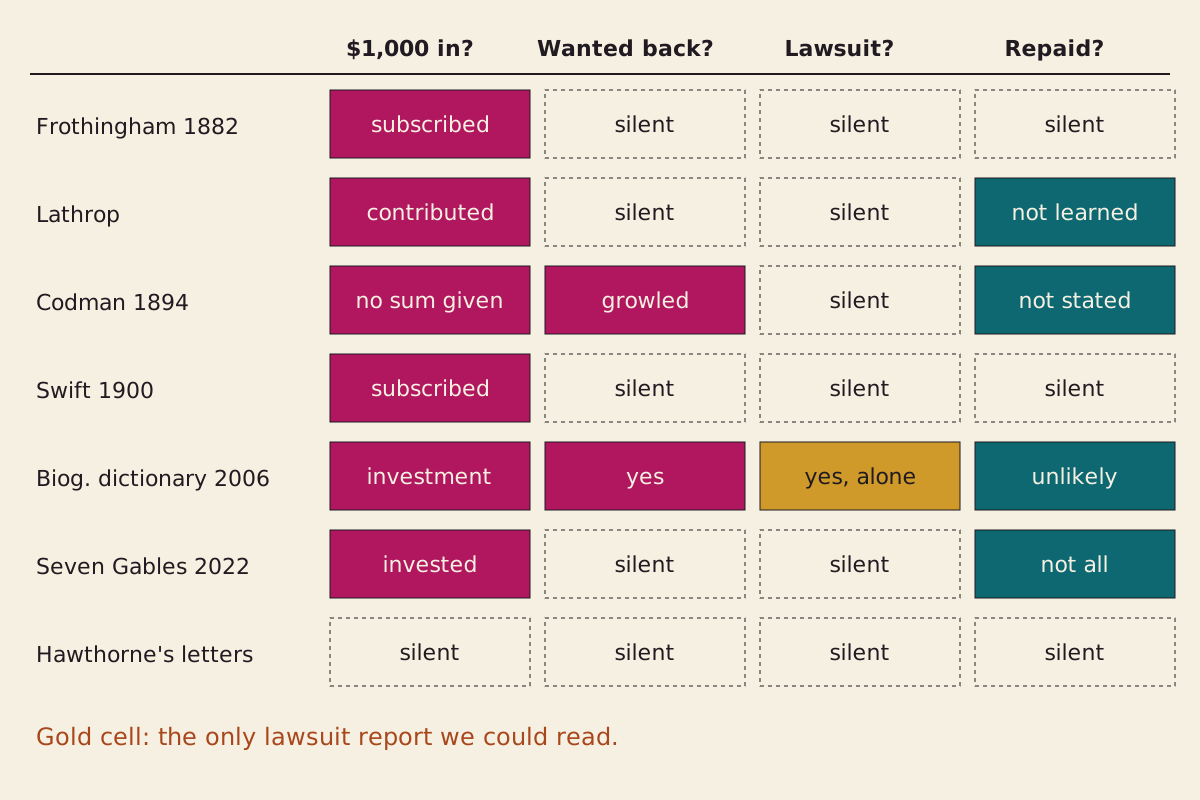
What seven of the sources we read say about the money. Dashed cells mean the source is silent, which is not the same as no.
"What each source says about Hawthorne's money" by The What-If Observatory, https://whatifobservatory.com/utopias/brook-farm/, licensed under CC BY 4.0 (https://creativecommons.org/licenses/by/4.0/)
Data: Sources as named in the figure
Debt and the fire
Step 6: the one year we can audit. The finance report for the year to October 31, 1844, printed by Codman and Frothingham, gives income of $11,854.41 and spending of $10,409.14. After $284.43 of doubtful debts, $1,160.84 remained, about 9.8 percent of income. Interest and insurance ran at $1,752.44, or 14.8 percent, and the report carries a $1,964.88 deficit from 1842 and 1843, which it argues “is not a debt in itself” (Codman, chapter VI).
Lathrop calls the farm “financially sound” (section III) until 1844, and the report's pages do not back him up. Seeing: clear.
Even that surplus was paper, because the report wanted it paid out as stock certificates and admitted that “To some persons it may perhaps seem remarkable that a dividend should be declared when the Association is so much in want of ready money.” Ripley's appeal for capital, after nearly four years' work, still said the farm had “arrived at a point where this risk hardly exists” (both Codman, chapter VI).
Step 7: the fire and the sale. Mortgages reached $12,000 in 1843 and $14,500 in 1845. The Phalanstery, the great communal house, was begun in the summer of 1844 at 175 feet long and three stories high, with fourteen small houses on its upper floors and a dining hall for 300 to 400 people.
Work on it resumed on March 2, 1846. On the evening of March 3, during a dance at another house, it caught fire. In about an hour and a half it was gone. The community's paper, the Harbinger, in a report reprinted by Codman and Noyes, blamed a defective chimney and, probably, “a spark from the stovepipe” (Codman, chapter XI; Noyes, chapter XLII), while Sears, writing decades later, suspected malice and offered no proof.
About $7,000 had gone into the building, counting members' labor, and about $3,000 more would have finished it. That is about 70 percent of the estimated cost spent, though Swift elsewhere writes that 75 percent of the cost had been paid. And “no insurance had been effected” (Codman, chapter XI).
The Harbinger adds that the house was built with money from the loan stock, a class that drew a fixed rate, so the loss “falls upon the holders of partnership stock and the members of the Association,” and the members were the people doing the work. Where Hawthorne's 1841 shares stood in that order, we could not find.
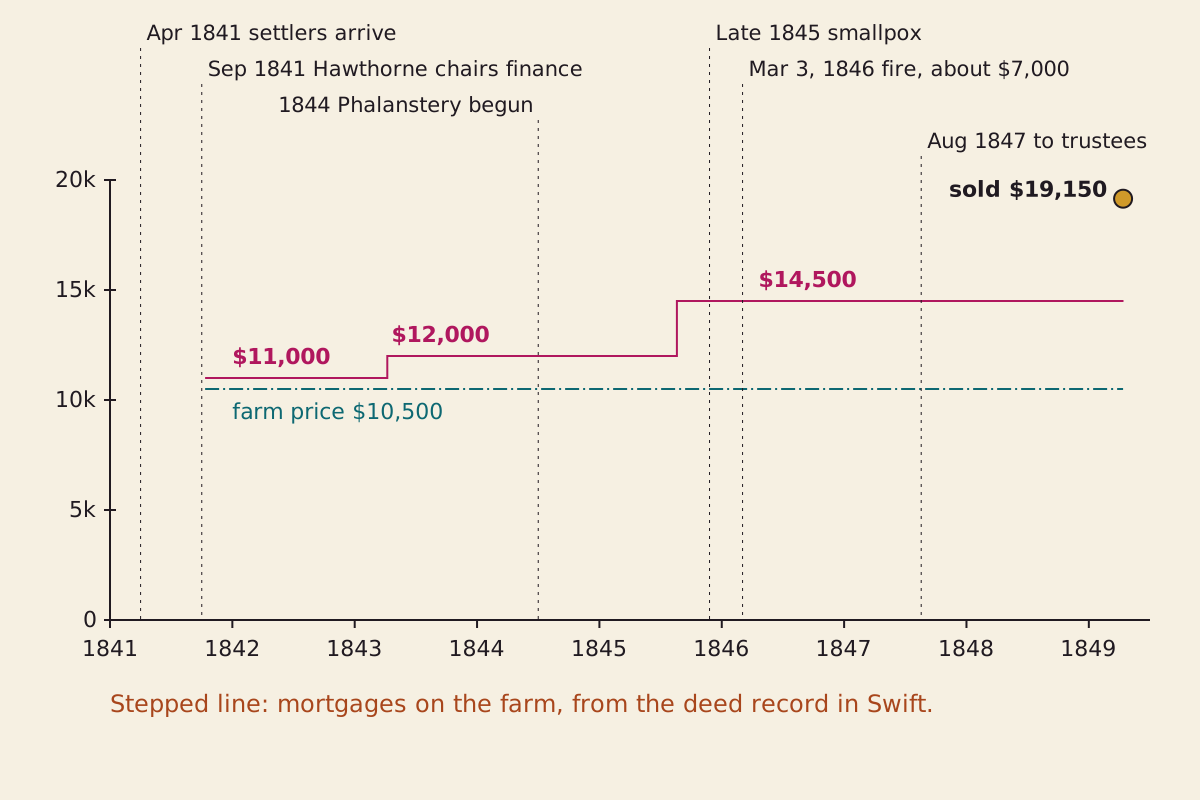
Mortgages by date, with the main events. The fire came after the last mortgage, so the debt did not wait for it.
"Brook Farm mortgages and events, 1841 to 1849" by The What-If Observatory, https://whatifobservatory.com/utopias/brook-farm/, licensed under CC BY 4.0 (https://creativecommons.org/licenses/by/4.0/)
Data: Swift (deeds, sale); Codman (fire); Hawthorne (finance chair); McEmry (date of the smallpox)
What was left in 1849?
Stockholders and creditors met in March 1847 and authorized Ripley to let the farm for one year for $350. That August the stockholders voted to pass the property to three trustees. On April 13, 1849, it sold at auction for $19,150, to become the Roxbury almshouse. Mortgages of $14,500, an execution of about $1,961 and $984 of accumulated interest came to $17,445.
Swift prints $1,704 as what remained “toward the settling of all other claims” (page 26), and the subtraction gives $1,705. Hawthorne's $1,000 alone would be 59 percent of that. The dictionary dates the bankruptcy to 1847, while Swift has the sale in 1849, and both dates are shown here. Seeing: hazy, because one input is printed as about and the deeds come through Swift.
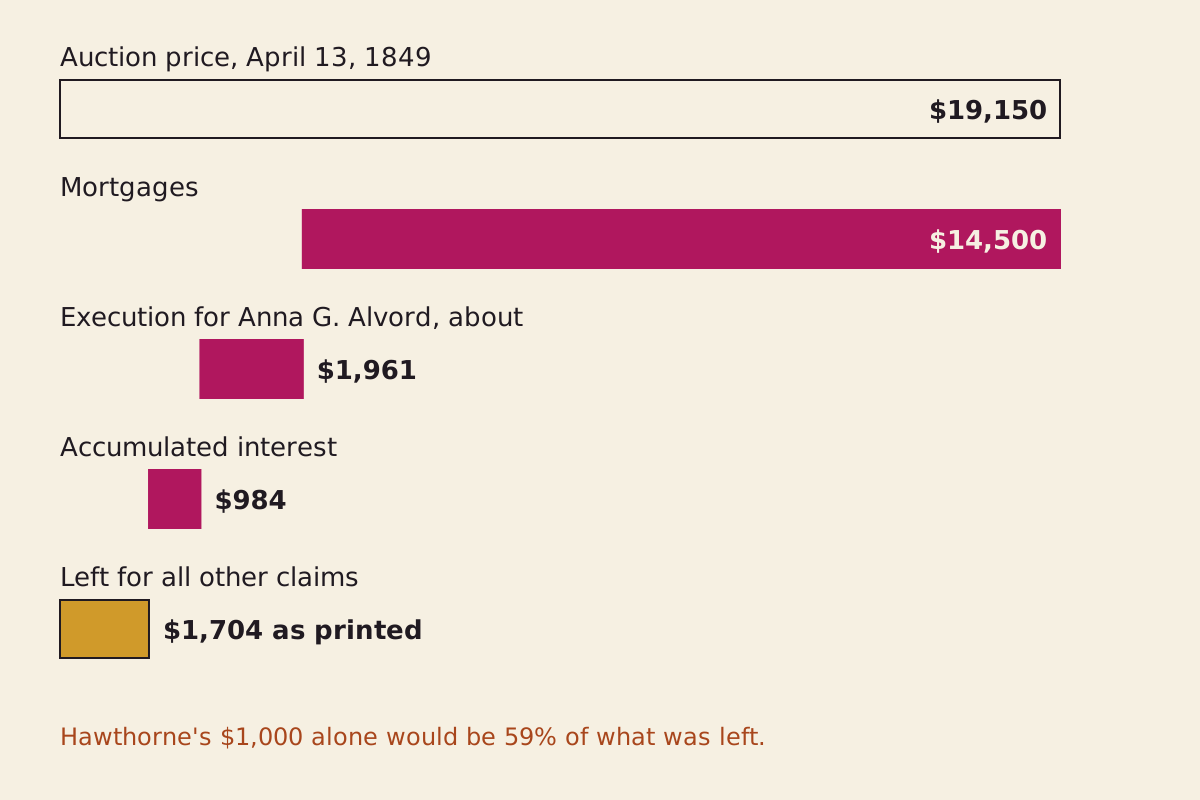
The 1849 sale, by Swift's figures from the county records. Who shared the last $1,704 was not in what we read.
"The 1849 sale of Brook Farm" by The What-If Observatory, https://whatifobservatory.com/utopias/brook-farm/, licensed under CC BY 4.0 (https://creativecommons.org/licenses/by/4.0/)
Data: Swift, from the county records
Why did it end?
The records point to several causes and do not rank them. Each row below is one reading, with what cuts against it.
| Cause | Who reports it | What complicates it |
|---|---|---|
| Too little capital | Codman: “Beginning with no real capital”; Swift's deeds | Lathrop calls it financially sound until 1844 |
| Weak farm returns | Codman: farm labor “the least success of anything” | The dictionary says the school did well |
| Money went elsewhere | Albert Brisbane's letter of December 1845, in Codman | One letter from one Fourierist organizer |
| Smallpox, late 1845 by the dictionary's date | Sears: “The smallpox killed the school.” | A memoir written decades later |
| The fire, 1846 | Sears: “This last loss bankrupted Brook Farm.” | Codman says it first “had shaken no one's faith” |
Who came out ahead?
Emerson's own verdict in that lecture was short: “all parties came out with a loss; some had spent on it the accumulations of years” (Noyes, chapter XI).
Membership is just as loose: about 20 at the start, over 70 by 1842 in the dictionary, and 115 members with no date in John Humphrey Noyes's 1870 table. Our How Many People Have Ever Lived page runs into the same problem at a much larger scale.
As for the Transcendentalists, the dictionary says the 1844 turn to Fourier cost the farm its ties to the individualists among them, and that printers, carpenters and mechanics took their places.
The dotted line falls after step 7. Up to there, each input is printed in a named book, though the deeds come through Swift alone, and the sums on them are ours. No book says what the farm would have earned with the building standing. From here on, we are guessing.
Step 8: if every year were 1844. We assume each year repeats the single surplus we can read. The burned $7,000 then equals 6.0 years of surplus, and the $14,500 of mortgages equals 12.5 years with no dividend paid out to anyone along the way. Seeing: overcast.
Step 9: if the building had been finished. We assume 5 percent on a $10,000 building, since we did not read the loan stock's rate. That is $500 a year, the gross board of 2.4 boarders at $4 a week, before feeding them, which looks easy until you remember that the money to finish it had to exist first. Brisbane's letter, in Codman's chapter VIII, says of raising funds in New York, “You might as well undertake to raise dead men.” Seeing: overcast.
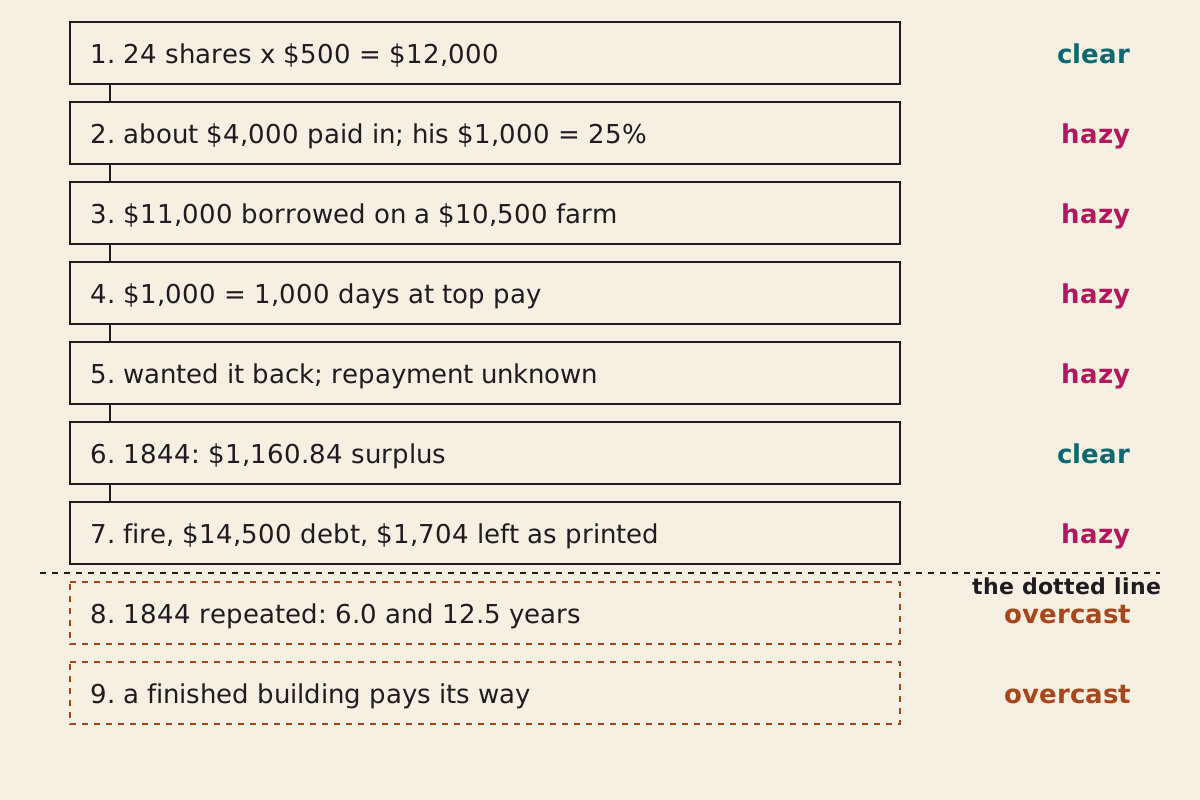
Nine steps. The dashed boxes are this site's what-if. Above the line, the inputs come from named books and the sums are ours.
"Step chain with the dotted line after step 7" by The What-If Observatory, https://whatifobservatory.com/utopias/brook-farm/, licensed under CC BY 4.0 (https://creativecommons.org/licenses/by/4.0/)
Data: Swift; Frothingham; Codman; Lathrop
Everything through the sale is paper you can check against a named book, but whether a standing Phalanstery would have paid its way, and whether Hawthorne's $1,000 would then have come home, lies past the dotted line.
Check my math:
| Step | Input | Value | Unit | Source no. | Source | Recomputed | Seeing |
|---|---|---|---|---|---|---|---|
| 1 | Shares subscribed | 24 | shares | 1; 2 | primary | no | clear |
| 1 | Price of a share | 500 | USD | 1; 2 | primary | no | clear |
| 1 | Capital subscribed | 12,000 | USD | 2 | primary | yes | clear |
| 1 | Hawthorne's subscription, shares 18 and 19 | 1,000 | USD | 1; 2 | primary | yes | clear |
| 2 | Paid in, about one third of the subscriptions | 4,000 | USD | 1; 2 | secondary | yes | hazy |
| 2 | Hawthorne's 1,000 as a share of money paid in, if he paid it all | 25 | percent | 1; 4 | site assumption | yes | hazy |
| 3 | Farm price | 10,500 | USD | 1; 2 | secondary | no | hazy |
| 3 | Mortgages of October 11, 1841 | 11,000 | USD | 1 | secondary | yes | hazy |
| 3 | Mortgaged above the farm price | 500 | USD | 1 | secondary | yes | hazy |
| 3 | Starting capital, apparently | 4,500 | USD | 1 | secondary | yes | hazy |
| 4 | Top pay for a day of labor | 1 | USD per 10-hour day | 3; 6 | primary | no | clear |
| 4 | Days at top pay to equal one share | 500 | days | 1; 3 | site assumption | yes | hazy |
| 4 | Years at top pay to equal Hawthorne's 1,000 | 3.33 | working years | 1; 3 | site assumption | yes | hazy |
| 4 | A year of board without working | 208 | USD | 1 | secondary | yes | hazy |
| 4 | Interest on one share | 25 | USD per year | 1; 3; 2 | primary | yes | clear |
| 4 | Weeks of board that interest covers | 6.25 | weeks | 1 | secondary | yes | hazy |
| 5 | Weeks of Ripley's 1849 Tribune pay to equal 1,000 | 200 | weeks | 3 | secondary | yes | hazy |
| 5 | Weeks of Ripley's 1851 Tribune pay to equal 1,000 | 40 | weeks | 3 | secondary | yes | hazy |
| 6 | 1844 income | 11,854.41 | USD | 3; 2 | primary | no | clear |
| 6 | 1844 expenditures | 10,409.14 | USD | 3; 2 | primary | no | clear |
| 6 | 1844 surplus after doubtful debts | 1,160.84 | USD | 3; 2 | primary | yes | clear |
| 6 | Deficit for 1842 and 1843 | 1,964.88 | USD | 3; 1 | primary | no | clear |
| 6 | Interest and insurance as a share of 1844 income | 14.8 | percent | 2; 3 | primary | yes | clear |
| 7 | Mortgages after 1843 and 1845 | 14,500 | USD | 1 | secondary | yes | hazy |
| 7 | Spent on the Phalanstery when it burned, about | 7,000 | USD | 3; 1 | primary | no | hazy |
| 7 | Still needed to finish it, estimated | 3,000 | USD | 3; 1 | primary | no | hazy |
| 7 | Share of the estimated cost spent, on those figures | 70 | percent | 3; 1 | secondary | yes | hazy |
| 7 | Claims paid first at the 1849 sale, one sum about | 17,445 | USD | 1 | secondary | yes | hazy |
| 7 | Left for all other claims, by subtraction | 1,705 | USD | 1 | secondary | yes | hazy |
| 8 | Fire loss in years of the 1844 surplus | 6.0 | years | 3 | site assumption | yes | overcast |
| 8 | Mortgages in years of the 1844 surplus | 12.5 | years | 1; 3 | site assumption | yes | overcast |
| 9 | Yearly interest on a finished building | 500 | USD per year | 3 | site assumption | yes | overcast |
| 9 | Boarders to gross that interest | 2.4 | boarders | 1 | site assumption | yes | overcast |
Download brook-farm-check-my-math.csv (where its values come from)
Next question:
Sources
- Lindsay Swift. Brook Farm: Its Members, Scholars, and Visitors. New York: Macmillan, 1900. Internet Archive scan. Original Read: chapter The Organization, pp. 17-26 (shares pp. 17-18, first deeds pp. 19-20, rules pp. 20-21, later deeds pp. 22-25, 1847 meetings and the sale pp. 25-26); The Buildings and Grounds, p. 39 (75 percent); chapter on household work.
- Octavius Brooks Frothingham. George Ripley. American Men of Letters. Boston: Houghton Mifflin, 1882. Internet Archive scan of a later printing. Original Read: chapter III, Brook Farm: the Articles of Association, share list and 1844 finance report.
- John Thomas Codman. Brook Farm: Historic and Personal Memoirs. Boston: Arena, 1894. Project Gutenberg eBook 7932. Original Read: chapters I (articles of agreement), II (later rules, farm returns), III and X (domestic scenes), VI (Ripley's appeal, 1844 finance report), VIII (Brisbane letter), XI (the fire), XII and XIII (laundry, capital), XIV (Hawthorne, debts, Tribune pay).
- George Parsons Lathrop. Biographical sketch of Hawthorne, in The Complete Works of Nathaniel Hawthorne, Riverside Edition, Appendix to Volume XII. Cambridge: Riverside Press, 1883. Project Gutenberg eBook 40529. Original Read: section III of the sketch, the Brook Farm passage.
- Nathaniel Hawthorne. Love Letters of Nathaniel Hawthorne, Volume 2. Chicago: Society of the Dofobs, 1907. Project Gutenberg eBook 41368. Original Read: letters from Brook Farm, April to October 1841, including those dated June 1 and September 29, 1841.
- John Van der Zee Sears. My Friends at Brook Farm. New York: Desmond FitzGerald, 1912. Project Gutenberg eBook 7302. Original Read: chapters VII, The School (wages, Hawthorne) and X, Unto This Last (smallpox, the fires, the end).
- John Humphrey Noyes. History of American Socialisms. Philadelphia: Lippincott, 1870. Project Gutenberg eBook 35687. Original Read: chapter XI, Channing's Brook Farm (a newspaper report of Emerson's lecture); chapter XLII, on the end of Brook Farm, opening only; the table of communities.
- McEmry, Aaron, “Brook Farm,” April 4, 2006, Dictionary of Unitarian and Universalist Biography, an on-line resource of the Unitarian Universalist Studies Network. Original Read: full page.
- Julia Wacker. Hawthorne and the Brook Farm Community. The House of the Seven Gables, July 1, 2022. Original Read: full page.
Cite this page
The What-If Observatory. "Brook Farm: By Swift’s List, Hawthorne Subscribed $1,000." Published 2026-11-09. https://whatifobservatory.com/utopias/brook-farm/. Add the date you read it.
Corrections
None so far.