Atlantis: Plato’s Own Speaker Called Its Ditch ‘Incredible’
The What-If Observatory Published
Plato's Critias gives Atlantis a ditch 100 feet deep, a stadium wide and 10,000 stadia long. That works out to about 10.4 billion cubic meters of earth, roughly 59 times the 232 million cubic yards a 1913 book gave for the Panama Canal, or 54 to 64 times across the stadium lengths we use, with English feet. Atlantis is a story in Plato, and his own speaker calls the ditch incredible.
Steps in this reading (5)
- Suppose:
- Critias's ditch were a real construction job.
- Hold fixed:
- Plato's figures; a stadium of about 185 meters (range shown); no digging machines.
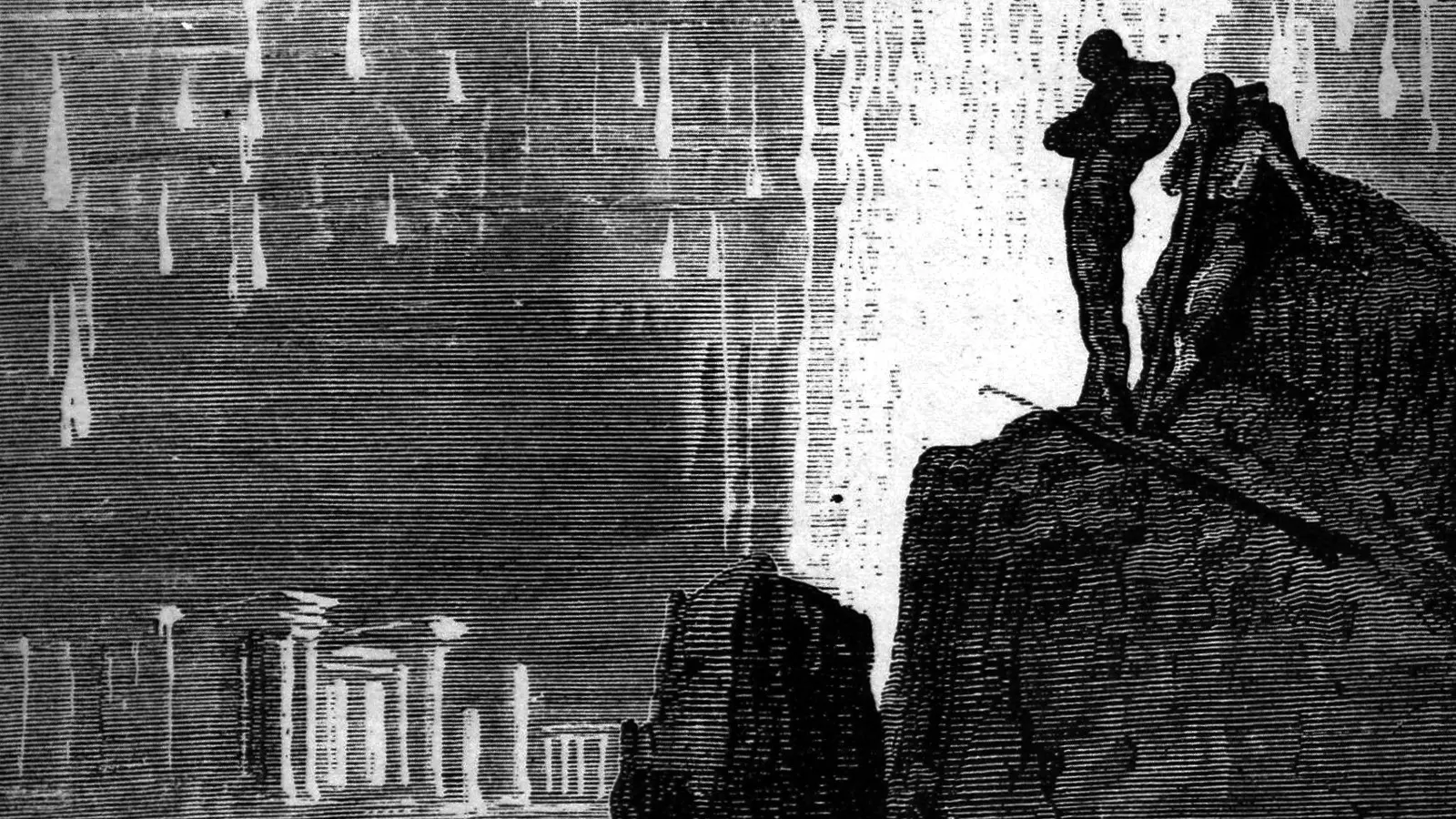
The Atlantis of Jules Verne, not of Plato. An illustration by Alphonse de Neuville for Twenty Thousand Leagues Under the Sea, from a 1922 Polish edition.
Nemo Aronax Atlantis, Alphonse de Neuville (Public Domain Mark 1.0)
"Nemo Aronax Atlantis" by Alphonse de Neuville — https://commons.wikimedia.org/wiki/File:Nemo_Aronax_Atlantis_(91182398).jpg — Public domain in the US (this edition published 1922) and in the EU (Neuville died 1885; the file's license tag gives 1897, likely the engraver; either date is past life+70); modified: cropped to 16:9 for the card and page, keeping the two figures and the columns; the falling lava above and the lower rocks removed

Beyond the sinking, Plato also left what amounts to a work order, with a depth, a width and a length, so the job can be priced like any other excavation.
Each step below carries a Seeing mark, a word from astronomy for how steady the air is, which we use here to rate how much weight a step can bear: clear, hazy or overcast. Whether the arithmetic itself holds is a separate check, in the table at the end.
What does Plato specify?
In the story, Atlantis is an island empire founded by the god Poseidon, which attacks Europe and Asia, loses to an ancient Athens and sinks. It runs through two dialogues, the Timaeus and the Critias, which we read in the English translation by Benjamin Jowett (1817–1893).
The ditch comes in the Critias, where the speaker describes a plain “of an oblong shape, extending in one direction three thousand stadia, but across the centre inland it was two thousand stadia.” A stadium, stadion in Greek, is an ancient unit of length of roughly 185 meters, so that plain measures about 555 by 370 kilometers.
Then the speaker stops to apologize for what comes next. “The depth, and width, and length of this ditch were incredible, and gave the impression that a work of such extent, in addition to so many others, could never have been artificial. Nevertheless I must say what I was told.”
Step 1: the figures. It was “excavated to the depth of a hundred feet, and its breadth was a stadium everywhere; it was carried round the whole of the plain, and was ten thousand stadia in length.” Seeing: clear, as a reading of the text, which says what Plato wrote and nothing about what stood on the ground.
The ditch is a working part of the plain rather than a moat. It “received the streams which came down from the mountains,” wound round the plain and met at the city before it was “let off into the sea,” while straight canals cut from it carried timber and crops by boat. In summer the same water served the fields, which is how Plato gets his two harvests a year.
| Item in the Critias | Plato's figure | What we do with it |
|---|---|---|
| Ditch | 100 feet deep, 1 stadium wide, 10,000 stadia long | The whole sum below |
| Plain | 3,000 by 2,000 stadia | Checks the ditch's length |
| Lots on the plain | 60,000, each 10 by 10 stadia | Checks the plain's area |
| Inland canals | 100 feet wide, every 100 stadia | Left out, because no depth is given |
| Harbor canal | 300 feet wide, 100 feet deep, 50 stadia long | About 26 million cubic meters, left out |
Do Plato's numbers add up?
They agree with one another, a thing he never points out. Walk around a rectangle of 3,000 by 2,000 stadia and you cover exactly 10,000 stadia, the length of the ditch. Multiply 60,000 lots by 100 square stadia and you get exactly 6,000,000, the area of that same rectangle.
Each lot also owes a sixth of a war chariot, and the total of 10,000 chariots is exactly what 60,000 lots produce.
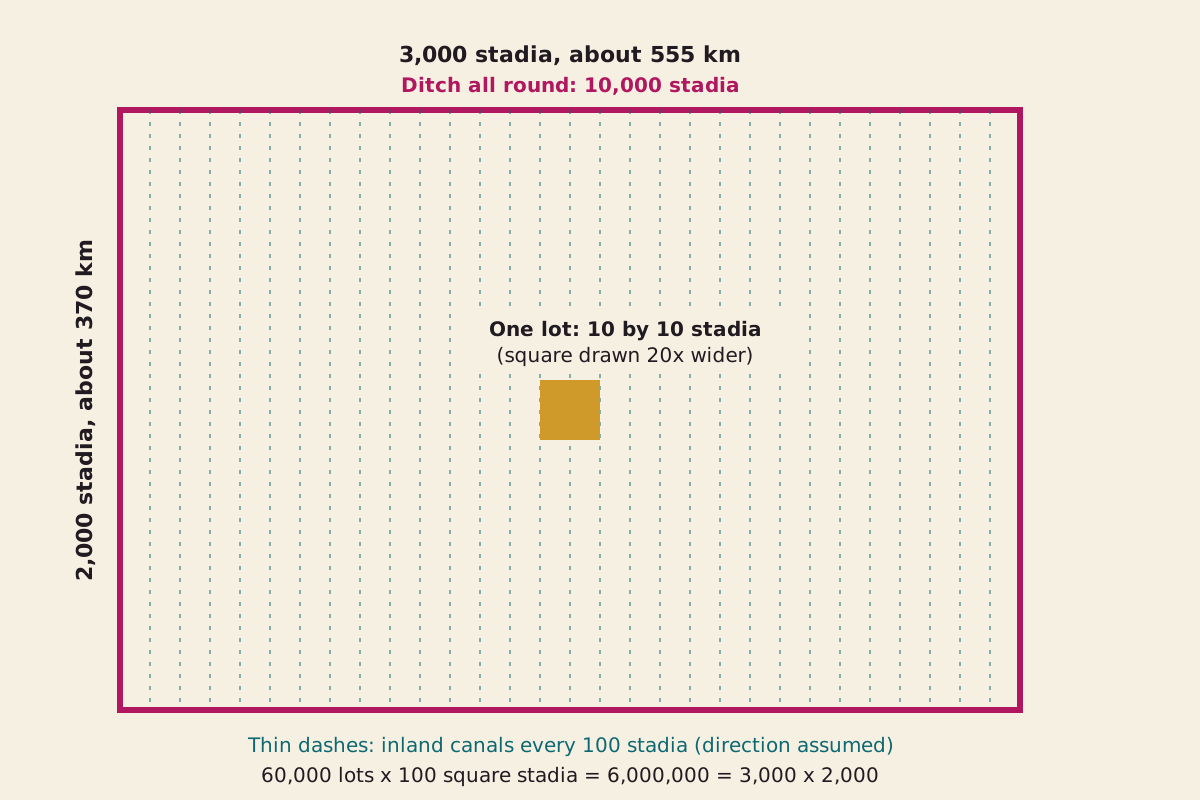
Plato's plain drawn to scale from his own numbers, with one lot enlarged so it can be seen. He says the plain was “for the most part rectangular,” so the neat corners are our simplification.
"Plan of Plato's plain, to scale" by The What-If Observatory, https://whatifobservatory.com/utopias/atlantis/, licensed under CC BY 4.0 (https://creativecommons.org/licenses/by/4.0/)
Data: Plato, Critias, Jowett translation (plain, ditch, lots, canals); Smith (stadium length)
We take those exact sums as a sign that somebody worked the figures before writing them down, which tells you about the author's care and nothing about any real plain.
Jowett noticed the craft in the apology as well. He set “the confession that the depth of the ditch in the Island of Atlantis was not to be believed” beside Poseidon, who as a god found no difficulty with the water supply, and concluded that Plato “ingeniously gives the impression that he is telling the truth which mythology had corrupted.”
How much dirt is that?
About 10.4 billion cubic meters. Three more steps get us there, starting with the unit.
Step 2: the stadium. No single length exists. E. Norman Gardiner's 1910 history of Greek athletics says a track was “a stade or 600 feet,” but that “there was no universal standard of measurement,” and he gives 177.5 meters for the track at Delphi and 192.27 meters for the one at Olympia (ch. XII). William Smith's dictionary of antiquities, in an 1884 edition, gives 606 feet 9 inches, about 184.9 meters, and calls that the Olympic stadium.
Smith and Gardiner disagree about Olympia, so we use all three values. Seeing: hazy.
Step 3: the volume. We treat the ditch as a trench with straight sides, 30.48 meters deep, 184.9 meters wide and about 1,849 kilometers long. That gives about 10.4 billion cubic meters, or 9.6 to 11.3 billion across the three stadium lengths. Seeing: hazy.
Jowett's “feet” are a translator's English, and the difference matters a little. If Plato's hundred feet were local feet at 600 to the stadium, as Gardiner describes, the depth would grow and shrink along with the stadium, and the range would widen to 9.3 to 11.8 billion cubic meters.
The total also counts the ditch alone and leaves out the rest of the waterworks. Cut across the plain at intervals of 100 stadia, the inland canals make 29 channels of 2,000 stadia each, if they run the short way, which Plato does not say. At 100 feet wide, every meter of depth in those channels would add about 327 million cubic meters, or 1.8 Panama Canals. He never gives the depth.
Now spread the ditch's spoil across the plain, about 205,000 square kilometers, and it lies only about 5 centimeters deep.
How does it compare with the Panama Canal?
Step 4: the comparison. Frederic Haskin's The Panama Canal, published in 1913, says “the excavations total 232,000,000 cubic yards” (ch. II), which is about 177 million cubic meters. Dividing gives about 58.8 Panama Canals, or 54.1 to 63.5 across the stadium lengths, and 52.5 to 66.8 with local feet.
The multiple depends on whose count you take, since these books went to press before the work was finished. J. Saxon Mills, also in 1913, brings the American total to 195 million cubic yards, which comes to about 70 Panama Canals, and Willis Abbot's book of that year says about 200 million, which makes about 68.
Mills also credits the French companies with 81,548,000 cubic yards. If Haskin's total leaves those out, the ditch falls to about 43. Haskin remains our yardstick because our other canal comparisons come from his book, and we have no final tally to set beside these. Seeing: hazy.
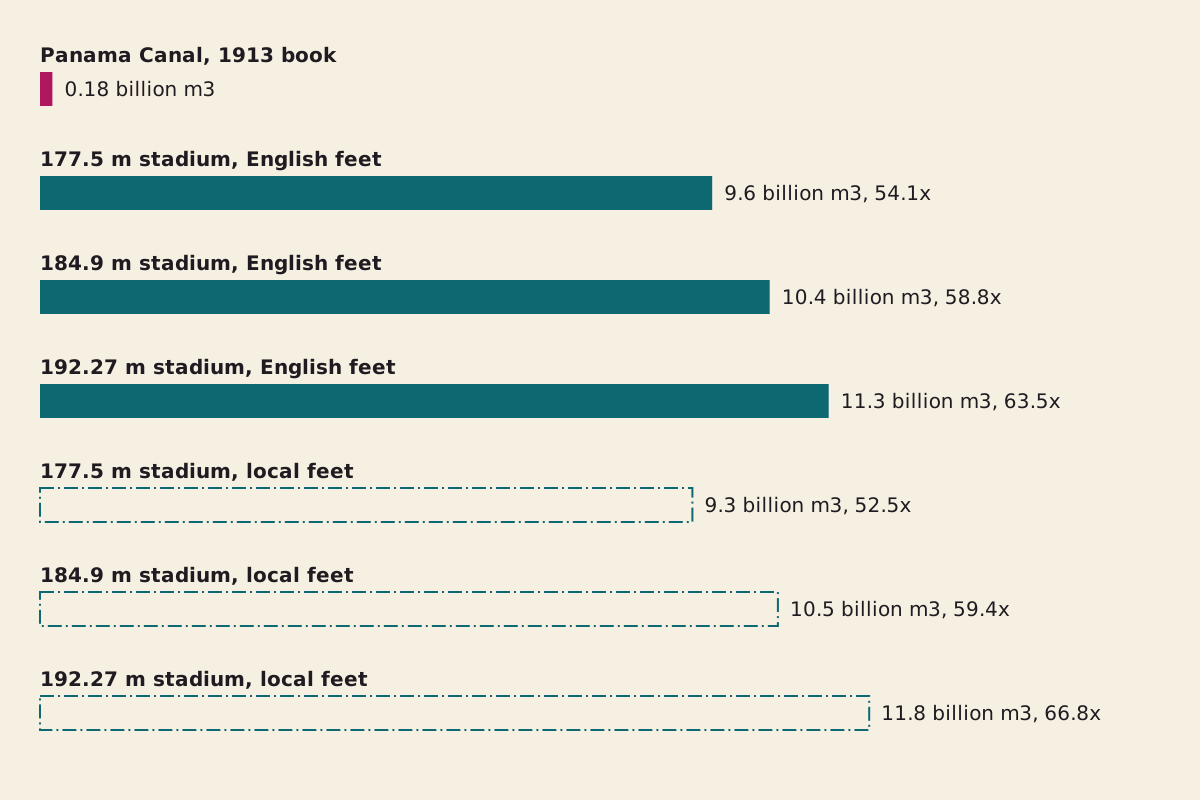
Six cases for the ditch and the 1913 Panama figure, on one linear scale. Solid ditch bars use Jowett's feet as English feet. Dashed bars assume local feet at 600 to the stadium.
"Volume of Plato's ditch against the Panama Canal" by The What-If Observatory, https://whatifobservatory.com/utopias/atlantis/, licensed under CC BY 4.0 (https://creativecommons.org/licenses/by/4.0/)
Data: Plato, Critias, Jowett translation (ditch); Gardiner 1910 and Smith (stadium lengths); Haskin 1913 (Panama)
Haskin's own yardstick was the Washington Monument, and he sized the canal's excavation at 5,840 solid shafts of it. On the same yardstick the ditch comes to about 343,000.
Length does most of the work in the Panama multiple. Haskin says the canal is 50 miles long, which makes the ditch about 23 canals end to end, while its cross-section is nothing unusual for the Panama works.
His account of Culebra Cut, the great trench through Culebra Mountain, makes the point. He gives it as nine miles long, with 105,000,000 cubic yards taken out, and dividing one by the other gives an average cross-section of about 5,540 square meters. Plato's ditch comes to about 5,640.
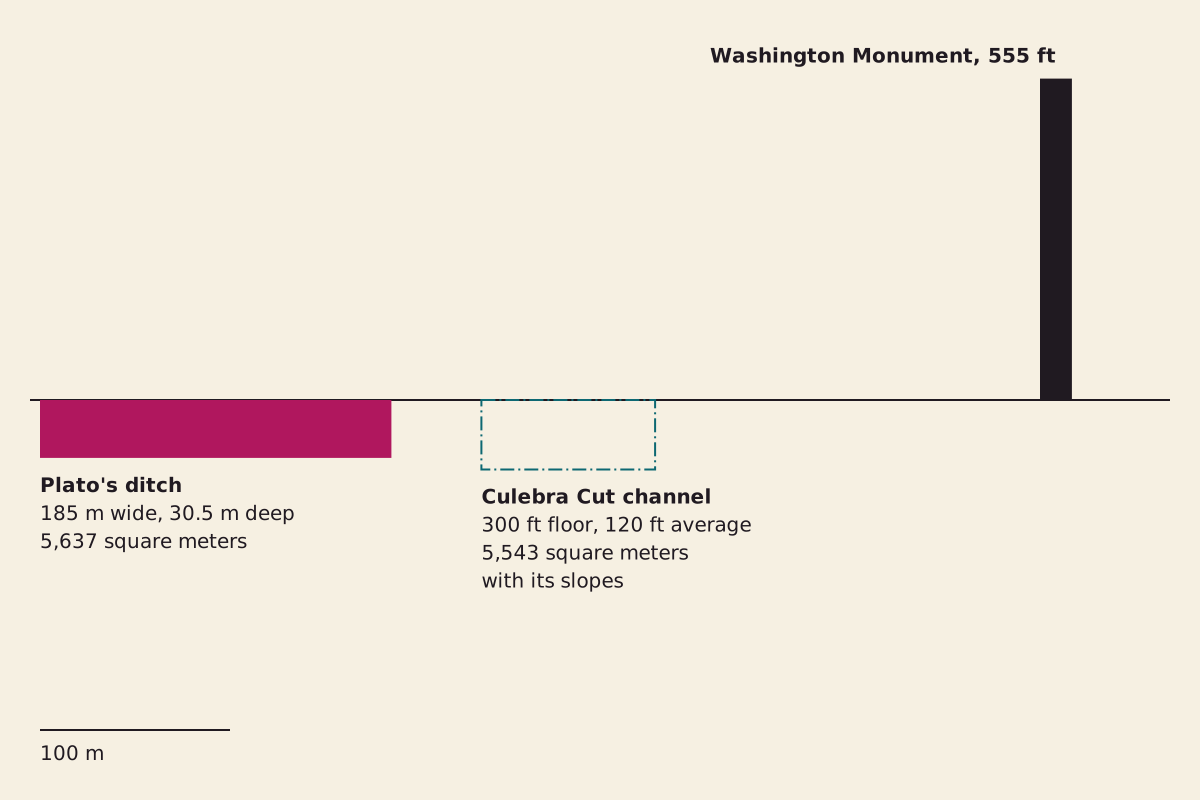
Three shapes at one scale. Culebra Cut is drawn as its channel floor and average depth, though its sloping sides reach far wider, and the 5,543 figure includes them. The floor, average depth and monument height come from the 1913 book, and the square-meter figures are our arithmetic.
"Cross-sections of Plato's ditch and Culebra Cut" by The What-If Observatory, https://whatifobservatory.com/utopias/atlantis/, licensed under CC BY 4.0 (https://creativecommons.org/licenses/by/4.0/)
Data: Plato, Critias, Jowett translation (ditch); Smith (stadium length); Haskin 1913 (Culebra Cut, Washington Monument)
So the ditch is roughly one Culebra Cut, carried on for about 128 times the length. The harbor canal in the table above, a side job in Plato's telling, would by itself come to about 15 percent of the 1913 Panama figure.
William Burr's 1903 engineering history gives the Great Pyramid about 3,500,000 cubic yards, and on that figure the ditch would hold about 3,900 Great Pyramids.
Is Atlantis real, and where was it?
Plato is the only source for Atlantis that we could read, and his Victorian translator called it invention. Jowett wrote that “we may safely conclude that the entire narrative is due to the imagination of Plato,” and he noted that “there is no such legend in any writer previous to Plato,” naming Homer, Pindar and Herodotus among the silent.
That was not the only view in his pages. He reports that the scholar M. Martin thought the tradition came from Egypt through Solon, and he argues against him at length. He also says that Strabo and Longinus, among the ancients, believed the tale about as little as a modern reader believes in Gulliver.
For a modern reading we have one review, not a survey. In Bryn Mawr Classical Review in 2018, Carol Atack treats Atlantis as Plato's own literary creation, and she reports Christopher Gill's reminder, in his 2017 commentary, that Plato's text is the story's only source. We read her review and not Gill's book, and one review cannot tell you where all scholars stand today.
Where does Plato put it?
He gives one answer. The Timaeus puts the island “in front of the straits which are by you called the Pillars of Heracles,” the narrow entrance to the inner sea, and makes it “larger than Libya and Asia put together.” The Critias adds that its end nearest the Pillars faced “the region of Gades.”
Then “in a single day and night of misfortune” it “disappeared in the depths of the sea,” and the Critias dates the war to nine thousand years before the telling.
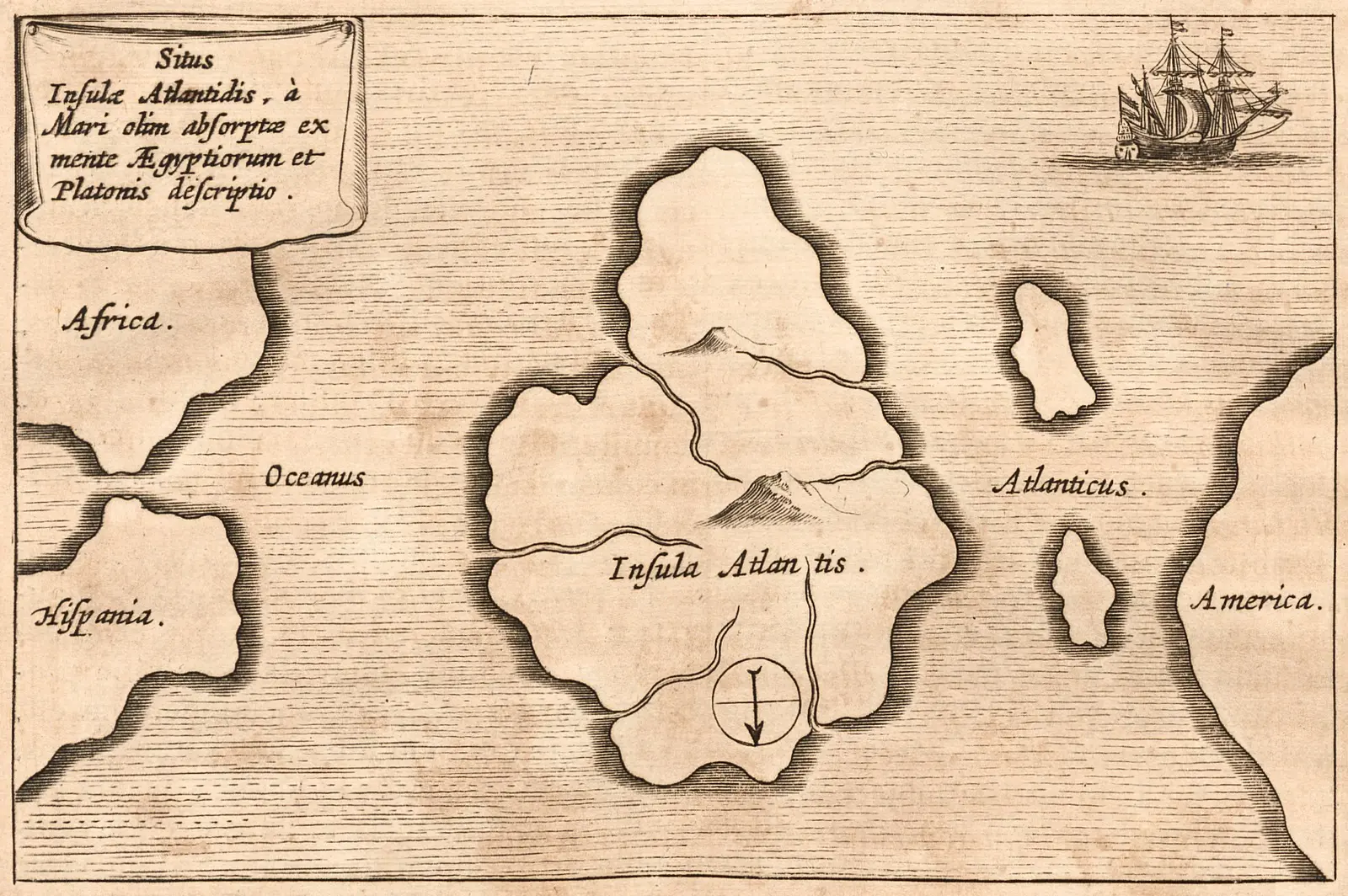
Athanasius Kircher's map in Mundus subterraneus, Amsterdam, 1664. North is at the bottom, so Spain sits below Africa. The title credits the description to the Egyptians and Plato.
"Atlantis Kircher Mundus subterraneus 1678" by Athanasius Kircher — https://commons.wikimedia.org/wiki/File:Atlantis_Kircher_Mundus_subterraneus_1678.jpg — Public domain in the US (published 1664) and in the EU (author died 1680, life+70)

People kept looking anyway. Jowett lists some of the places they tried: “America, Arabia Felix, Ceylon, Palestine, Sardinia, Sweden.” His explanation is a good one: “It was a legend so adapted to the human mind that it made a habitation for itself in any country.” We do not grade the candidate sites, since no figure in Plato's ditch could settle that question and our sums come out the same on any map.
Is Atlantis a utopia or a warning?
It is both, in sequence, and the two dialogues split the roles between them.
| Dialogue | What Atlantis is | Plato's words |
|---|---|---|
| Critias, early | Wise and well governed | “uniting gentleness with wisdom” |
| Critias, later | Rich and corrupted | “full of avarice and unrighteous power” |
| Timaeus | The invader Athens defeats | “unprovoked made an expedition” |
The early kings come close to a utopia's founders, since they “despised everything but virtue” and thought wealth “only a burden.” Then “the divine portion began to fade away,” and Zeus gathers the gods to decide on a punishment. The text stops there, on the words “he spake as follows.” The file's line for what ran out first reads records insufficient, because the story blames that divine portion and is the only record of it.
The muster shows what Plato was setting up. Each of the 60,000 lots owes a list of fighting men, and by our count that list comes to 20 per lot: riders, a charioteer, heavy infantry, archers, slingers, stone-throwers, javelin men and sailors. Against an Athens that keeps “about twenty thousand” men and women, the plain alone would field 1,200,000 men, a ratio of about 60 to 1.
The sailors alone come to 240,000, which is exactly 200 for each of the 1,200 ships. Seeing: hazy, since our count of the list is one reading of a crowded sentence.
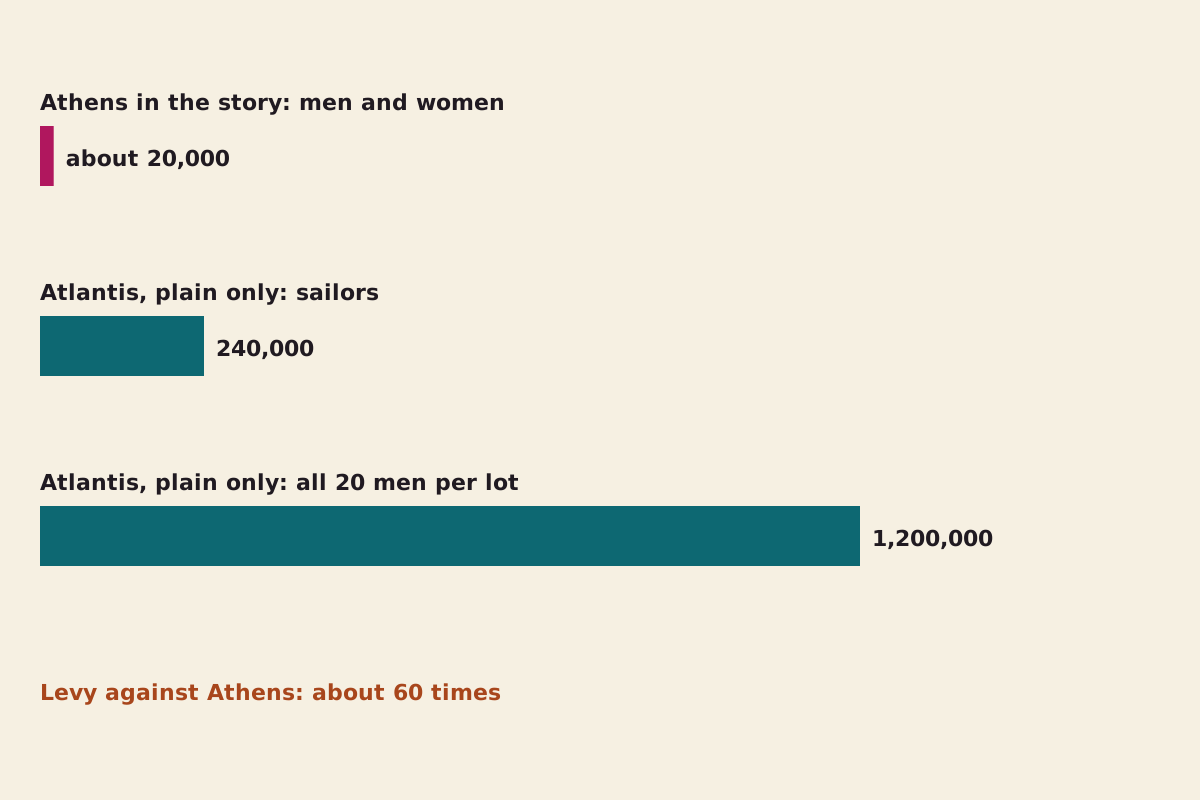
Plato's two forces on one linear scale. The Atlantis bars count only the plain, and the 20-per-lot tally is ours.
"Plato's Athens against the muster of Atlantis" by The What-If Observatory, https://whatifobservatory.com/utopias/atlantis/, licensed under CC BY 4.0 (https://creativecommons.org/licenses/by/4.0/)
Data: Plato, Critias, Jowett translation
Jowett reads that gap as deliberate, “evidently designed to contrast with the myriads and barbaric array” of Atlantis, and he sees the war as “prophetic or symbolical of the struggle of Athens and Persia.” Those explanations are his, and they do not depend on our sums.
Modern readers disagree about the purpose. Atack's review says Pierre Vidal-Naquet's reading, first published in 1964, has dominated later work and ties the story to Athenian politics, while Gill pushes back toward a more philosophical one. She thinks both can stand together.
Our angle in these files is the ledger, meaning who pays and who digs, and it sits beside the moral reading without replacing it. A real commune such as Brook Farm leaves money you can trace, and Jeremy Bentham's Panopticon left a plan that Britain never built as he drew it. Atlantis, in the texts we read, has a plan and no ledger.
Who dug the ditch, and how long would it take?
Start with a pace that really happened.
Step 5: the machine benchmark. Haskin reports that in March 1909, “for the only time in the history of the world,” one project dug “4,000,000 cubic yards of material in one month” (ch. II), which is about 3.06 million cubic meters. Hold that record every month with steam shovels and the ditch takes about 284 years. Seeing: hazy, as a comparison of pace, since the Hold fixed line rules machines out of the job itself and this number serves only as a yardstick.
Moving the earth is a second problem. George Vose's 1857 railroad handbook says shovels alone move earth 10 to 20 feet, barrows 20 to 100, and carts 100 to 500. The middle of Plato's ditch lies about 303 feet from either bank. A shovel gang alone would not do, and that is before anyone lifts a load out of a hole 100 feet deep.
What about digging by hand?
The dotted line falls after step 5. Up to there, every input is Plato's text or a figure from a named book, but Plato gives no digging rate, no schedule and no workforce, and we found no source for a rate that fits this job. From here on, we are guessing.
Step 6: a rate. We assume 2 cubic meters per digger per day and 250 working days a year, and the table also runs 1 and 5 cubic meters. Those are our own round numbers, and they come to about 20.8 million digger-years, or 8.3 to 41.7 million across the range. Seeing: overcast.
Step 7: a workforce. Plato gives one number we can borrow, the 60,000 lots, so the table runs one digger per lot, then ten, then all 20 men of the muster. Shared out evenly, each lot would owe about 31 meters of trench, which is still 185 meters wide and 30 deep, or some 174,000 cubic meters of earth.
| Diggers | At 1 cubic meter a day | At 2 cubic meters a day | At 5 cubic meters a day |
|---|---|---|---|
| 60,000 | 695 years | 347 years | 139 years |
| 600,000 | 69 years | 35 years | 14 years |
| 1,200,000 | 35 years | 17 years | 7 years |
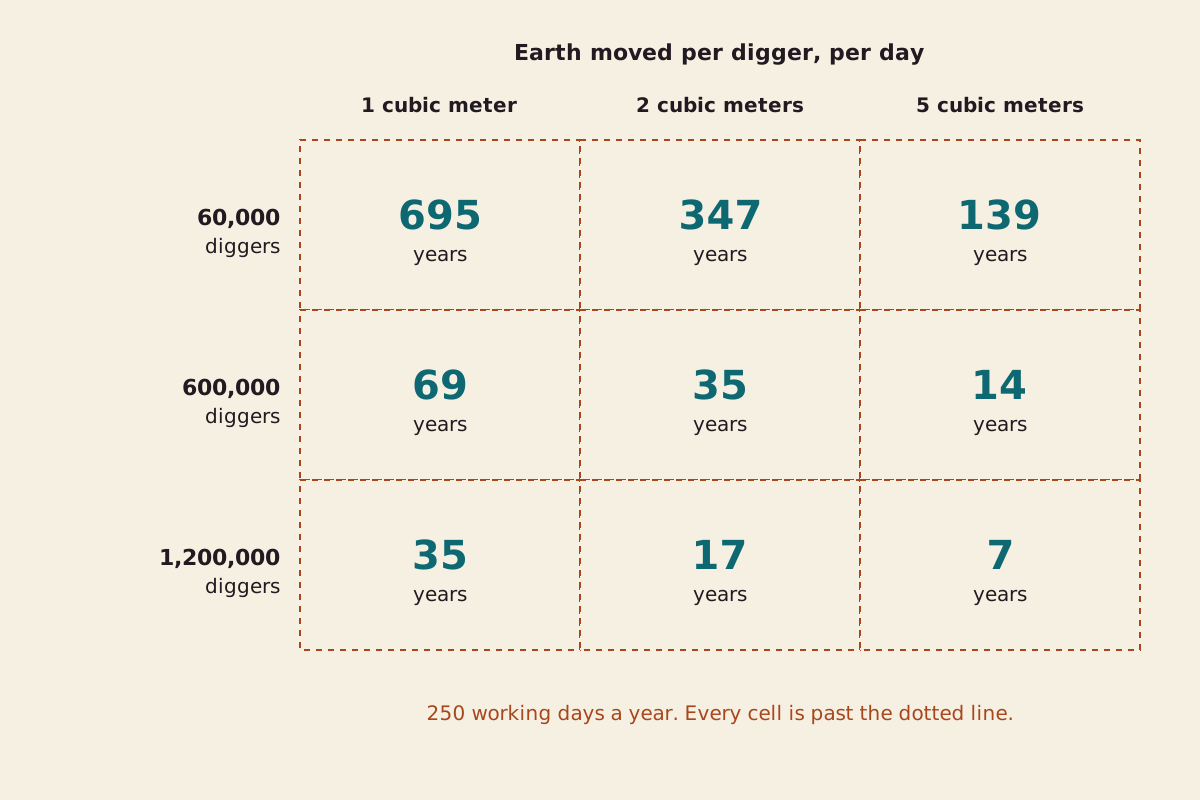
Nine guesses, each from the same 10.4 billion cubic meters and 250 working days. None of them counts hauling, water, tools, food or deaths.
"Years to dig Plato's ditch, by workforce and digging rate" by The What-If Observatory, https://whatifobservatory.com/utopias/atlantis/, licensed under CC BY 4.0 (https://creativecommons.org/licenses/by/4.0/)
Data: Plato, Critias, Jowett translation (ditch, lots); Smith (stadium length); rates, days and workforces are this page's assumptions
Plato's own phrase for the plain is “the labours of many generations of kings through long ages,” and a job of several centuries would fit it, though a fit between a story and our guess is evidence for neither. Whether a society could spend that many working lives is a separate sum, and our count of how many people have ever lived is the place to start. Seeing: overcast.
Step 8: who paid and who dug. On money, Plato is generous and vague. The kings had “such an amount of wealth as was never before possessed by kings and potentates,” drawn from foreign goods and from the island's own mines, timber and crops.
On labor he is silent, and he itemizes what each lot owes the army, down to that sixth of a chariot, without listing a single shovel. Each lot must find a leader “for the men who were fit for military service,” so the text hands out commanders and no foremen. In Jowett's whole text of the dialogue, the word “labours” appears once, it belongs to the kings, and no slave, servant, wage or digger appears. Seeing: overcast.
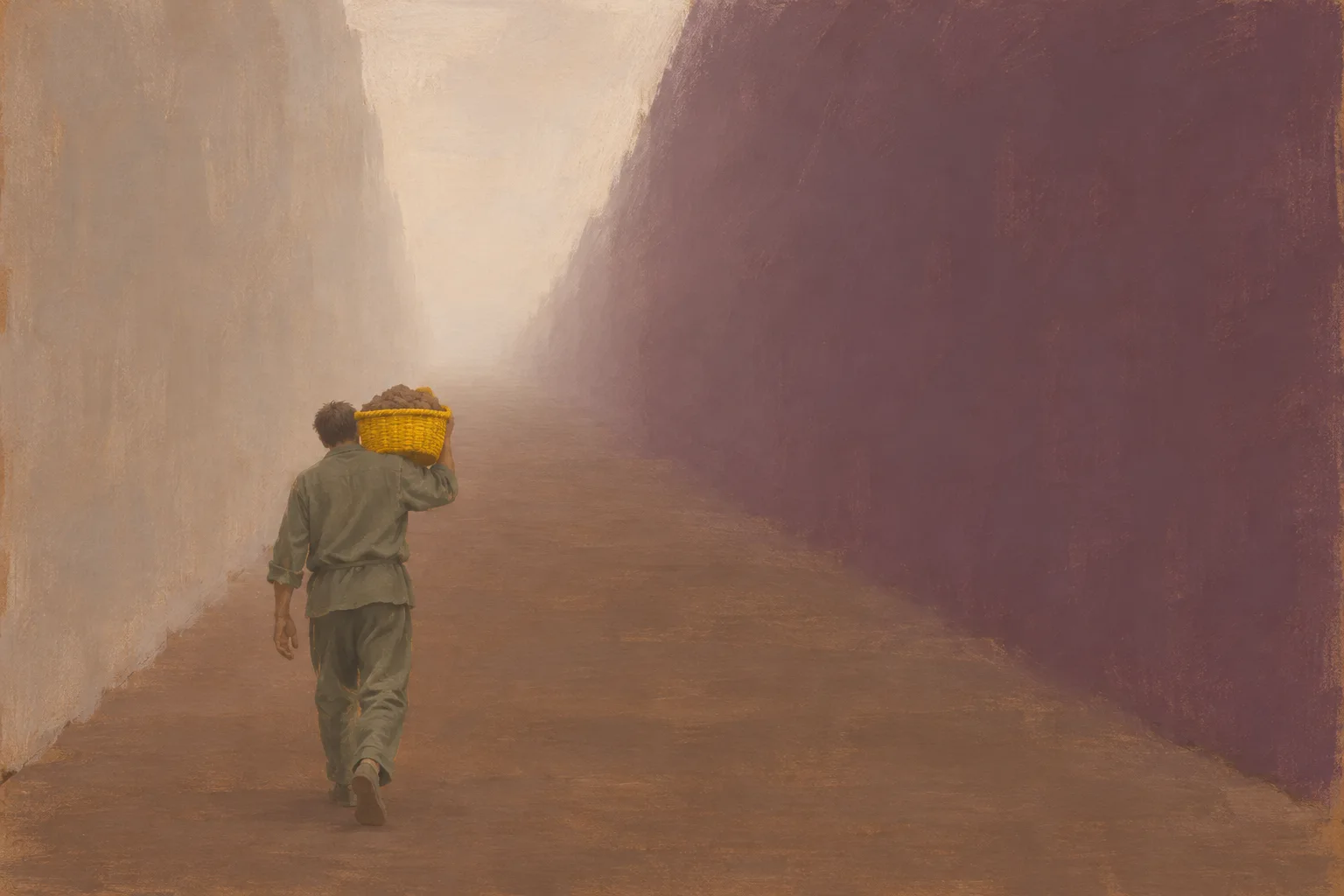 Illustration
Plato gives the ditch's size and names no one who dug it. Not to scale.
Illustration: The What-If Observatory. Generated schematic illustration — not a photograph or historical record. © The What-If Observatory, all rights reserved.
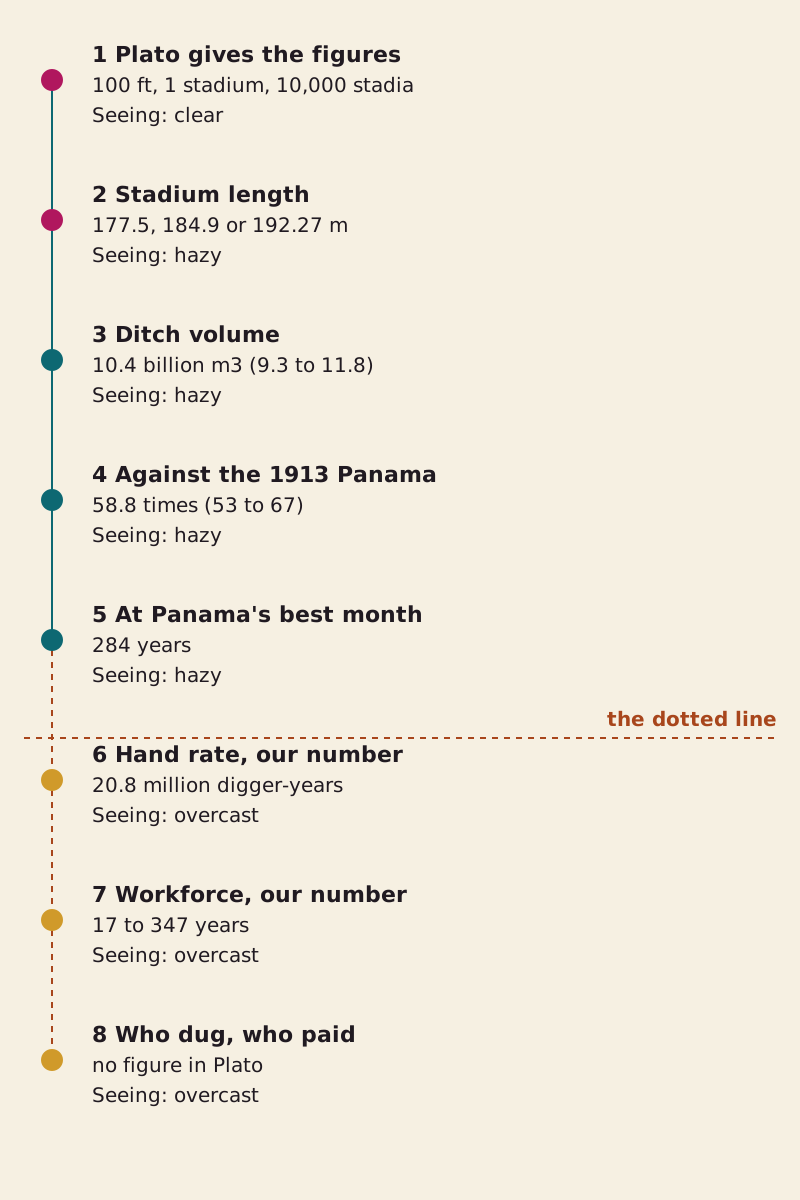
The chain behind this page. Step 1 is Plato's text. Steps 2 to 5 add stadium lengths and 1913 figures. Steps 6 to 8 sit past the dotted line.
"The chain behind Plato's ditch" by The What-If Observatory, https://whatifobservatory.com/utopias/atlantis/, licensed under CC BY 4.0 (https://creativecommons.org/licenses/by/4.0/)
Data: Plato, Critias, Jowett translation; Gardiner 1910; Smith; Haskin 1913
So the dirt sits above that line, and the diggers sit below it.
Check my math:
| Step | Input | Value | Unit | Source no. | Source | Recomputed | Seeing |
|---|---|---|---|---|---|---|---|
| 1 | Ditch depth | 100 | ft | 1 | primary | no | clear |
| 1 | Ditch width | 1 | stadium | 1 | primary | no | clear |
| 1 | Ditch length | 10,000 | stadia | 1 | primary | no | clear |
| 1 | Perimeter of a true 3,000 by 2,000 rectangle | 10,000 | stadia | 1 | site assumption | yes | hazy |
| 1 | 60,000 lots of 100 square stadia | 6,000,000 | square stadia | 1 | primary | yes | clear |
| 1 | Chariots: 60,000 lots × one sixth | 10,000 | chariots | 1 | primary | yes | clear |
| 1 | Men Plato lists per lot, our count | 20 | men | 1 | primary | yes | hazy |
| 1 | Plain's levy: 60,000 × 20 | 1,200,000 | men | 1 | site assumption | yes | hazy |
| 1 | Levy against Athens's about 20,000 | 60 | times | 1 | site assumption | yes | hazy |
| 1 | Sailors: 60,000 × 4 | 240,000 | men | 1 | primary | yes | hazy |
| 1 | Sailors per ship, 1,200 ships | 200 | men | 1 | primary | yes | hazy |
| 2 | Stadium at Delphi | 177.5 | m | 4 | secondary | no | hazy |
| 2 | Stadium in Smith, 606 ft 9 in | 184.94 | m | 5 | secondary | yes | hazy |
| 2 | Stadium at Olympia | 192.27 | m | 4 | secondary | no | hazy |
| 3 | Ditch volume, 184.94 m stadium | 1.042 × 10¹⁰ | m³ | 1, 5 | site assumption | yes | hazy |
| 3 | Ditch volume, stadium range | 9.603 × 10⁹ to 1.127 × 10¹⁰ | m³ | 1, 4 | site assumption | yes | hazy |
| 3 | Same, local feet | 9.321 × 10⁹ to 1.185 × 10¹⁰ | m³ | 1, 4 | site assumption | yes | hazy |
| 3 | Spoil spread over the plain | 5.08 | cm | 1 | site assumption | yes | hazy |
| 3 | Inland canals, per meter of depth | 3.269 × 10⁸ | m³ per m | 1, 5 | site assumption | yes | hazy |
| 3 | Plain area | 205,000 | km² | 1, 5 | site assumption | yes | hazy |
| 4 | Panama excavation, 232,000,000 cubic yards | 1.774 × 10⁸ | m³ | 3 | secondary | yes | hazy |
| 4 | Ditch in Panama Canals | 58.8 | times | 1, 3, 5 | site assumption | yes | hazy |
| 4 | Stadium range | 54.1 to 63.5 | times | 1, 3, 4 | site assumption | yes | hazy |
| 4 | Local feet | 52.5 to 66.8 | times | 1, 3, 4 | site assumption | yes | hazy |
| 4 | On Mills's 195 million cubic yards | 69.9 | times | 1, 5, 9 | site assumption | yes | hazy |
| 4 | On Abbot's about 200 million cubic yards | 68.2 | times | 1, 5, 10 | site assumption | yes | hazy |
| 4 | On Haskin plus 81,548,000 French cubic yards, only if he leaves them out, which he does not say | 43.5 | times | 1, 3, 5, 9 | site assumption | yes | hazy |
| 4 | Ditch in Washington Monuments, from Haskin's 5,840 | 343,000 | times | 1, 3, 5 | site assumption | yes | hazy |
| 4 | Ditch length in Panama Canals, from Haskin's 50 miles | 23 | times | 1, 3, 5 | site assumption | yes | hazy |
| 4 | Harbor canal against Panama | 14.5 | percent | 1, 3, 5 | site assumption | yes | hazy |
| 4 | Ditch cross-section | 5,637 | m² | 1, 5 | site assumption | yes | hazy |
| 4 | Culebra Cut average cross-section | 5,543 | m² | 3 | secondary | yes | hazy |
| 4 | Ditch length in Culebra Cuts | 128 | times | 1, 3, 5 | site assumption | yes | hazy |
| 4 | Ditch in Great Pyramids | 3,900 | times | 1, 5, 6 | site assumption | yes | hazy |
| 5 | Panama's best month, 4,000,000 cubic yards | 3.058 × 10⁶ | m³ | 3 | secondary | yes | hazy |
| 5 | Ditch at that pace | 284 | years | 1, 3, 5 | site assumption | yes | hazy |
| 5 | Haul by shovel, barrow, cart | 10–20, 20–100, 100–500 | ft | 7 | secondary | no | hazy |
| 5 | Middle of the ditch to a bank | 303 | ft | 5 | site assumption | yes | hazy |
| 6 | Earth per digger per day | 2 | m³ per day | — | site assumption | no | overcast |
| 6 | Working days per year | 250 | days | — | site assumption | no | overcast |
| 6 | Digger-years | 2.08 × 10⁷ | digger-years | 1, 5 | site assumption | yes | overcast |
| 6 | Digger-years at 5 and at 1 cubic meters | 8.34 × 10⁶ to 4.17 × 10⁷ | digger-years | 1, 5 | site assumption | yes | overcast |
| 7 | One lot's share of the ditch | 30.8 | m of length | 1, 5 | site assumption | yes | overcast |
| 7 | One digger per lot | 347 | years | 1, 5 | site assumption | yes | overcast |
| 7 | 20 men per lot | 17 | years | 1, 5 | site assumption | yes | overcast |
| 8 | Who dug and who paid: no figure in Plato | — | — | 1 | primary | no | overcast |
Download atlantis-check-my-math.csv (where its values come from)
The stadium and foot cases behind the volume bars are in a second file.
Next question:
- How many blocks did the real pyramid take? Great Pyramid blocks
- How many people have ever lived to dig? The count of everyone ever born
Sources
- Plato. Critias. Translated by Benjamin Jowett. Project Gutenberg eBook 1571. Original Read: full text of the dialogue and Jowett's introduction.
- Plato. Timaeus. Translated by Benjamin Jowett. Project Gutenberg eBook 1572. Original Read: section on Atlantis in the dialogue and in Jowett's introduction.
- Frederic J. Haskin. The Panama Canal. Doubleday, Page, 1913. Project Gutenberg eBook 41807. Original Read: chapters I (canal length), II (excavation total, Washington Monument, record month) and VI (Culebra Cut).
- E. Norman Gardiner. Greek Athletic Sports and Festivals. Macmillan, 1910. Project Gutenberg eBook 59952. Original Read: chapter XII, The Stadium.
- William Smith. A Smaller Dictionary of Greek and Roman Antiquities. 12th ed. London: John Murray, 1884. Project Gutenberg eBook 65909. Original Read: entry Stadium and title page.
- William H. Burr. Ancient and Modern Engineering and the Isthmian Canal. J. Wiley & Sons, 1903. Project Gutenberg eBook 75910. Original Read: section on the pyramids.
- George L. Vose. Handbook of Railroad Construction. 1857. Project Gutenberg eBook 56688. Original Read: section 119, on moving earth.
- Carol Atack. Review of Christopher Gill, Plato's Atlantis Story: Text, Translation and Commentary (Liverpool University Press, 2017). Bryn Mawr Classical Review 2018.06.40. Original Read: full page: the review only; Gill's book and Vidal-Naquet's work not read, known only through this review.
- J. Saxon Mills. The Panama Canal: A History and Description of the Enterprise. Thomas Nelson and Sons; preface dated 1913. Project Gutenberg eBook 34124. Original Read: chapters XI (French excavation) and XII (Culebra Cut), and the preface.
- Willis J. Abbot. Panama and the Canal in Picture and Prose. Syndicate Publishing Company, 1913. Project Gutenberg eBook 64476. Original Read: chapter XII, The Culebra Cut.
Cite this page
The What-If Observatory. "Atlantis: Plato’s Own Speaker Called Its Ditch ‘Incredible’." Published 2026-11-09. https://whatifobservatory.com/utopias/atlantis/. Add the date you read it.
Corrections
None so far.