Twin Paradox: Einstein’s 1905 Version Had Clocks, Not Twins
The What-If Observatory Published
Ten years × 0.6 = 6 years: at 80% of light speed, the traveler's clock ends 4 years behind Earth's. That is the standard special-relativity formula, for a round trip in flat space with an instant turn. Einstein's 1905 paper posed it with two clocks and no people, Paul Langevin sent a traveler in 1911, and Hermann Weyl was probably first to mention twins, by one 2022 paper's reading. A 2007 paper reports flown clocks and stored muons showing the effect, though not on a straight trip out and back.
Steps in this reading (6)
- Suppose:
- one twin flies at 80% of light speed and returns.
- Hold fixed:
- flat spacetime, Earth treated as unmoving, one speed each way, a turn taken as instantaneous.
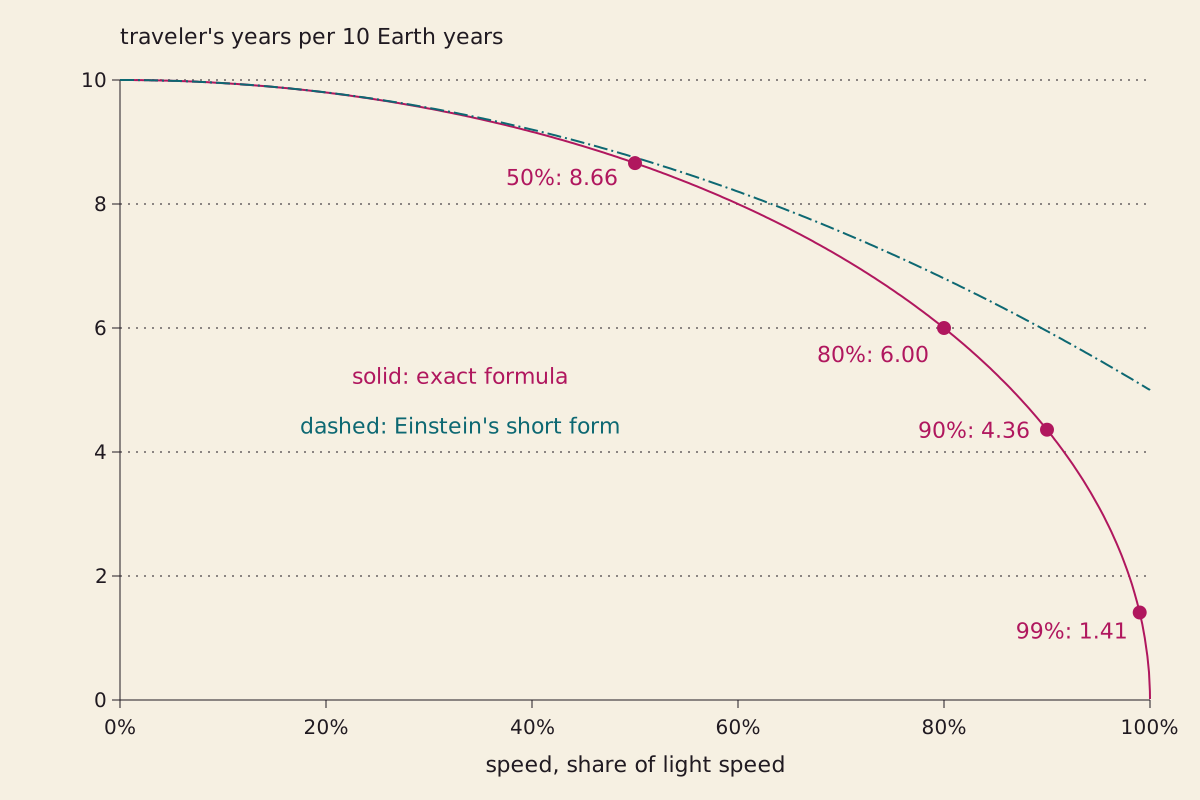
The traveler's years for each 10 years on Earth, by cruising speed, with an instant turn. The solid curve is the exact formula. The dashed curve is the short form Einstein printed, which is good only at low speed.
"Traveler's years per 10 Earth years against speed" by The What-If Observatory, https://whatifobservatory.com/paradoxes/twin-paradox/, licensed under CC BY 4.0 (https://creativecommons.org/licenses/by/4.0/)
Data: Einstein 1905, Annalen der Physik 17
The twin paradox asks why that gap has only one answer, since each twin sees the other moving and could say the other's clock runs slow. The sum comes first, then the question of what breaks the tie. Each step carries a Seeing mark, a label borrowed from astronomy, where shimmering air blurs a view, and here it rates how much weight a step can bear: clear, hazy or overcast.
Who ages less, and by how much?
The traveler does, by 4 years in 10.
Step 1: the rate. The effect is time dilation, the slowing of a moving clock as read from a system at rest. In section 4 of his 1905 paper, Albert Einstein finds that such a clock falls behind by 1 − √(1 − (v/V)²) seconds each second, where V is light speed. So it runs at √(1 − (v/V)²) of the rate of clocks at rest. Seeing: clear.
Step 2: the trip. At 80 percent of light speed that square root is exactly 0.6, so when Earth's calendar counts 10 years, the traveler's clock counts 6. The speed, the 10 years and the sharp turn are our choices, picked for easy numbers. The sum is exact for that setup, but the sharp turn moves the result, as step 5 shows. Seeing: hazy.
| Speed, share of light speed | Traveler's years per 10 on Earth | Gap, years | Gap by Einstein's short form, years |
|---|---|---|---|
| 50% | 8.66 | 1.34 | 1.25 |
| 80% | 6.00 | 4.00 | 3.20 |
| 90% | 4.36 | 5.64 | 4.05 |
| 99% | 1.41 | 8.59 | 4.90 |
Einstein's own example uses the short form in the last column, ½t(v/V)². He says it holds only up to terms of the fourth and higher order, and the table shows how far it drifts at these speeds.
At ordinary speeds the gap nearly vanishes. Coryn Bailer-Jones and Davide Farnocchia list Voyager 1's asymptotic speed, its speed once far from the Sun, as 16.6048 kilometers per second relative to the solar system's center of mass, and our Fermi paradox sums use that figure. A clock coasting at that speed lags one at rest in that frame by about 1.5 billionths.
Over that page's 1.8-billion-year galaxy crossing, the ship's clock would lose about 2.77 years. Seeing: hazy, because the crossing rests on a round width.
Why isn't it symmetric?
Because the two trips cannot be swapped.
The objection is old. Einstein himself gave it to a character called Kritikus in a 1918 dialogue, as Galina Weinstein recounts it in a 2012 paper. From the moving clock's side the other clock is the mover, so each clock should end up behind the other, yet two clocks side by side cannot both be late.
That objection hides an assumption, the kind we look for first: that each twin can claim the same steady point of view, or frame of reference. Earth keeps one frame through the whole trip, while the traveler uses two, one going out and one coming back. The next table holds under these assumptions and no others:
- Spacetime is flat, with no gravity.
- Earth counts as unmoving, with its spin and orbit ignored.
- The traveler holds 80 percent of light speed each way and reverses at once.
- Each clock is ideal, so its rate depends on speed and not on acceleration.
Step 3: the jump. On each leg the traveler is right to say Earth's clock runs slow, at 3 years × 0.6 = 1.8 years, which accounts for 3.6 of Earth's 10 years. The other 6.4 sit in the switch of frames, where “right now” on Earth moves from 1.8 to 8.2. Seeing: hazy, because the size of that jump comes from our sharp turn.
| Moment | Earth's clock, Earth's frame | Traveler's clock | Earth's clock, traveler's frame |
|---|---|---|---|
| Departure | 0 | 0 | 0 |
| Turn, just before | 5 | 3 | 1.8 |
| Turn, just after | 5 | 3 | 8.2 |
| Reunion | 10 | 6 | 10 |
Nothing happens to Earth's clock at that jump. A 2022 paper by Abdaljalel Alizzi, Abhijit Sen and Zurab Silagadze, following G. Builder, treats such strange behavior as a sign of how artificial an accelerated observer's coordinates are.
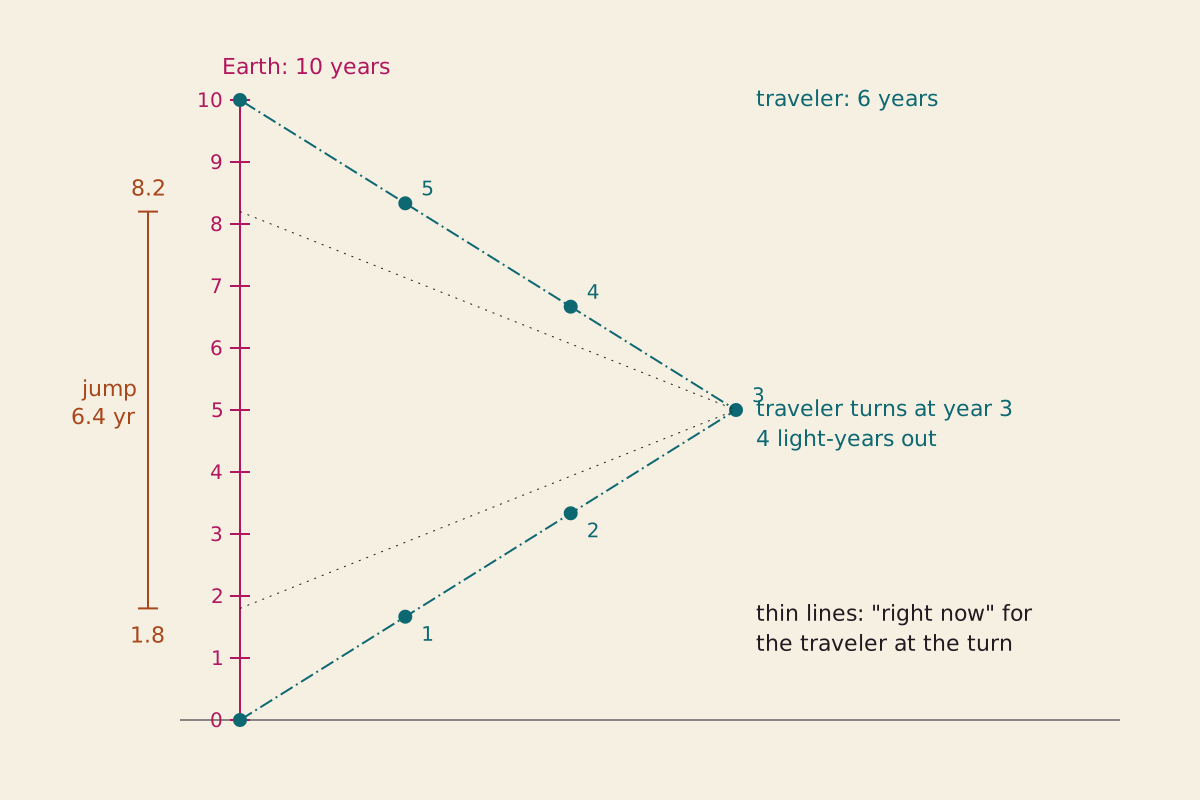
Our spacetime diagram of the trip, drawn from the table above. Time runs up and distance runs right. The thin lines show what “right now” means to the traveler just before and just after the turn.
"Spacetime diagram of the round trip at 80 percent of light speed" by The What-If Observatory, https://whatifobservatory.com/paradoxes/twin-paradox/, licensed under CC BY 4.0 (https://creativecommons.org/licenses/by/4.0/)
Data: Einstein 1905, Annalen der Physik 17
Step 4: count the light. Here is a check with no frame switch, in which each twin sends a flash once a year by their own clock. Einstein's Doppler formula, in section 7 of the same paper, cuts the rate to one third while the two separate, and the reverse case triples it while they approach. Seeing: hazy for the totals, which share the sharp turn, though the formula itself is clear.
| Who counts | Flashes at one third the rate | Flashes at triple the rate | Total |
|---|---|---|---|
| Traveler, counting Earth's | 3 years: 1 flash | 3 years: 9 flashes | 10 |
| Earth, counting the traveler's | 9 years: 3 flashes | 1 year: 3 flashes | 6 |
You can count this asymmetry. The traveler sees the rate change at the halfway point of the trip, while Earth sees it only at year 9, because light from the turn needs 4 years to arrive.
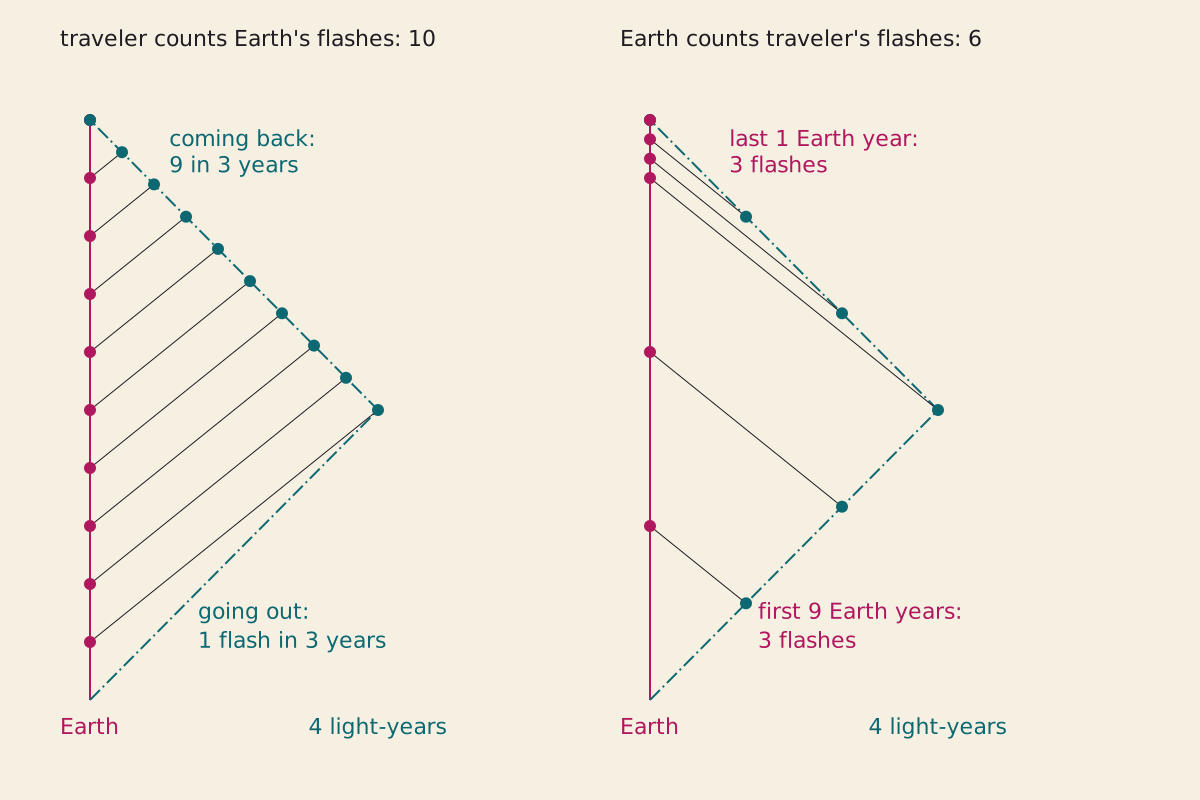
Yearly flashes on the same trip, traced ray by ray. The left panel shows Earth's flashes reaching the traveler. The right panel shows the traveler's flashes reaching Earth.
"Yearly light flashes on the round trip" by The What-If Observatory, https://whatifobservatory.com/paradoxes/twin-paradox/, licensed under CC BY 4.0 (https://creativecommons.org/licenses/by/4.0/)
Data: Einstein 1905, Annalen der Physik 17
Does the acceleration cause the gap?
Not on our sums, though acceleration does mark which twin is which.
Step 5: price the turn. Swap the instant turn for a steady 1 g felt aboard, the pull you feel standing still, at the standard 9.80665 meters per second squared, and each change between rest and 80 percent of light speed takes 1.29 Earth years and 1.06 traveler years. A trip has four such legs, and the turn accounts for two of them. Seeing: hazy, because the 1 g is our number and it moves the result.
| Trip, Earth years | Legs at 1 g | Traveler's clock, years | Gap, years |
|---|---|---|---|
| 10 | none, instant turn | 6.00 | 4.00 |
| 10 | turn only | 6.58 | 3.42 |
| 10 | all four | 7.16 | 2.84 |
| 20 | all four | 13.16 | 6.84 |
| 100 | all four | 61.16 | 38.84 |
The four legs add a fixed 1.16 years to the traveler's clock on any trip long enough to fit them, which takes at least 5.17 Earth years. The gap keeps growing with the cruise, from 2.84 years to 38.84, while the legs stay the same size.
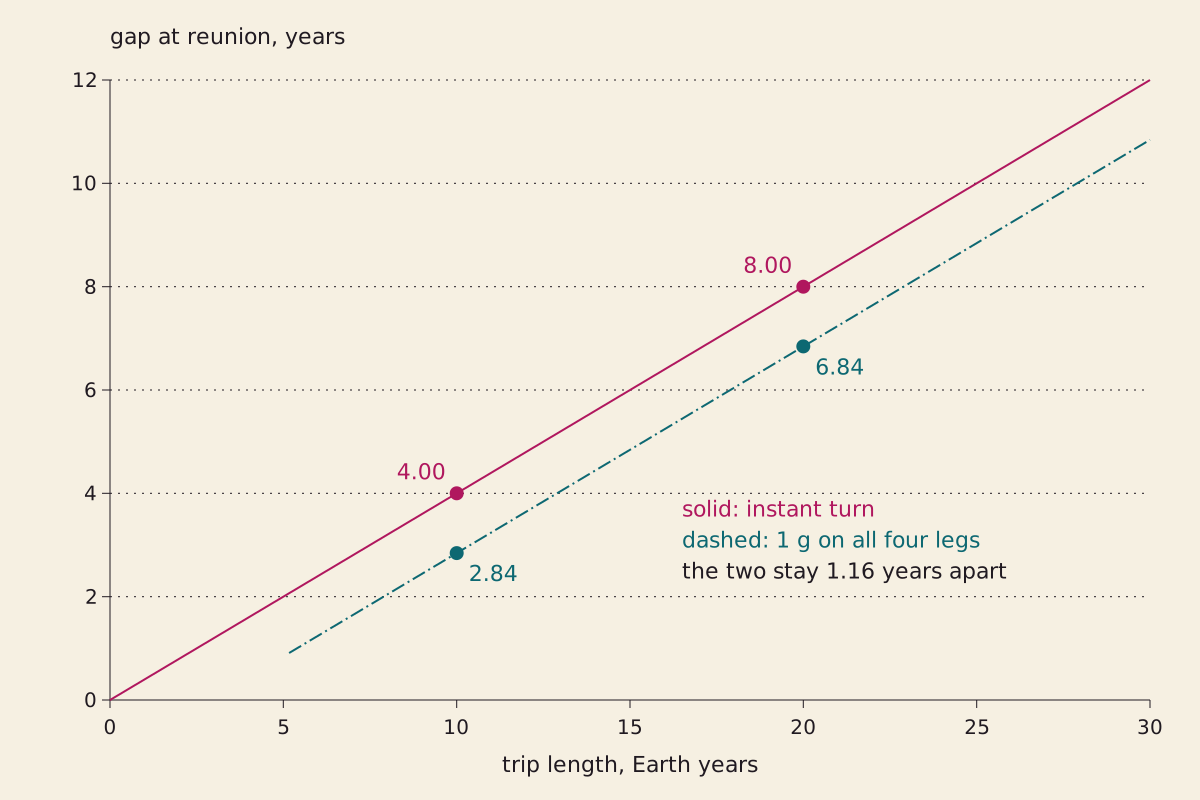
The gap against trip length at 80 percent of light speed. Both lines climb at the same slope, because the cruise sets the slope.
"Gap at reunion against trip length, with and without 1 g legs" by The What-If Observatory, https://whatifobservatory.com/paradoxes/twin-paradox/, licensed under CC BY 4.0 (https://creativecommons.org/licenses/by/4.0/)
Data: Einstein 1905, Annalen der Physik 17; NIST CODATA 2022 and SP 811
That still leaves room to argue about how to explain the gap, so we credit each position, as with Schrödinger's cat, and do not name a winner.
| Position | Held by | What breaks the tie | Read in |
|---|---|---|---|
| Unequal frames | Einstein's “Relativist,” 1918 | Only non-accelerated frames count as equal, and the traveler's is not one | Weinstein |
| The accelerated one | Langevin, 1911 | The one “most strongly accelerated” ages less | Weinstein |
| An accelerometer | The usual resolution, per Wortel, Malin, Semon, 2007 | The traveler changes frames, and an accelerometer can tell the twins apart | Wortel et al. |
| No tie to break | Herbert Dingle, from 1956 | The twins are symmetrical, so they end up the same age | Alizzi et al. |
| Acceleration not needed | Luise Lange, 1927; Lord Halsbury, 1957 | A clock reading handed to an observer passing the other way gives the same gap | Alizzi et al. |
| Two routes | Hermann Bondi | Like two motorists on different roads | Alizzi et al. |
| Two paths | Alizzi, Sen, Silagadze, 2022 | A straight path through spacetime has the longest clock time; acceleration only marks a bent one | Alizzi et al. |
Bondi's line, as Alizzi and colleagues quote it, fits our table: “although the extra length is due to the curves it does not lie in the curves.” Those authors call the paradox “trivial” (p. 22) from a spacetime view, and they add that in a closed space both twins can coast the whole way while the ages still differ.
Who told it first?
Not Einstein, if you mean twins. His 1905 paper never uses the word. It has synchronized clocks at points A and B, and it calls the result an “eigentümliche Konsequenz,” a peculiar consequence in our translation. It then sends one of two clocks around a closed curve “bis sie wieder nach A zurückkommt,” until it comes back to A, and that clock arrives behind the one that stayed.
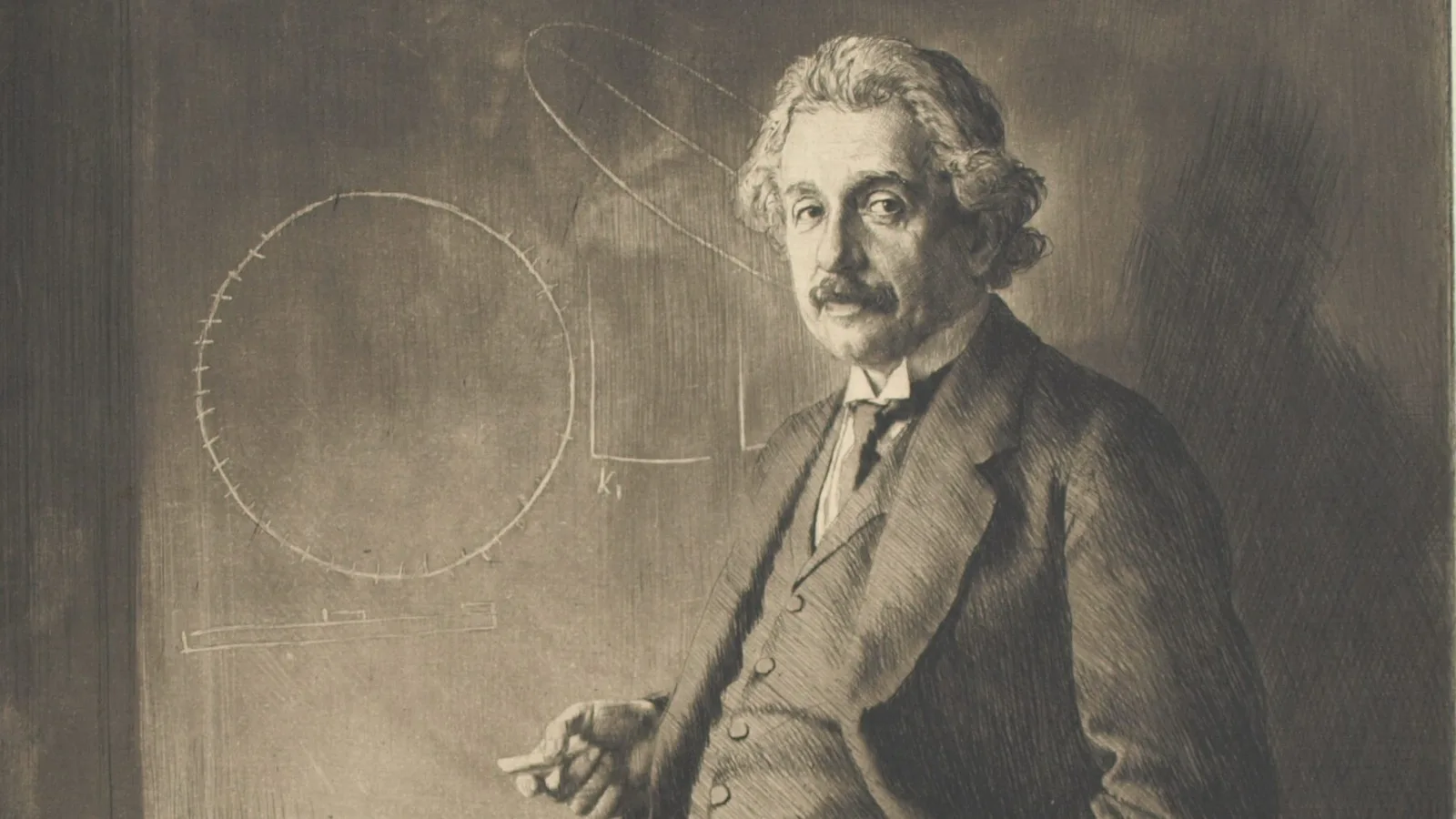
Albert Einstein in 1921, 16 years after the clock paper, in an etching by Ferdinand Schmutzer. It is shown here for the history only.
Albert Einstein, etching by Ferdinand Schmutzer, 1921, Ferdinand Schmutzer (Public Domain Mark 1.0)
"Albert Einstein, etching by Ferdinand Schmutzer, 1921" by Ferdinand Schmutzer — https://commons.wikimedia.org/wiki/File:Albert_Einstein,_Etching_by_Ferdinand_Schmutzer_1921.jpg — Public domain in the US (published 1921) and in the EU (author died 1928, life+70); faithful reproduction of a two-dimensional work; modified: cropped to 16:9, keeping the whole head, the chalk drawings on the blackboard and the hand; the margin, the signature, the edition mark and the lower part of the figure removed, downsized to 1800 px wide, card view shows this 16:9 crop

Paul Langevin added a person in a 1911 lecture in Bologna, asking who would “dedicate two years of his life” to see Earth two hundred years on, as Alizzi and colleagues quote him in English (p. 21). Weinstein quotes the condition, a speed within one twenty-thousandth of light's, and we get a factor of 100.00 at that limit, which matches his 2 years and at least 200. Seeing: hazy, because we read him secondhand.
Our two history sources part ways on who wrote of twins first: Weinstein says Langevin's humans were the “twins” and that he spoke of the “Twin Paradox” (p. 2). Alizzi and colleagues say Weyl was probably first to mention twins, and that none of the three called the effect a paradox.
The Langevin passage Weinstein quotes has a traveler and no twin. We read neither Langevin's nor Weyl's own text, so both readings stand.
Both sources do agree on the clocks. “Einstein considered two clocks, not twins,” Alizzi and colleagues write (p. 21). They trace the paradox label to the writing of Henri Bergson, who attended Langevin's lecture and argued with Einstein in Paris in 1922. Weinstein has Einstein speaking of a clock paradox later on, so the name's history stays unsettled too.
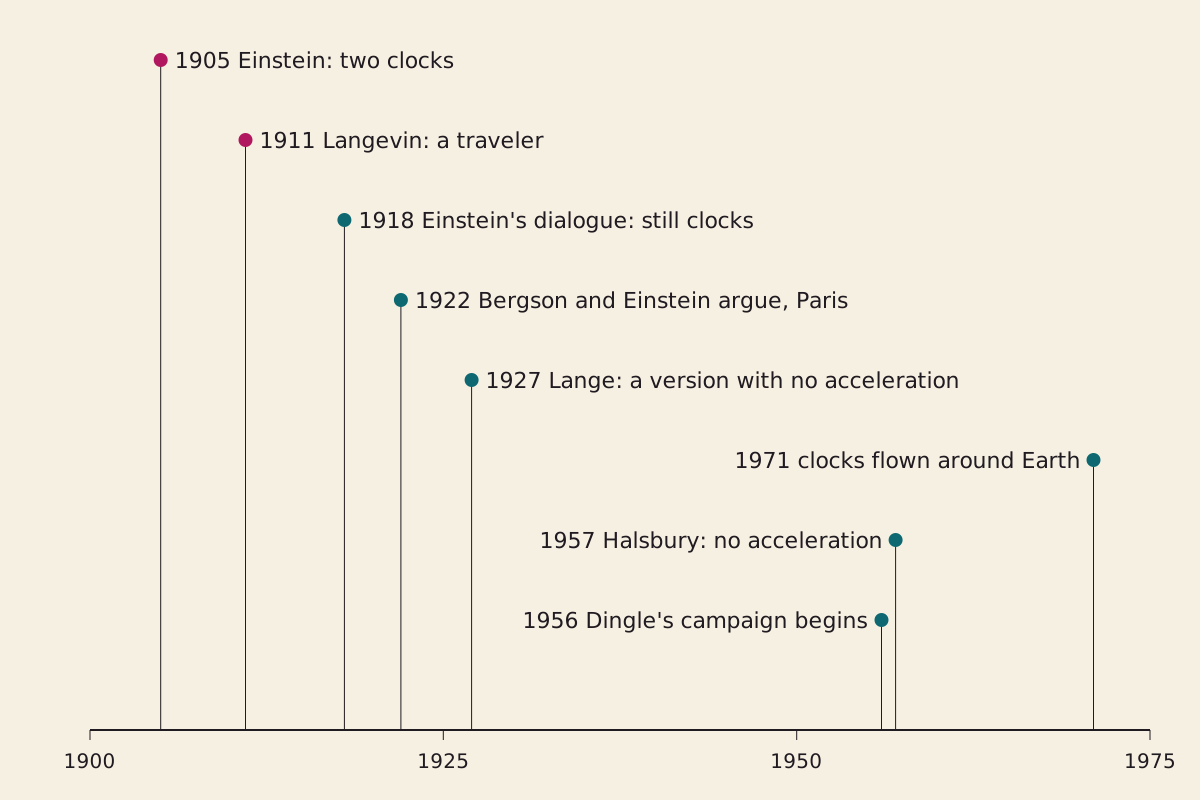
Eight dates in the story, as the papers we read report them. Weyl has no point on it, because we read no date for his mention of twins.
"From two clocks to a named paradox, 1905 to 1971" by The What-If Observatory, https://whatifobservatory.com/paradoxes/twin-paradox/, licensed under CC BY 4.0 (https://creativecommons.org/licenses/by/4.0/)
Data: Einstein 1905, Annalen der Physik 17; Weinstein 2012, arXiv:1205.0922; Alizzi, Sen and Silagadze 2022, arXiv:2209.12654; Wortel, Malin and Semon 2007, arXiv:gr-qc/0703090
Has it been measured?
Yes for clocks, on looped paths. The sources we read report no flown twin and no straight round trip. A 2007 paper by Stephanie Wortel, Shimon Malin and Mark Semon notes that the usual experiments do not move clocks along straight lines, and that they resemble what is called a “circular twin paradox.” We read all of the results below in that paper, not in the originals.
Step 6: the readings. Seeing: hazy, because they reach us secondhand and the paths differ from our trip.
| Experiment | Clock | Prediction | Result | Read in |
|---|---|---|---|---|
| Hay and colleagues, 1960 | Cobalt-57 on a rotor, up to 500 turns a second | Time dilation | Agreed within 2 percent uncertainty | Wortel et al., 2007 |
| Hafele and Keating, flown 1971, westward | Four cesium clocks on airliners; prediction includes a height effect | 275 ± 21 ns | 273 ± 7 ns | Wortel et al., 2007 |
| Hafele and Keating, flown 1971, eastward | Four cesium clocks on airliners; prediction includes a height effect | −40 ± 23 ns | −59 ± 10 ns | Wortel et al., 2007 |
| Bailey and colleagues | Muons in a storage ring, at about 0.9994 of light speed | Time dilation | Agreed within 0.1 percent uncertainty | Wortel et al., 2007 |
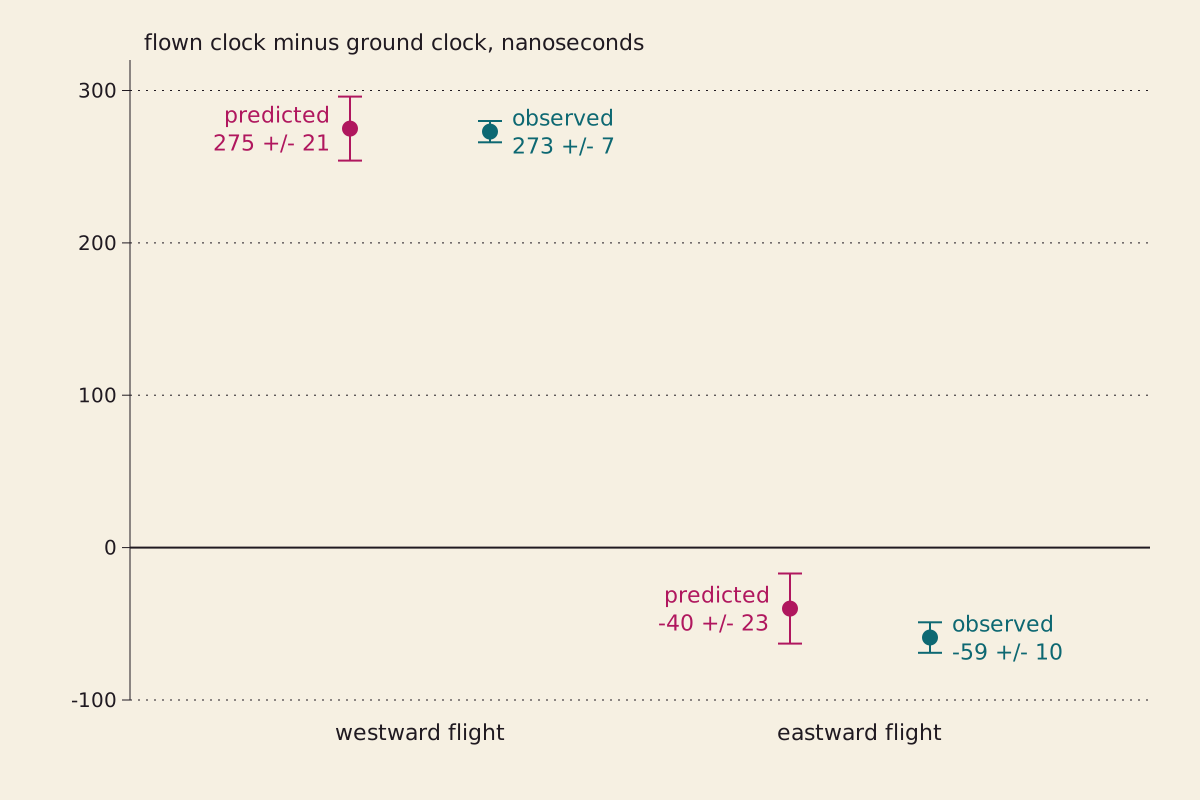
The flown-clock results from the table, with their stated uncertainties. A plus sign means the flown clock gained on the ground clock. The predictions include a height effect from general relativity.
"Hafele and Keating: predicted and observed clock differences, as reported in 2007" by The What-If Observatory, https://whatifobservatory.com/paradoxes/twin-paradox/, licensed under CC BY 4.0 (https://creativecommons.org/licenses/by/4.0/)
Data: Wortel, Malin and Semon 2007, arXiv:gr-qc/0703090
The sign is the surprise. The clocks flown west came back ahead of the ground clock, so flying alone is not what makes a clock lag. Wortel and colleagues explain it from a viewpoint above the North Pole, where the ground clock is itself moving with Earth's spin.
The muons test the ideal-clock assumption, since they felt about 10^18 times the pull of gravity and their rate still followed speed alone, within 0.1 percent.
Step 7: from clocks to bodies. We assume a body ages at the rate its clock runs, although Weinstein suggests Einstein may have left the biology of observers outside his theory's scope. The readings we have come from clocks and muons, so this step stays Seeing: hazy.
Where we stop
Step 8: the bill. Section 10 of the 1905 paper gives kinetic energy, the energy of motion, as (γ − 1) times mass times V², where γ is 1 over our 0.6. At 80 percent of light speed that is two thirds of a ship's rest energy, or 5.992 × 10^16 joules per kilogram, before any losses. Seeing: clear, for that floor only.
The ratio is the safe part, as it is with the Moon at half its distance, and the same goes for rooms on paper in Hilbert's Hotel, where a table checks only what it can list.
The dotted line falls before step 9, which asks whether any ship could fly this trip. No input on this page says how to carry that energy, shield a crew or hold 1 g for years. From here on, we are guessing.
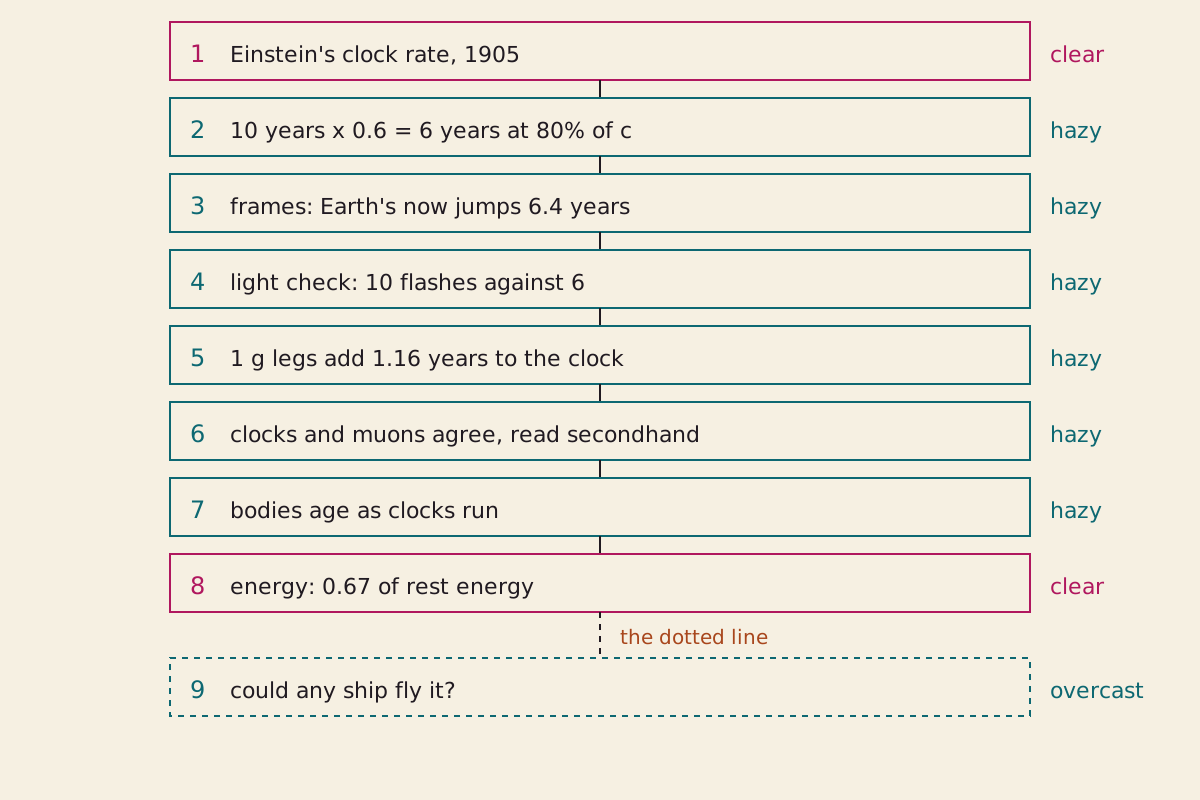
The chain behind this page. Step 1 rests on Einstein's formula. Steps 2 to 7 add our setup, our own number and secondhand readings. Step 8 is a floor, and step 9 sits past the dotted line.
"Twin paradox chain, step by step" by The What-If Observatory, https://whatifobservatory.com/paradoxes/twin-paradox/, licensed under CC BY 4.0 (https://creativecommons.org/licenses/by/4.0/)
Data: Einstein 1905, Annalen der Physik 17; Weinstein 2012, arXiv:1205.0922; Alizzi, Sen and Silagadze 2022, arXiv:2209.12654; Wortel, Malin and Semon 2007, arXiv:gr-qc/0703090; NIST CODATA 2022 and SP 811
So the 4-year gap sits above that line, and any real ship sits below it, at Seeing: overcast.
Check my math:
| Step | Input | Value | Unit | Source no. | Source | Recomputed | Seeing |
|---|---|---|---|---|---|---|---|
| 1 | Rate of a moving clock, seen from the rest system | formula | — | 1 | primary | no | clear |
| 2 | Chosen cruising speed | 0.8 | share of light speed | — | site assumption | no | hazy |
| 2 | Chosen trip length on Earth | 10 | years | — | site assumption | no | hazy |
| 2 | Chosen time for the turn and for each change of speed | 0 | years | — | site assumption | no | hazy |
| 2 | Clock rate at 80 percent of light speed | 0.6000 | ratio | 1 | primary | yes | clear |
| 2 | Traveler's clock over the trip | 6.00 | years | 1 | site assumption | yes | hazy |
| 2 | Gap at reunion | 4.00 | years | 1 | site assumption | yes | hazy |
| 2 | Einstein's short form at 80 percent of light speed | 3.20 | years | 1 | site assumption | yes | hazy |
| 2 | Factor at the limit of a speed within one twenty-thousandth of light | 100.00 | ratio | 1, 2 | secondary | yes | hazy |
| 2 | Voyager 1 asymptotic speed, relative to the solar system center of mass | 16.6048 | km/s | 8 | primary | no | clear |
| 2 | Speed of light | 299,792.458 | km/s | 6 | primary | no | clear |
| 2 | Voyager 1 clock lag per unit time | 1.534 × 10^-9 | ratio | 1, 6, 8 | primary | yes | clear |
| 2 | Lag over a non-stop galaxy crossing at that speed | 2.77 | years | 1, 6, 8 | site assumption | yes | hazy |
| 3 | Earth's clock read in the outbound frame at the turn | 1.8 | years | 1 | site assumption | yes | hazy |
| 3 | Earth's clock read in the inbound frame at the turn | 8.2 | years | 1 | site assumption | yes | hazy |
| 3 | Jump in the Earth time the traveler calls now, on switching frames | 6.4 | years | 1 | site assumption | yes | hazy |
| 4 | Doppler factor for receding parties | 0.3333 | ratio | 1 | primary | yes | clear |
| 4 | Earth's flashes the traveler counts | 10 | flashes | 1 | site assumption | yes | hazy |
| 4 | Traveler's flashes Earth counts | 6 | flashes | 1 | site assumption | yes | hazy |
| 5 | Standard acceleration of free fall | 9.80665 | m/s2 | 7 | primary | no | clear |
| 5 | One 1 g leg to 80 percent of light speed, Earth years | 1.2916 | years | 6, 7 | site assumption | yes | hazy |
| 5 | One 1 g leg to 80 percent of light speed, traveler years | 1.0642 | years | 6, 7 | site assumption | yes | hazy |
| 5 | Traveler's clock, 10-year trip, 1 g during the turn only | 6.58 | years | 1, 6, 7 | site assumption | yes | hazy |
| 5 | Traveler's clock, 10-year trip, 1 g on all four legs | 7.16 | years | 1, 6, 7 | site assumption | yes | hazy |
| 5 | Traveler's clock, 20-year trip, 1 g on all four legs | 13.16 | years | 1, 6, 7 | site assumption | yes | hazy |
| 5 | Traveler's clock, 100-year trip, 1 g on all four legs | 61.16 | years | 1, 6, 7 | site assumption | yes | hazy |
| 5 | Shortest trip that fits all four legs | 5.17 | years | 6, 7 | site assumption | yes | hazy |
| 5 | Years the four legs add on any trip long enough to fit them | 1.16 | years | 1, 6, 7 | site assumption | yes | hazy |
| 6 | Hafele and Keating westward, predicted | 275 ± 21 | ns | 4, 5 | secondary | no | hazy |
| 6 | Hafele and Keating westward, observed | 273 ± 7 | ns | 4 | secondary | no | hazy |
| 6 | Hafele and Keating eastward, predicted | −40 ± 23 | ns | 4, 5 | secondary | no | hazy |
| 6 | Hafele and Keating eastward, observed | −59 ± 10 | ns | 4 | secondary | no | hazy |
| 6 | Hay and colleagues 1960, predicted against measured | 2 | percent uncertainty | 4 | secondary | no | hazy |
| 6 | Bailey and colleagues, predicted against measured | 0.1 | percent uncertainty | 4 | secondary | no | hazy |
| 7 | A body ages at the rate its clock runs | — | — | 2, 4 | site assumption | no | hazy |
| 8 | Kinetic energy at 80 percent of light speed, as a share of rest energy | 0.6667 | ratio | 1 | primary | yes | clear |
| 8 | Kinetic energy per kilogram at that speed | 5.992 × 10^16 | joules per kilogram | 1, 6 | primary | yes | clear |
| 9 | Whether any ship could fly this trip | — | — | — | site assumption | no | overcast |
Download twin-paradox-check-my-math.csv (where its values come from) Data: Einstein 1905, Annalen der Physik 17; Weinstein 2012, arXiv:1205.0922; Wortel, Malin and Semon 2007, arXiv:gr-qc/0703090; NIST CODATA 2022 and SP 811; Bailer-Jones and Farnocchia 2019, arXiv:1912.03503
Download twin-paradox-table.csv (where its values come from) Data: Einstein 1905, Annalen der Physik 17
Years here are Julian years of 365.25 days, units were checked, and the computed numbers in the text were compared with the CSV. The 1 g legs were checked by stepping the motion numerically as well as by formula.
Next question:
- How many years would a galaxy crossing take? The Fermi paradox
- What if every room is taken? Hilbert's Hotel
Sources
- Albert Einstein (1905). “Zur Elektrodynamik bewegter Körper.” Annalen der Physik (ser. 4) 17, 891–921; the clock passage is section 4, p. 904. Original Read: chapter-level reading of the German text: sections 4, 7 and 10.
- Galina Weinstein (2012). “Einstein's Clocks and Langevin's Twins.” arXiv:1205.0922. Original Read: preprint, full text; quoted passages at pp. 2, 3, 4.
- Abdaljalel Alizzi, Abhijit Sen, Zurab K. Silagadze (2022). “Do moving clocks slow down?” arXiv:2209.12654; Eur. J. Phys. 43 (2022), 065601, per the abstract page. Original Read: preprint, full text; quoted passages at pp. 21, 22.
- Stephanie Wortel, Shimon Malin, Mark D. Semon (2007). “Two Examples of Circular Motion for Introductory Courses in Relativity.” arXiv:gr-qc/0703090. Original Read: preprint, full text; quoted phrase at p. 1, reported results at pp. 4, 5; the journal version has a 2008 erratum (Am. J. Phys. 76, 595) that we have not read.
- J. C. Hafele, R. E. Keating (1972). “Around-the-world atomic clocks: Predicted relativistic time gains.” Science 177, 166–168. Original Read: bibliography only; the figures come through Wortel, Malin and Semon 2007.
- National Institute of Standards and Technology. “CODATA Value: speed of light in vacuum” (2022 CODATA recommended values). Original Read: value page, last read 2026-10-07.
- National Institute of Standards and Technology. NIST Guide to the SI, Appendix B.8: Factors for Units Listed Alphabetically (Special Publication 811). Original Read: single value via the appendix table: foot, yard, standard acceleration of free fall.
- Coryn A. L. Bailer-Jones, Davide Farnocchia (2019). “Future stellar flybys of the Voyager and Pioneer spacecraft.” Research Notes of the American Astronomical Society 3:59; extended version, arXiv:1912.03503. Original Read: preprint (extended version), Table 1 and its notes.
- European Southern Observatory. “Adaptive Optics.” Original Read: full page. Text license: CC BY 4.0.
Cite this page
The What-If Observatory. "Twin Paradox: Einstein’s 1905 Version Had Clocks, Not Twins." Published 2026-11-09. https://whatifobservatory.com/paradoxes/twin-paradox/. Add the date you read it.
Corrections
None so far.