Schrödinger’s Cat: The Odds Are Easy. What They Mean Is Not
The What-If Observatory Published
In 1935 Erwin Schrödinger offered his cat as an absurd case that quantum theory permits. In this thought experiment, a sample is so small that within an hour one atom might decay or, at even odds, none, in J. D. Trimmer's translation as Anthony Sudbery quotes it. A decay kills the cat, so after the hour the theory writes the cat as alive and dead in equal parts. Even odds set an effective one-hour half-life for the first decay, but no sum says what that means before anyone looks.
Steps in this reading (7)
- Suppose:
- a sealed steel chamber holds a cat, a Geiger counter and a very small radioactive sample.
- Hold fixed:
- one hour, even odds of a decay, and nothing else disturbing the chamber.
Winter: Cat on a Cushion, a color lithograph by Théophile-Alexandre Steinlen, 1909. It came 26 years before the paper and has nothing to do with physics.
"Winter: Cat on a Cushion" by Théophile-Alexandre Steinlen — https://commons.wikimedia.org/wiki/File:Winter-_Cat_on_a_Cushion_MET_DP242969.jpg — CC0 1.0 (https://creativecommons.org/publicdomain/zero/1.0/); modified: cropped to 16:9, keeping the whole head and ears; the lower sheet, the printed signature and the printer's line removed

The arithmetic is short, and we can check it. What it means is another matter, so this page marks where one stops and the other starts. Each step carries a Seeing mark, a word taken from astronomy for how much moving air disturbs a view. Here it rates how much weight a step can bear: clear, hazy or overcast.
What did Schrödinger actually set up?
A cat, a counter and a very small sample, as far as we could read. We could not read his 1935 paper in Naturwissenschaften or Trimmer's 1980 English translation directly. We read the passage as Sudbery quotes it in a 2017 lecture, so every quotation from the paper on this page comes through him.
The passage counts this setup among the “quite ridiculous cases” (p. 4) one can set up. Its terms are these:
- A cat is “penned up in a steel chamber.”
- A Geiger counter holds a “tiny bit of radioactive substance.”
- In one hour, one atom may decay or, “with equal probability, perhaps none.”
- A decay fires the counter, and a relay sets off a device that kills the cat.
- The whole system is left to itself for the hour.
The passage names no isotope and gives no atom count. It also says chamber, not box, though Sudbery's own lecture says box. Seeing: hazy. We have the terms secondhand, and his wording can be read more than one way, as the half-life section shows.
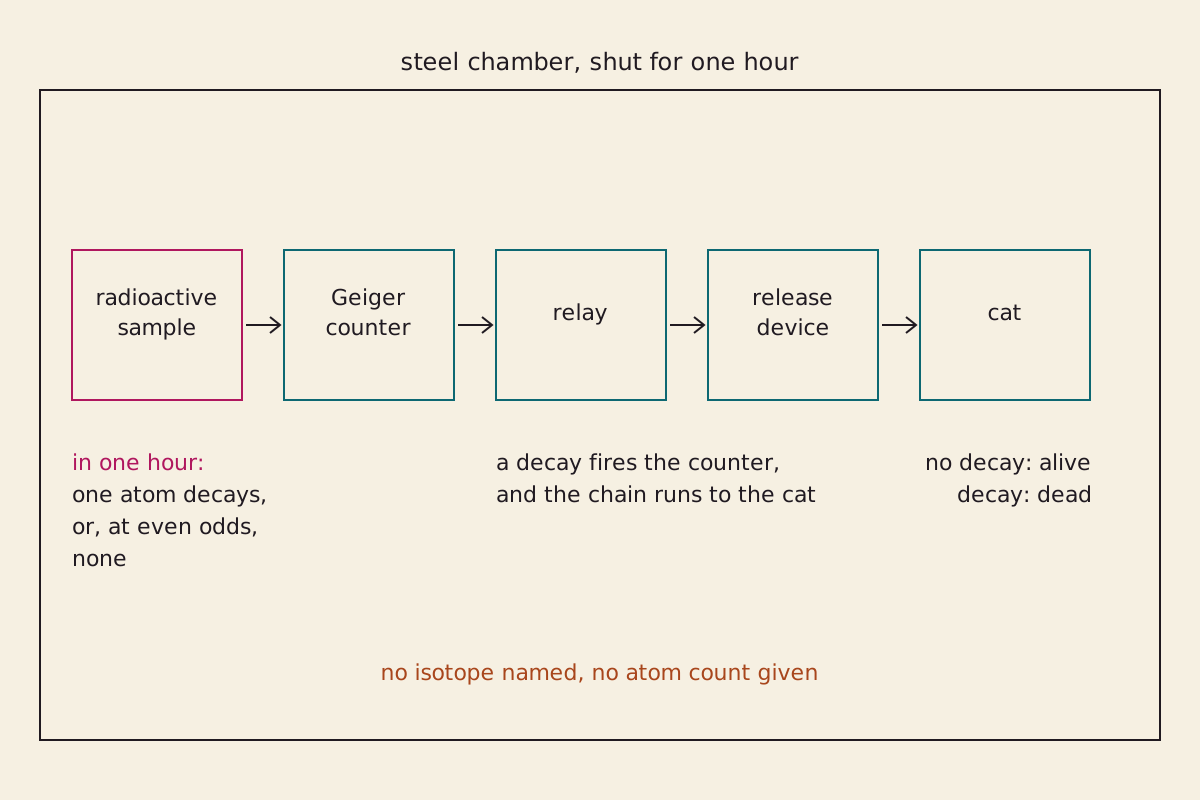
The parts in the order the passage gives them. This is our schematic, not a plan of anything built, and nothing in it is to scale.
"Schrödinger's stated setup as a chain of parts" by The What-If Observatory, https://whatifobservatory.com/paradoxes/schrodingers-cat/, licensed under CC BY 4.0 (https://creativecommons.org/licenses/by/4.0/)
Data: Sudbery 2017, arXiv:2309.06387 (the quoted passage)
Why one hour?
Because one hour at even odds fixes the whole curve. A half-life is the time a radioactive sample takes to lose half its atoms, and a 1986 US Geological Survey report by G. Brent Dalrymple gives the rule behind it.
The chance that an atom decays in a given time “is exactly the same for all atoms” (Dalrymple, p. 6), and each one decays independently. We assume the unnamed substance is a single isotope, so that rule covers all of it. Seeing: hazy.
So the chance of no decay falls by the same fraction in every equal stretch of time. Half after one hour means a quarter after two. As a formula, the chance of no decay by time t is 2^(−t/1 h), the curve of a one-hour half-life, for the first decay only. Seeing: hazy, since the even odds reach us secondhand and the isotope is our assumption.
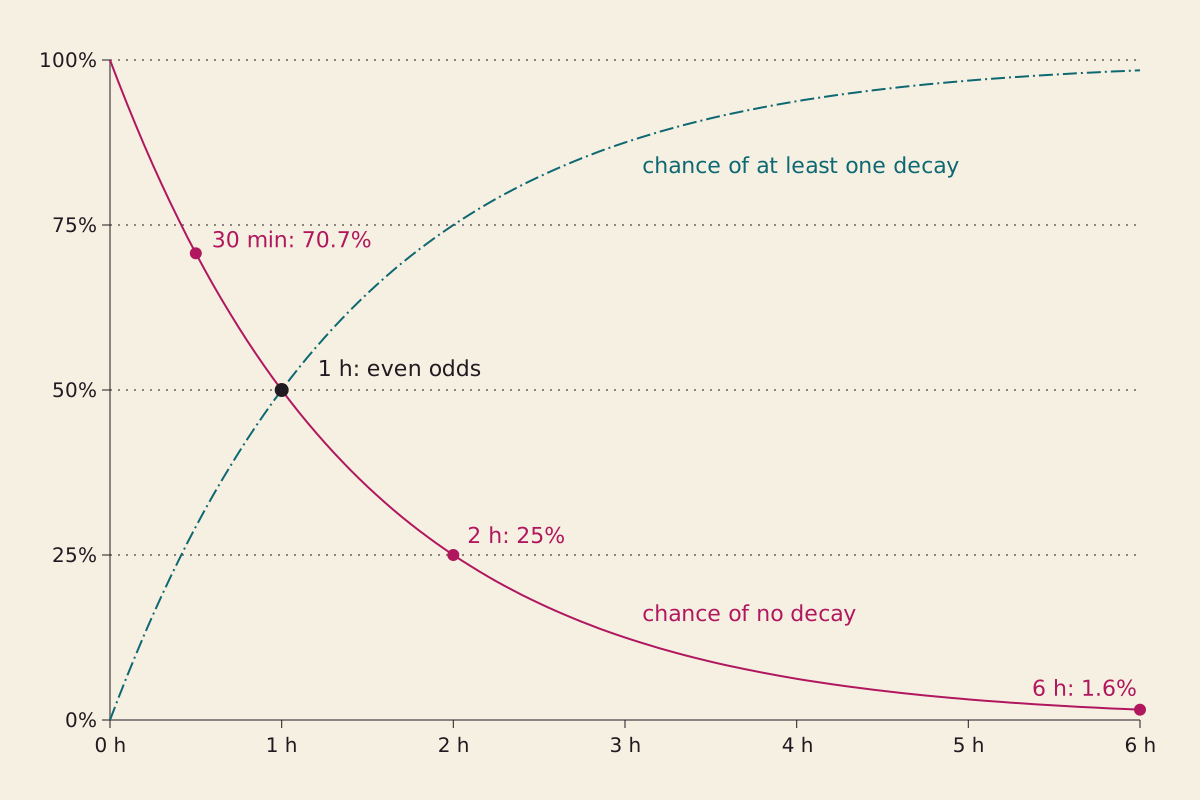
The chance of no decay and the chance of at least one decay in Schrödinger's sample, if the odds are even at one hour. The two curves cross at exactly that point.
"Chance of no decay against time for the whole sample" by The What-If Observatory, https://whatifobservatory.com/paradoxes/schrodingers-cat/, licensed under CC BY 4.0 (https://creativecommons.org/licenses/by/4.0/)
Data: Sudbery 2017, arXiv:2309.06387 (even odds in one hour); Dalrymple 1986, USGS (decay rule)
How long before a decay is nearly certain?
At even odds in one hour, about 6.64 hours gets a decay to 99 percent. A full day leaves a 1 in 16,777,216 chance of no decay at all.
| Time shut | Chance of no decay | Chance of at least one decay |
|---|---|---|
| 30 minutes | 70.7% | 29.3% |
| 1 hour | 50% | 50% |
| 2 hours | 25% | 75% |
| 6.64 hours | 1% | 99% |
| 24 hours | 1 in 16,777,216 | nearly 100% |
These odds belong to this stated setup only. Seeing: hazy.
Whose half-life is it?
The sample's first decay. An atom's own half-life matches it only in a one-atom sample.
Dalrymple notes that an atom's half-life is a constant and “is not related to the number of atoms present” (p. 9). Schrödinger's hour is a different quantity: the even-odds time for the first decay anywhere in the sample. Add atoms and that time shrinks, so the hour fixes only a ratio of half-life to atoms.
A sample of N atoms meets Schrödinger's terms if each atom has a half-life of N hours. After N hours that sample can still be expected to keep half its atoms, so the one-hour figure is an effective half-life for the first decay only. Both 8,766 atoms with a 1-year half-life and 8,766,000 atoms with a 1,000-year half-life qualify. Those half-lives are our examples, not his.
Taken strictly, his wording lists one atom or none, and that holds exactly only for a sample of one atom. Larger samples add a third outcome, two or more decays, which reaches 15.3 percent. The cat's odds do not change, because the first decay settles them.
There is another strict reading: exactly one decay as likely as none. In a large sample that puts the chance of none at 36.8 percent, not 50. We use even odds for the cat because the passage ends on “equal parts.” That choice moves the numbers, so Seeing: hazy.
| Atoms in the sample | Half-life of each | No decay | Exactly one | Two or more |
|---|---|---|---|---|
| 1 | 1 hour | 50% | 50.0% | 0% |
| 2 | 2 hours | 50% | 41.4% | 8.6% |
| 10 | 10 hours | 50% | 35.9% | 14.1% |
| 8,766 | 1 year | 50% | 34.7% | 15.3% |
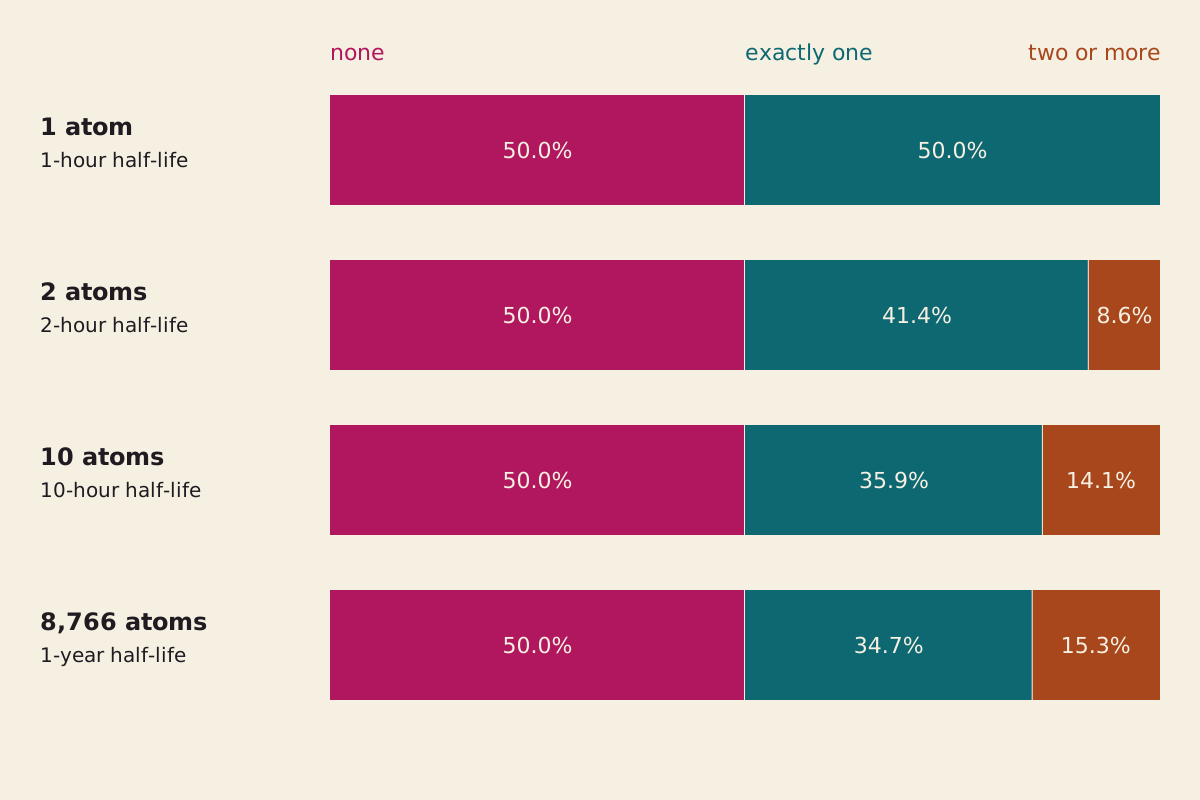
Decays in the hour for four samples, each built so the chance of none stays at 50 percent. Only the split among the other outcomes moves.
"Decays in the hour for samples of different sizes, at even odds of none" by The What-If Observatory, https://whatifobservatory.com/paradoxes/schrodingers-cat/, licensed under CC BY 4.0 (https://creativecommons.org/licenses/by/4.0/)
Data: Sudbery 2017, arXiv:2309.06387 (even odds in one hour); Dalrymple 1986, USGS (decay rule)
What was he objecting to?
The theory's reach. On Sudbery's account, if quantum mechanics governs all matter, it governs cats, and a state of here and a state of there can add to form a third state. Applied to the chamber, Schrödinger wrote, the theory has “the living and the dead cat (pardon the expression) mixed or smeared out in equal parts” (p. 4). Sudbery's reading is that Schrödinger regards this consequence of orthodox quantum mechanics as “ridiculous.”
Even “smeared” was loose, Sudbery says. In the same paper Schrödinger insists that “a shaky or out-of-focus photograph” differs from “a snapshot of clouds and fog banks” (p. 5). Sudbery adds that the paper was prompted by the one from Einstein, Podolsky and Rosen, and that it introduced the word entanglement.
Schrödinger's view did not stay put, on Sudbery's telling. He quotes Schrödinger in 1955, citing the Dublin Seminars published in 1996: “I really do believe that the wave function (of the universe) is all that there is” (p. 9). Sudbery concludes that Schrödinger anticipated the many-worlds reading Hugh Everett published in 1957. We did not read those seminars, so that verdict is Sudbery's.
Our page on the twin paradox also starts from what its first text says.
In papers, the cat started slowly. By Sudbery's count, only 26 people mentioned it in a scientific paper in its first 40 years, though he says that may reflect citing habits, since the idea was well known by 1975. In 2016, the year before his lecture, 119 papers had it in the title.
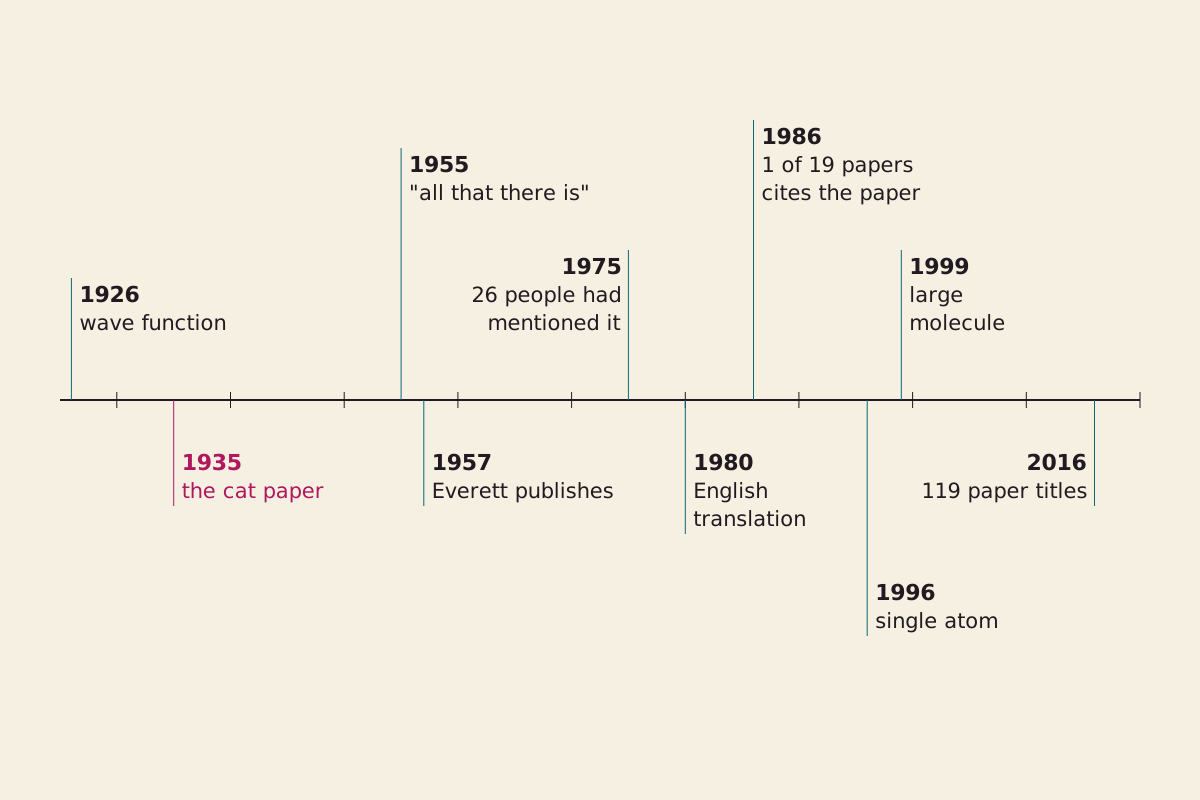
Ten dates in the cat's history, all as Sudbery's lecture reports them. The counts are his, and we did not repeat them.
"The cat's history as one lecture reports it" by The What-If Observatory, https://whatifobservatory.com/paradoxes/schrodingers-cat/, licensed under CC BY 4.0 (https://creativecommons.org/licenses/by/4.0/)
Data: Sudbery 2017, arXiv:2309.06387
| Year | As Sudbery's lecture reports it |
|---|---|
| 1926 | Schrödinger explains quantum mechanics in terms of a wave function |
| 1935 | Schrödinger's paper tells the story of the cat |
| 1955 | Schrödinger says the wave function “is all that there is” |
| 1957 | Everett publishes the idea later called many worlds |
| 1975 | 26 people have mentioned the cat in a scientific paper since 1935; the count may reflect citing habits |
| 1980 | The English translation of the 1935 paper appears |
| 1986 | A centenary symposium has 19 papers, and only John Bell's cites the cat paper; the year is in doubt, as noted below |
| 1996 | Wineland's group makes a superposition state of a single atom |
| 1999 | Zeilinger's group does it with a large molecule |
| 2016 | 119 papers have “Schrödinger's cat” in the title |
Sudbery's 1986 is in doubt. The proceedings he cites are dated 1987, and a 2024 commentary by Tuck C. Choy recalls a Schrödinger centenary at Imperial College in 1987. We could not read the proceedings, so we leave his year in his list and lean toward 1987.
Has anyone done it with a real cat?
Not as of our latest reading. “Nobody has done it with a cat (yet),” Sudbery said in 2017 (p. 12). What labs build are smaller relatives: an object cut off from everything else, in a superposition, the sum of states described above. He lists a single atom from Wineland's group in 1996, a large molecule from Zeilinger's group three years later, and a 2010 proposal aimed at living things.
A real cat would be hard to cut off. Sudbery says such a state cannot in practice appear on its own, because a cat keeps getting entangled with air molecules and radiation. Entangled means two things no longer have separate definite states, only linked ones.
He adds that an observer who opens the chamber never sees a blend either. The theory gives a live cat with a glad observer, plus a dead cat with a sad one.
A Cat Curled Up, Sleeping, a pencil drawing by Édouard Manet, who died in 1883. No chamber and no counter, just a cat.
"A Cat Curled Up, Sleeping" by Édouard Manet — https://commons.wikimedia.org/wiki/File:A_Cat_Curled_Up,_Sleeping_MET_1995.493.jpg — CC0 1.0 (https://creativecommons.org/publicdomain/zero/1.0/)

Is the cat really alive and dead?
The question assumes the plus sign in that sum means “and.” Sudbery's point, drawn from the two-slit experiment, is that it cannot mean “or” and surely does not mean “and.” So before any table, here is what we assume:
- The chamber starts with no decay, and the chance of no decay then follows the one-hour curve above.
- The chamber is sealed, with no entanglement with anything outside.
- Only the Schrödinger equation acts during the hour, with no collapse.
- All decay times are lumped into one label, “decay, dead.” The other label is “no decay, alive.”
- A label's weight is the square of its amplitude, and the weight gives the odds of finding that label.
- Phases are ignored.
Under those six assumptions, and only those, the state is a sum of two labels with amplitudes a and b:
| Time shut | Weight, no decay, alive | Weight, decay, dead | a | b |
|---|---|---|---|---|
| 0 | 1 | 0 | 1.000 | 0.000 |
| 30 minutes | 0.707 | 0.293 | 0.841 | 0.541 |
| 1 hour | 0.5 | 0.5 | 0.707 | 0.707 |
| 2 hours | 0.25 | 0.75 | 0.500 | 0.866 |
| 6 hours | 0.016 | 0.984 | 0.125 | 0.992 |
The 1-hour row is Schrödinger's “equal parts.” The table gives weights and does not say what the state is. Seeing: hazy.
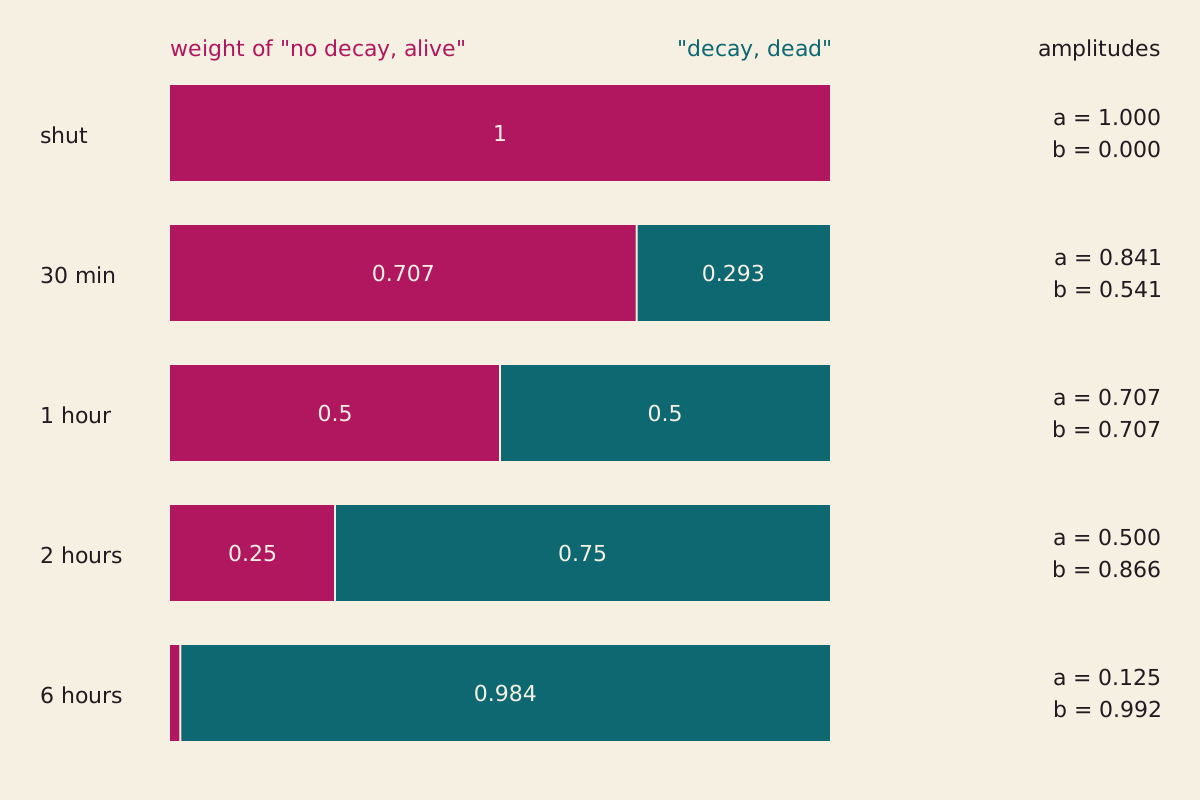
The table above as bars. Each row follows only from the listed assumptions and does not settle what the state is.
"State weights and amplitudes over time, under the assumptions listed on the page" by The What-If Observatory, https://whatifobservatory.com/paradoxes/schrodingers-cat/, licensed under CC BY 4.0 (https://creativecommons.org/licenses/by/4.0/)
Data: Sudbery 2017, arXiv:2309.06387 (even odds; weights as squared amplitudes); Dalrymple 1986, USGS (decay rule)
Which answers do people give?
Here are five, each credited to whoever holds it. A survey by Peter J. Lewis in the Internet Encyclopedia of Philosophy does not discuss the cat, so fitting its Copenhagen and hidden-variable rows to the chamber is our step.
| Position | Held by | Before anyone looks | Read in |
|---|---|---|---|
| Copenhagen | Bohr, Heisenberg, 1920s | The state does not describe the cat. It sums up what to expect from a measurement. | Lewis; fitted to the cat by us |
| Many worlds | Everett 1957, though the talk of worlds may not be his; popularized by DeWitt 1971 | Both outcomes occur, in separate branches. | Lewis, Sudbery |
| Hidden variables | Bohm 1952 | Added variables pick out one outcome as the actual one. | Lewis, Bassi et al.; fitted to the cat by us |
| Spontaneous collapse | Ghirardi, Rimini, Weber 1986 | An added collapse process leaves a large object with one outcome. | Lewis, Bassi et al. |
| Truth values | Sudbery 2017 | One world. The whole sum is true, and “cat alive” has a truth value between 0 and 1. | Sudbery |
Lewis notes that it is not clear Everett himself endorsed the talk of worlds. A 2023 review by Angelo Bassi, Mauro Dorato and Hendrik Ulbricht calls Bohm's theory and collapse models different theories, not strictly interpretations. It also says that, among formulations and interpretations of non-relativistic quantum mechanics, only collapse models “have experimental consequences” (abstract). That is their claim, in a review focused on collapse models.
We do not pick a winner. Our habit is narrower: check what the question assumes, then say which parts the numbers can reach.
Where we stop
Every reading through step 6 has a source or a stated assumption. A page like how many people have ever lived can test its number against a second road. This page has none, because the setup handed us the odds.
The dotted line falls before step 7, which asks what the state is before anyone looks. Sudbery said in 2017 that the measurement problem, the puzzle of what a measurement does to that state, “still has no generally accepted solution” (p. 8), and Lewis treats the choice among interpretations as an open question. From here on, we are guessing.
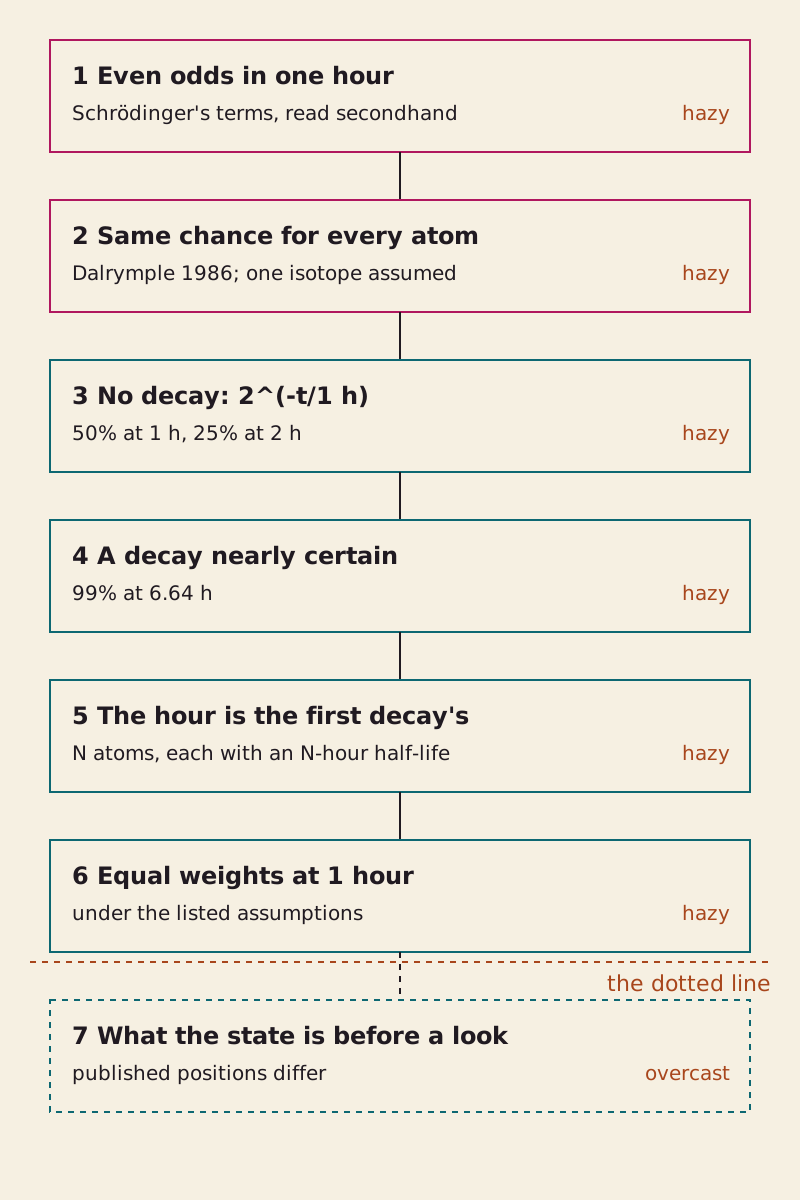
The chain behind this page. Steps 1 to 6 rest on named sources and stated assumptions. Step 7 sits past the dotted line.
"Schrödinger's cat chain, step by step" by The What-If Observatory, https://whatifobservatory.com/paradoxes/schrodingers-cat/, licensed under CC BY 4.0 (https://creativecommons.org/licenses/by/4.0/)
Data: Sudbery 2017, arXiv:2309.06387; Dalrymple 1986, USGS
So the one-hour curve sits above that line. What the chamber holds before it opens sits below it. Seeing: overcast.
Check my math:
| Step | Input | Value | Unit | Source no. | Source | Recomputed | Seeing |
|---|---|---|---|---|---|---|---|
| 1 | Chance of no decay in the stated window | 0.5 | probability | 1 | secondary | no | hazy |
| 1 | Stated window | 1 | hour | 1 | secondary | no | hazy |
| 2 | Same decay chance for all atoms, each independent | rule | — | 2 | secondary | no | hazy |
| 3 | Sample decay rate: ln 2 ÷ 1 hour | 0.6931 | per hour | 1, 2 | secondary | yes | hazy |
| 3 | No decay after 30 minutes | 70.71 | percent | 1, 2 | secondary | yes | hazy |
| 3 | No decay after 2 hours | 25.00 | percent | 1, 2 | secondary | yes | hazy |
| 4 | Time to a 99 percent chance of decay | 6.64 | hours | 1, 2 | secondary | yes | hazy |
| 4 | Chance of no decay after 24 hours, as 1 in 2^24 | 16,777,216 | 1 in N | 1, 2 | secondary | yes | hazy |
| 5 | Atoms needed at a 1-year half-life | 8,766 | atoms | 2 | site assumption | yes | hazy |
| 5 | Atoms needed at a 1,000-year half-life | 8,766,000 | atoms | 2 | site assumption | yes | hazy |
| 5 | Exactly one decay, many atoms: ln 2 ÷ 2 | 34.7 | percent | 1, 2 | site assumption | yes | hazy |
| 5 | Two or more decays, many atoms | 15.3 | percent | 1, 2 | site assumption | yes | hazy |
| 5 | No decay if exactly one decay and none are equally likely, many atoms: 1/e | 36.8 | percent | 1 | site assumption | yes | hazy |
| 6 | Weight of each label at 1 hour | 0.5 | weight | 1 | secondary | yes | hazy |
| 6 | Amplitude of each label at 1 hour | 0.7071 | amplitude | 1 | secondary | yes | hazy |
| 7 | What the state is before anyone looks | — | — | 1, 4 | secondary | no | overcast |
Download schrodingers-cat-check-my-math.csv (where its values come from) Data: Sudbery 2017, arXiv:2309.06387; Dalrymple 1986, USGS; Bassi, Dorato and Ulbricht 2023, arXiv:2310.14969 (step 7, cited, no value taken)
Download schrodingers-cat-survival.csv (where its values come from) Data: Sudbery 2017, arXiv:2309.06387; Dalrymple 1986, USGS
Units were checked, and the computed numbers in the text were compared with the same recalculation behind the CSV. Sudbery's dates and counts were not recomputed. Years here are Julian years of 365.25 days.
Next question:
- What if a hotel never fills? Hilbert's Hotel
- What if one twin leaves? The twin paradox
Sources
- Anthony Sudbery. “The life and entangled adventures of Schrödinger's cat.” Lecture given 10 June 2017; arXiv:2309.06387, 2023. Original Read: preprint v2, full text; quoted passages on pp. 4, 5, 8, 9, 11 and 12. Text license: CC BY 4.0.
- G. Brent Dalrymple. “Radiometric Dating, Geologic Time, And The Age Of The Earth: A Reply To ‘Scientific’ Creationism.” U.S. Geological Survey Open-File Report 86-110, 1986. Original Read: section on the fundamentals of radiometric dating, quoted passages on pp. 6 and 9 of the report, last read 2026-11-08.
- Peter J. Lewis. “Interpretations of Quantum Mechanics.” Internet Encyclopedia of Philosophy. Original Read: chapter-level reading: introduction and the sections on these positions, restated, not reproduced.
- Angelo Bassi, Mauro Dorato, Hendrik Ulbricht (2023). “Collapse Models: a theoretical, experimental and philosophical review.” arXiv:2310.14969. Original Read: preprint, abstract (p. 1, quoted), part of the introduction (p. 3) and the passages on the GRW model.
- Erwin Schrödinger (1935). “Die gegenwärtige Situation in der Quantenmechanik.” Naturwissenschaften 23, 807. English translation by J. D. Trimmer, 1980, reprinted in Wheeler and Zurek (eds.), Quantum Theory and Measurement, 1983. Original Read: bibliography only; the passage read as quoted by Sudbery.
- European Southern Observatory. “Adaptive Optics.” Original Read: full page. Text license: CC BY 4.0.
- Tuck C. Choy (2024). “Commentary on Peierls's ‘In defence of “measurement”’.” arXiv:2411.07359v2. Original Read: preprint v2, the sentence on p. 3 recalling the Schrödinger centenary at Imperial College in 1987.
Cite this page
The What-If Observatory. "Schrödinger’s Cat: The Odds Are Easy. What They Mean Is Not." Published 2026-11-09. https://whatifobservatory.com/paradoxes/schrodingers-cat/. Add the date you read it.
Corrections
None so far.