Hilbert’s Hotel: In Cantor’s Terms, Full Can Still Take More
The What-If Observatory Published
In the winter of 1924–25, David Hilbert lectured on a full hotel that could still take a guest. Hilbert's Hotel has one room for each counting number, and when everyone moves from room n to room n+1, room 1 comes free. Hilbert left the story out of his writings, and it became better known through George Gamow's 1947 book, according to Helge Kragh's history. The moves hold on paper if the rooms form a completed set, but whether such a hotel could ever exist is still disputed.
Steps in this reading (7)
- Suppose:
- a hotel with one room for each counting number is full.
- Hold fixed:
- one guest per room, nobody leaves, and all guests move at once, in no time.
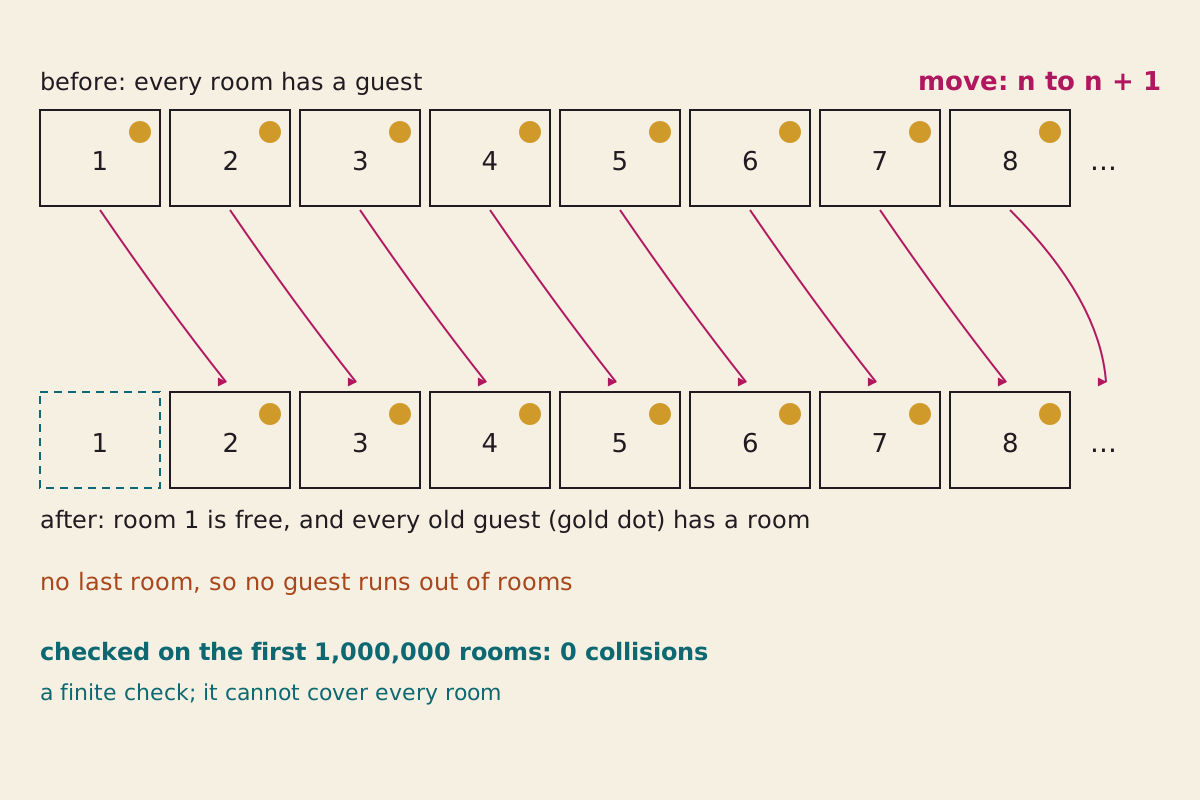
Hilbert's first move, drawn for eight rooms of an endless row. Our check covers a finite list of rooms, not every room.
"One new guest in a full hotel" by The What-If Observatory, https://whatifobservatory.com/paradoxes/hilberts-hotel/, licensed under CC BY 4.0 (https://creativecommons.org/licenses/by/4.0/)
Each step below carries a Seeing mark, a term borrowed from astronomy for how steadily the air holds an image. Here it rates how much weight a step can bear: clear, hazy or overcast.
How does a full hotel take one more?
Everyone moves up one room. In Hilbert's lecture, as Kragh quotes it, the manager need only make sure that “each of the old guests moves to a new room with the number one unit larger,” and room 1 is then empty for the newcomer (p. 730 of the 2013 edition of the lectures).
A five-room hotel cannot do this. The guest from room 5 would need a room 6 that does not exist, and so 1 guest is left over. Hilbert's hotel has no last room, which means it has no last guest to strand.
We ran the move on the first 1,000,000 rooms, and all 1,000,000 guests landed in different rooms while room 1 stayed empty. A run like that can only ever cover a finite list, however long the list gets.
Reaching every room takes a short proof, not a run. Each room number n has exactly one n+1, and two different rooms never send their guests to the same place. A hotel already full, with every guest moving at once, asks for more: it treats the rooms as a completed whole, an assumption some mathematicians reject, as a table further down shows. Seeing: hazy.
Infinitely many more?
Double every room number. Hilbert gave this move too, again as Kragh quotes it: the guest in room n goes to room 2n, which leaves “infinitely many rooms with odd numbers” free for the new arrivals. On the first 1,000,000 rooms we got 0 collisions and a highest room of 2,000,000, which leaves 1,000,000 odd rooms free up to that point.
The same proof carries the move to every room, and a full hotel asks for the same assumption. Seeing: hazy.
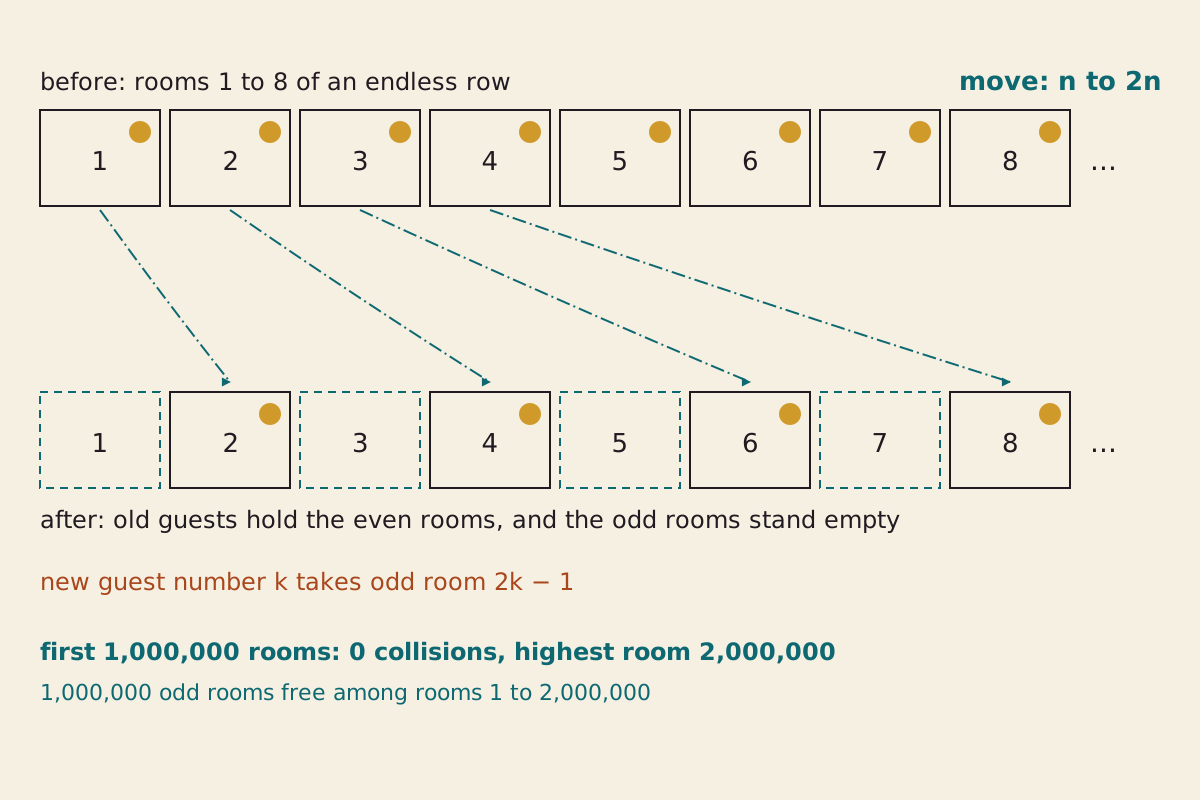
Hilbert's second move. After it, new guest number k can take odd room 2k − 1.
"Endless new guests in a full hotel" by The What-If Observatory, https://whatifobservatory.com/paradoxes/hilberts-hotel/, licensed under CC BY 4.0 (https://creativecommons.org/licenses/by/4.0/)
Any finite crowd can use the first move with a bigger step, as Hilbert also said. Take everyone counted on our page about how many people have ever lived: about 117 billion births through 2022, by a Population Reference Bureau model. Each old guest moves up 117 billion rooms, so the guest from room 1 lands in room 117,000,000,001. Seeing: hazy.
This table holds only under four assumptions: the rooms form a completed set, each room holds one guest, nobody leaves, and all moves happen at once.
| Who arrives | Move for old guests | Rooms freed | Left over, full five-room hotel | Left over, this hotel |
|---|---|---|---|---|
| 1 guest | n to n+1 | Room 1 | 1 guest | 0 |
| 7 guests | n to n+7 | Rooms 1 to 7 | 7 guests | 0 |
| About 117 billion guests | n to n + 117 billion | Rooms 1 to 117 billion | All of them | 0 |
| One guest per counting number | n to 2n | Every odd room | All of them | 0 |
| One guest per positive fraction | n to 2n, then walk the fractions | Every odd room | All of them | 0 |
| One guest per decimal between 0 and 1 | No move works | Not enough | All of them | At least 1, whatever the move |
What if a guest arrives for every fraction?
They all fit. Fractions look far more crowded than room numbers, because between any two of them sit endless others. Yet Martin Meyries, in a 2015 introduction to infinity, sets out Cantor's proof that the positive fractions can be put in a single list, which is all the hotel needs.
Write the positive fractions in a grid, then walk along its diagonals, skipping repeats such as 2/2, which is only 1/1 again. The walk runs 1/1, 1/2, 2/1, 3/1, 1/3, and on from there. Once doubling has emptied the odd rooms, fraction number k takes odd room 2k − 1.
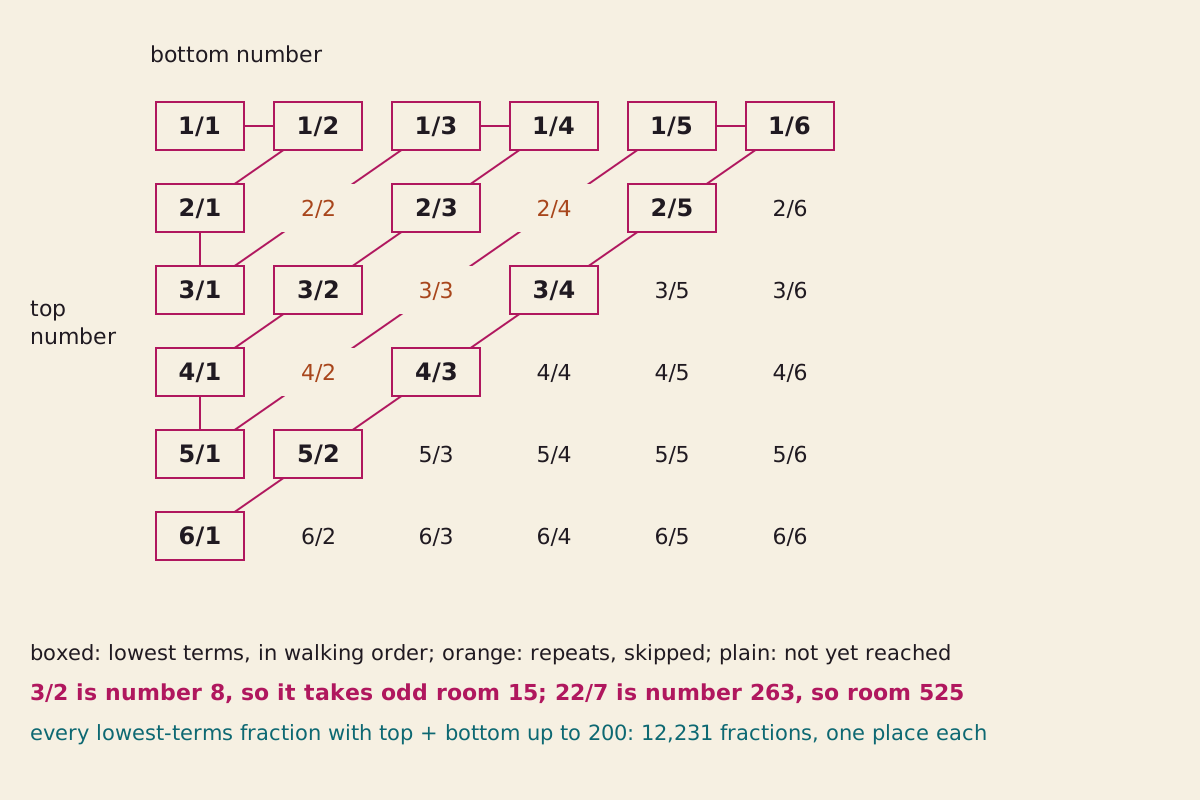
A walk through the positive fractions, in the order Meyries gives. Sending them to odd rooms is our own step.
"Walking the positive fractions along diagonals" by The What-If Observatory, https://whatifobservatory.com/paradoxes/hilberts-hotel/, licensed under CC BY 4.0 (https://creativecommons.org/licenses/by/4.0/)
So 3/2 is number 8 and takes room 15, while 22/7 is number 263 and takes room 525. A different walk would give different rooms.
Across all 12,231 lowest-terms fractions with a positive top and bottom that add up to 200 or less, every one got exactly one place, which is a statement about that finite list alone. Seeing: hazy.
Is every infinity the same size?
No, on Cantor's account. Bradley Dowden, writing in the Internet Encyclopedia of Philosophy, says the natural numbers, the even integers and the rational numbers can all be shown to have one size, and that the real numbers are larger. So one guest per decimal is the crowd this hotel cannot seat.
Meyries sets out the argument, which runs on any list at all. Match decimals to rooms, then build a new decimal by taking digit k of line k and adding 1, with 9 becoming 0. The result differs from every line in at least one digit, so it matches no line digit for digit.
One wrinkle his version skips, and this note is ours: a decimal ending in endless 9s equals another decimal, as 0.4999… equals 0.5, so a full proof has to rule that case out, for instance by never building a 0 or a 9.
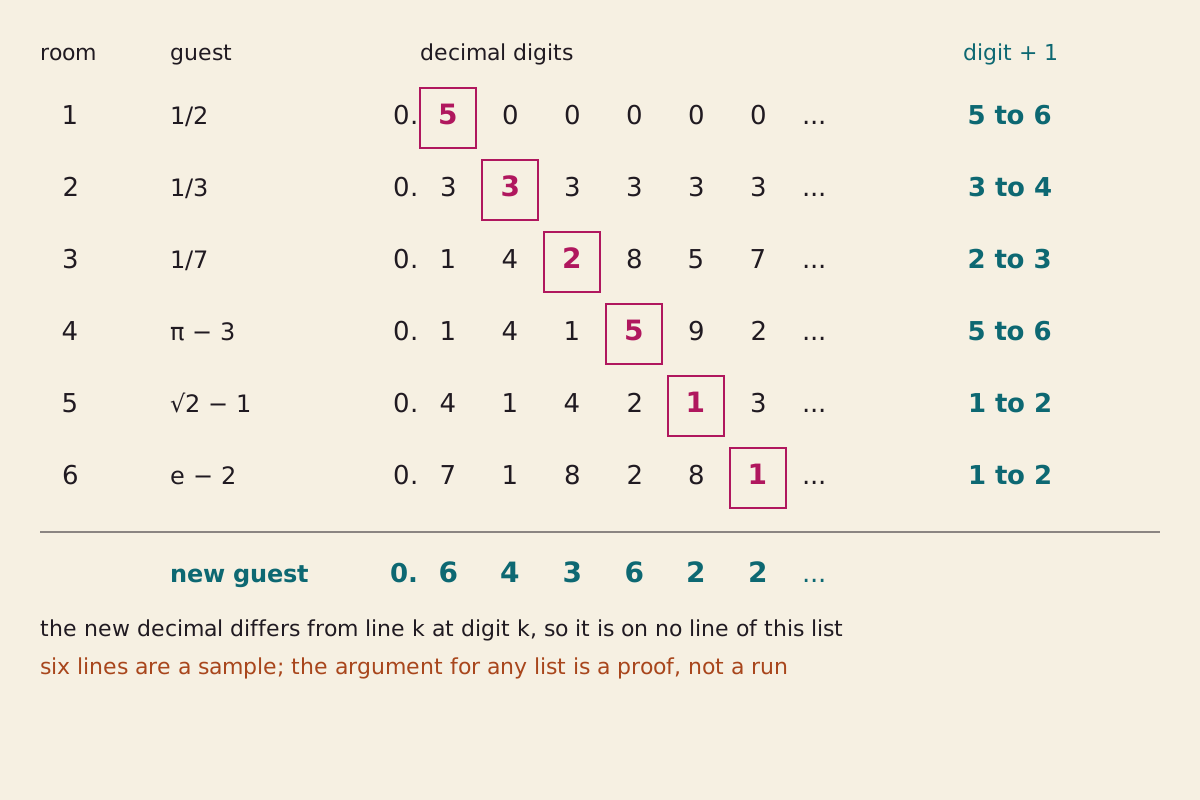
Our own six-line list, using the rule as Meyries sets it out. Six lines are a sample, and the same rule applies to any list.
"A decimal that a six-line list misses" by The What-If Observatory, https://whatifobservatory.com/paradoxes/hilberts-hotel/, licensed under CC BY 4.0 (https://creativecommons.org/licenses/by/4.0/)
| Room | Guest | First six digits | Digit on the diagonal | New digit |
|---|---|---|---|---|
| 1 | 1/2 | 0.500000 | 5 | 6 |
| 2 | 1/3 | 0.333333 | 3 | 4 |
| 3 | 1/7 | 0.142857 | 2 | 3 |
| 4 | π − 3 | 0.141592 | 5 | 6 |
| 5 | √2 − 1 | 0.414213 | 1 | 2 |
| 6 | e − 2 | 0.718281 | 1 | 2 |
Our six-line sample builds 0.643622.
The claim about every possible list is a proof rather than a run, and it again treats the rooms and the decimals as completed sets. Seeing: hazy.
Whose hotel was it?
Hilbert's, on the record Helge Kragh found, although Kragh himself first said otherwise. On March 1, 2014, he posted a paper titled “Gamow, not Hilbert,” and then Tilman Sauer told him about the lectures. The version of March 27 retracts that conclusion.
Hilbert told the story in a Göttingen lecture course during the winter semester of 1924–25. Lothar Nordheim, his assistant, wrote up the notes, and they reached print only in 2013. We could not read that edition, so every word from it here comes through Kragh.
The month is muddled, because Kragh's abstract and one later sentence say January 1924 while his section heading and conclusion say January 1925. A January inside a winter term of 1924–25 points to 1925, and that step is ours. Christoph Lamm writes 1924/25 and Petr Glivický writes 1924, so we print the term and leave the year of that January open. Seeing: hazy.
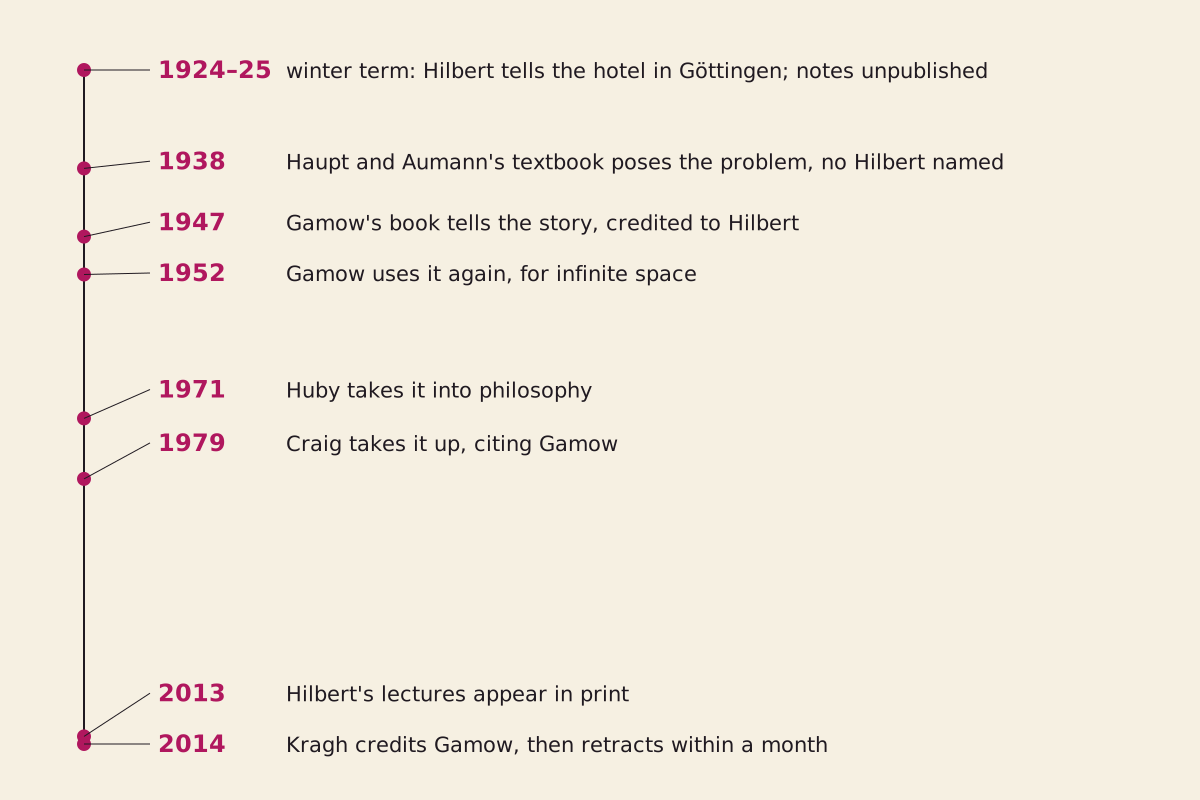
Eight dates in the hotel's history, all as Kragh reports them. We did not read the earlier works themselves.
"The hotel in lectures and in print" by The What-If Observatory, https://whatifobservatory.com/paradoxes/hilberts-hotel/, licensed under CC BY 4.0 (https://creativecommons.org/licenses/by/4.0/)
Data: Kragh 2014, arXiv:1403.0059 (dates)
The 1947 book, One, Two, Three … Infinity, called the hotel, as Kragh quotes it, “an example taken from one of the stories” about Hilbert (p. 17). Kragh sees little doubt that Gamow heard it in Göttingen in 1928, from Richard Courant or Nordheim, though that is his inference.
 Illustration
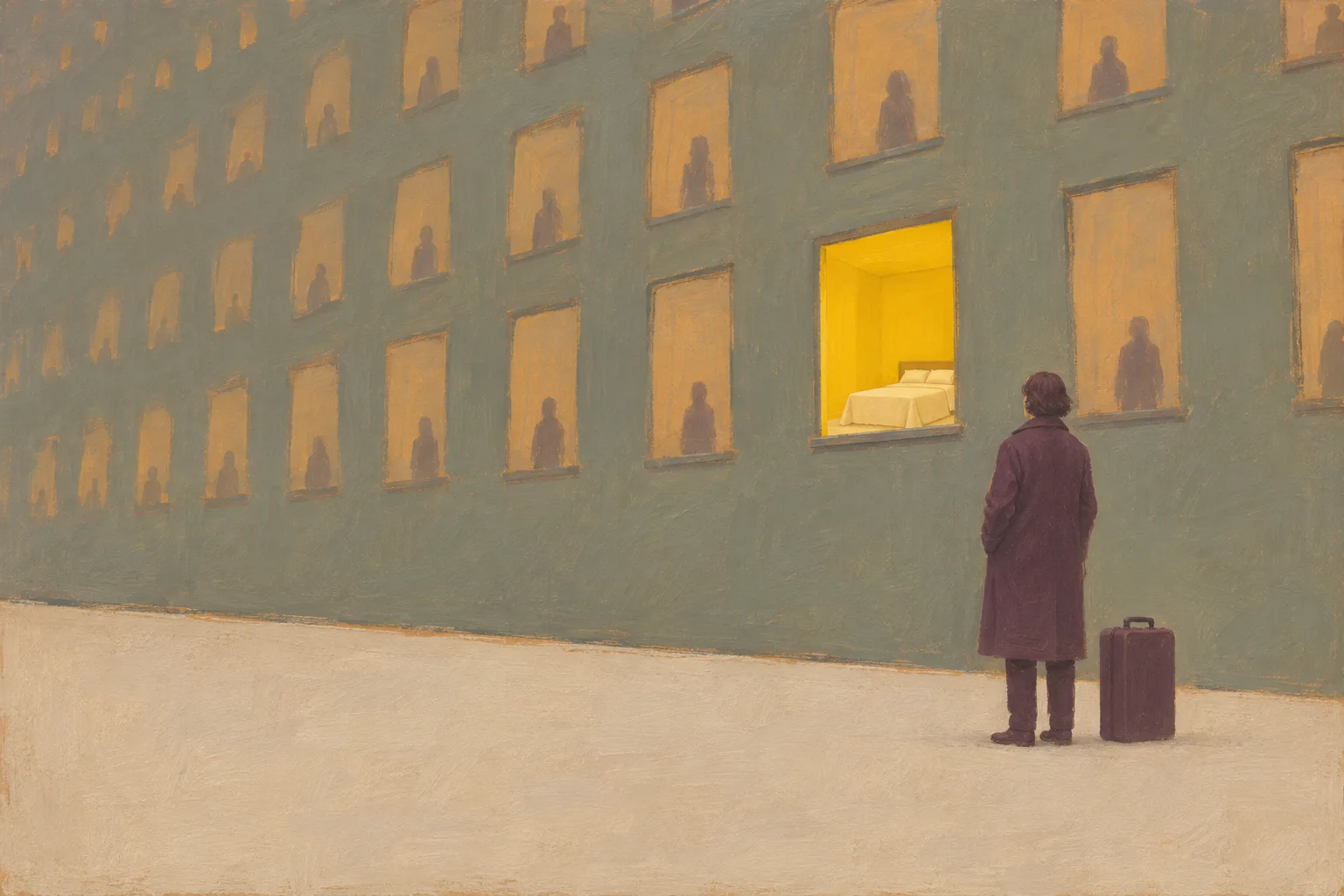
A hotel with no last room, full and still able to free one. This is an imagined scene, not any real building. Not to scale.
Illustration: The What-If Observatory. Generated schematic illustration — not a photograph or historical record. © The What-If Observatory, all rights reserved.
That book was not quite the first trace. A 1938 calculus textbook by Otto Haupt and Georg Aumann posed the problem without naming Hilbert, and it is the only earlier allusion Kragh knows. “Better known” also has limits, since Kragh says it took nearly three more decades for the hotel to draw wide interest.
| Year | As Kragh reports it |
|---|---|
| 1924–25 | Hilbert tells the hotel in Göttingen lectures; the notes stay unpublished |
| 1938 | Haupt and Aumann's textbook poses the problem, naming no Hilbert |
| 1947 | Gamow's book tells the story and credits Hilbert |
| 1952 | Gamow uses it again, to argue that infinite space can hold any amount of matter |
| 1971 | Pamela Huby takes it into philosophy |
| 1979 | William Lane Craig takes it up, citing Gamow |
| 2013 | Hilbert's lectures appear in print |
| 2014 | Kragh credits Gamow, then retracts within the month |
Could a real hotel do this?
The word doing the work is full.
In a finite hotel, “all rooms are occupied” and “there is no more space for new guests” are one fact. Kragh's summary is that in this hotel the first does not imply the second, and he calls the result strange but “not, strictly speaking, a paradox in the logical sense” (sec. 1).
So the question carries a habit over from finite hotels, where a part is always smaller than the whole. That difference is what Hilbert wanted from the story, Kragh says. Rooms 2, 3, 4 and onward are only part of the rooms, yet they hold everyone. That settles nothing about real buildings.
A real hotel would also lose “at once.” Relativity keeps physical objects under light speed in a vacuum, as Dowden notes. Einstein's 1905 paper goes further: speeds above light's have “keine Existenzmöglichkeit,” in our translation no possibility of existing (§ 10). The same limit runs through our page on the twin paradox.
Put rooms 10 meters apart, which is our own number, and send a notice down the hall at light speed.
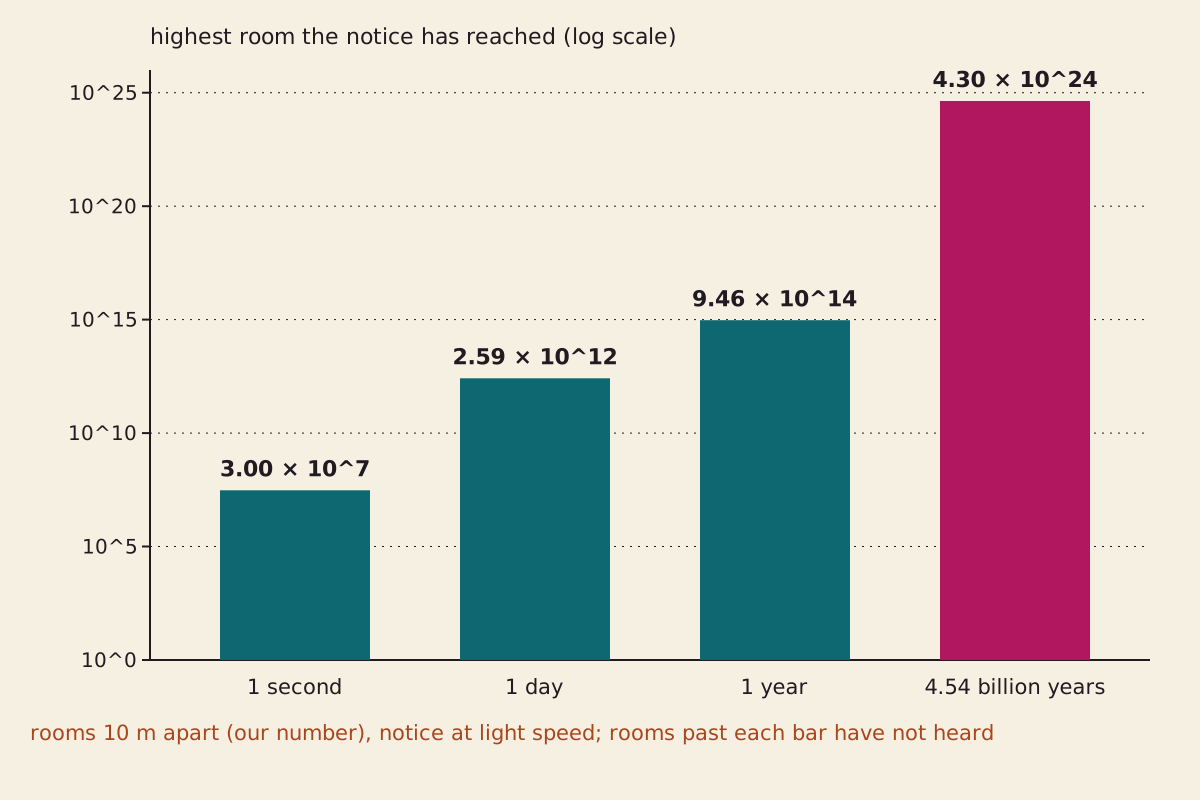
Rooms reached by a notice sent at light speed, with rooms 10 meters apart. Every room past each bar has not yet heard.
"How far a light-speed notice gets" by The What-If Observatory, https://whatifobservatory.com/paradoxes/hilberts-hotel/, licensed under CC BY 4.0 (https://creativecommons.org/licenses/by/4.0/)
Data: NIST CODATA 2022 (speed of light); USGS (age of the Earth)
| Time since the notice left | Highest room reached |
|---|---|
| 1 second | 3.00 × 10^7 |
| 1 day | 2.59 × 10^12 |
| 1 year | 9.46 × 10^14 |
| About 4.54 billion years, Earth's age by USGS, under 1 percent uncertain | About 4.30 × 10^24 |
After Earth's whole age, endless rooms still have not heard, and any other finite spacing ends the same way. Hold fixed said all guests move at once. That line does more work than it looks. Seeing: hazy.
Hilbert's own answer about real hotels was no, but he is only one of the people who answered. Here are the positions we could read, each credited to whoever holds it.
| Position | Held by | Does a completed infinity exist in nature? | Read in |
|---|---|---|---|
| Consistent mathematics | Georg Cantor | Kragh says he held the universe finite in time and space; Kateřina Trlifajová says he also accepted an actual infinity in created nature, such as monads | Kragh; Trlifajová |
| Mathematics only | Hilbert 1925 | “The infinity is nowhere to be found in reality” | Kragh |
| Real, for space | Gamow | He argued that space is infinite and can hold any amount of matter | Kragh |
| No completed set at all | L. E. J. Brouwer | The natural numbers cannot be built as a whole, so that set does not exist | Dowden |
| No completed set at all | Finitists | A rule makes each next numeral, and it never yields an actual infinity | Dowden |
| Absurd in any real sense | William Lane Craig | “Hilbert’s Hotel is absurd” | Kragh |
Kragh reports that Craig's use belongs to a theological argument about time, and that Landon Hedrick has criticized it. That dispute is outside this page, and we do not pick a winner either, since no sum here can.
Where we stop
Steps 1 to 7 rest on proofs under stated assumptions, sourced dates or a sum with one chosen number. Step 8 asks whether a completed infinity exists in nature.
The dotted line falls before step 8. No input here can decide that, much as no sum could say what Schrödinger's cat is before anyone looks. From here on, we are guessing.
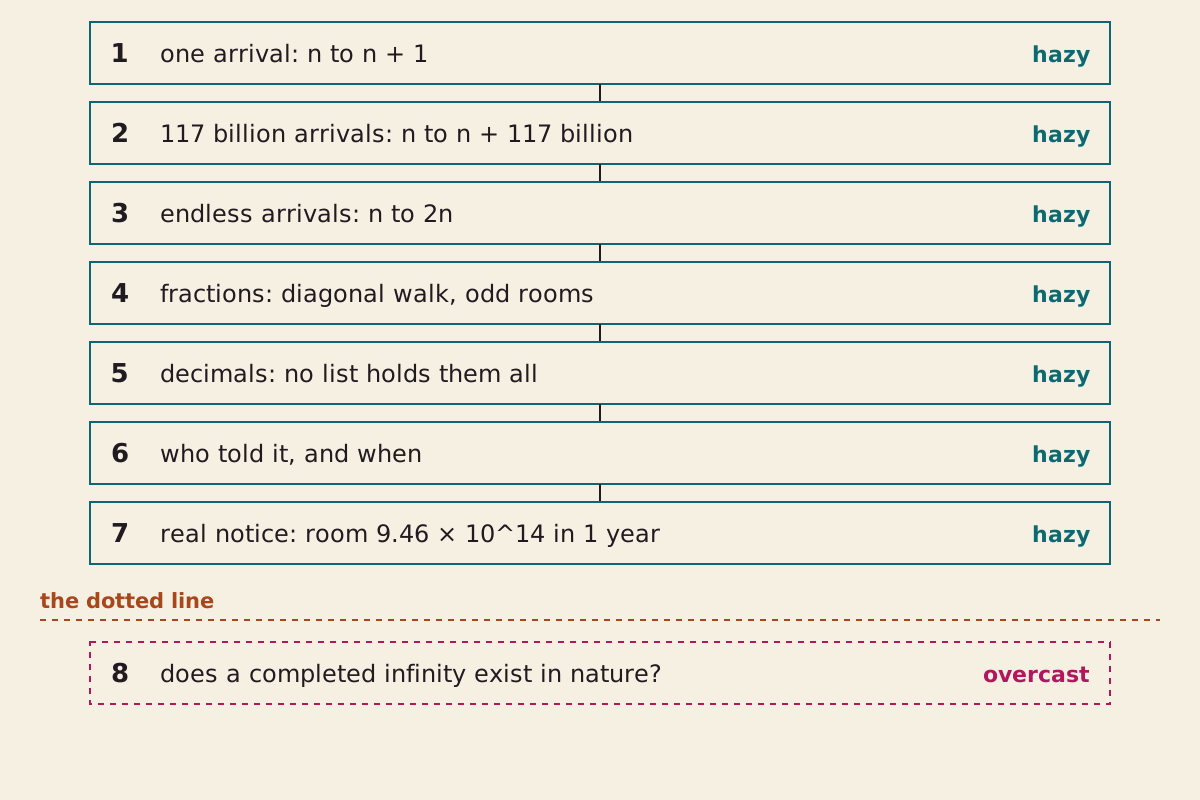
The chain behind this page. Step 8 sits past the dotted line. In the table below, only two constants rate clear.
"The chain behind this page" by The What-If Observatory, https://whatifobservatory.com/paradoxes/hilberts-hotel/, licensed under CC BY 4.0 (https://creativecommons.org/licenses/by/4.0/)
So the room numbers sit above that line, while a building with no last room sits below it. Seeing: overcast.
Check my math:
| Step | Input | Value | Unit | Source no. | Source | Recomputed | Seeing |
|---|---|---|---|---|---|---|---|
| 1 | Move for one arrival, as Hilbert gave it | rule | — | 1 | secondary | no | hazy |
| 1 | Guests sharing a room among the first 1,000,000 rooms | 0 | guests | — | site assumption | yes | hazy |
| 1 | Guests left without a room in a full 5-room hotel under the same move | 1 | guest | — | site assumption | yes | hazy |
| 2 | About 117 billion births through 2022, a Population Reference Bureau model figure, used as the size of one crowd | 117,000,000,000 | people | 7 | secondary | no | hazy |
| 2 | New room of the guest from room 1 under that move | 117,000,000,001 | room number | 7 | site assumption | yes | hazy |
| 3 | Move for endless arrivals, as Hilbert gave it | rule | — | 1 | secondary | no | hazy |
| 3 | Guests sharing a room among the first 1,000,000 rooms | 0 | guests | — | site assumption | yes | hazy |
| 3 | Odd rooms free among rooms 1 to 2,000,000 | 1,000,000 | rooms | — | site assumption | yes | hazy |
| 4 | Positive lowest-terms fractions with top + bottom up to 200, each given one number | 12,231 | fractions | — | site assumption | yes | hazy |
| 4 | Room for the fraction 3/2, under our walk and odd-room rule | 15 | room number | 6 | site assumption | yes | hazy |
| 4 | Room for the fraction 22/7, under our walk and odd-room rule | 525 | room number | 6 | site assumption | yes | hazy |
| 5 | Diagonal decimal built from our six-line list | 0.643622 | decimal | — | site assumption | yes | hazy |
| 5 | Any list of decimals misses at least one | proof | — | 6 | secondary | no | hazy |
| 6 | Term of the lectures with the hotel | 1924-25 | winter semester | 1, 2 | secondary | no | hazy |
| 6 | Year of Gamow's book | 1947 | year | 1 | secondary | no | hazy |
| 7 | Distance from one room to the next | 10 | meters | — | site assumption | no | hazy |
| 7 | Speed of light | 299,792.458 | km/s | 13 | primary | no | clear |
| 7 | Age of the Earth, by USGS, under 1 percent uncertain | 4.54 × 10^9 | years | 14 | primary | no | clear |
| 7 | No notice travels faster than light | rule | — | 15 | primary | no | hazy |
| 7 | Highest room reached by a light-speed notice in 1 Julian year | 9.46 × 10^14 | room number | 13 | site assumption | yes | hazy |
| 7 | Highest room reached in Earth's age, approximate | 4.30 × 10^24 | room number | 13, 14 | site assumption | yes | hazy |
| 8 | Whether a completed infinity exists in nature | open | — | 1 | secondary | no | overcast |
Download hilberts-hotel-check-my-math.csv (where its values come from) Data: Kragh 2014, arXiv:1403.0059; Meyries 2015, arXiv:1506.06319; Population Reference Bureau 2022; NIST CODATA 2022; USGS, Geologic Time: Age of the Earth
Download hilberts-hotel-mappings.csv (where its values come from) Data: Kragh 2014, arXiv:1403.0059; Meyries 2015, arXiv:1506.06319
The room checks run on finite lists, so they test the moves and cannot prove anything about every room. Those rows stay hazy for that reason, even though each one was rerun. Units were checked. Years here are Julian years of 365.25 days.
Next question:
- What if the box stayed shut? Schrödinger's cat
- How many people have ever lived? Births through 2022, counted two ways
Sources
- Helge Kragh. “The True (?) Story of Hilbert's Infinite Hotel.” arXiv:1403.0059v2, March 27, 2014. Original Read: preprint v2, full text.
- Christoph Lamm. “An Episode in The Old Mathematical Intelligencer.” arXiv:2509.01366, 2025. Original Read: preprint, the passage on the hotel in the section on castles and cottages. Text license: CC BY 4.0.
- Petr Glivický. “Metaphors in Teaching Infinity: Limits, Cardinalities, and Nonstandard Models.” arXiv:1812.06943, 2018. Original Read: preprint, section 3.2 on Hilbert's hotel.
- William Ewald and Wilfried Sieg (eds.). David Hilbert's Lectures on the Foundations of Arithmetics and Logic 1917-1933. Springer, 2013. Original Read: bibliography only; p. 730 read as quoted by Kragh and by Lamm.
- European Southern Observatory. “Adaptive Optics.” Original Read: full page. Text license: CC BY 4.0.
- Martin Meyries. “Infinity: A simple, but not too simple introduction.” arXiv:1506.06319, 2015. Original Read: preprint, sections on countability, the hotel, and the two diagonal arguments.
- Toshiko Kaneda, Carl Haub. “How Many People Have Ever Lived on Earth?” Population Reference Bureau, November 15, 2022. Original Read: full article; conclusions and stated assumptions used, period table not reproduced.
- Bradley Dowden. “The Infinite.” Internet Encyclopedia of Philosophy. Original Read: chapter-level reading: sections on sizes of infinity, relativity, constructivism and finitism, restated, not reproduced.
- George Gamow. One, Two, Three … Infinity: Facts and Speculations of Science. Viking Press, 1947, p. 17. Original Read: bibliography only; read as quoted by Kragh.
- Helge Kragh. “Gamow, not Hilbert: The Architect of Hilbert's Grand Hotel.” arXiv:1403.0059v1, March 1, 2014. Original Read: preprint v1, title and abstract.
- David Hilbert. “Über das Unendliche.” Mathematische Annalen 95: 161–190, dated 1925 in Kragh's reference list; a lecture of June 4, 1925. Original Read: bibliography only; p. 190 read as quoted by Kragh.
- Paul Copan and William L. Craig. Creation Out of Nothing. Baker Academic, 2004, p. 204. Original Read: bibliography only; read as quoted by Kragh.
- National Institute of Standards and Technology. “CODATA Value: speed of light in vacuum” (2022 CODATA recommended values). Original Read: value page, last read 2026-10-07.
- U.S. Geological Survey. “Geologic Time: Age of the Earth.” Original Read: full page.
- Albert Einstein (1905). “Zur Elektrodynamik bewegter Körper.” Annalen der Physik (ser. 4) 17, 891–921; the clock passage is section 4, p. 904. Original Read: chapter-level reading of the German text: sections 4, 7 and 10.
- Kateřina Trlifajová. “Theological Reasoning of Cantor's Set Theory.” arXiv:2407.18972, 2024; journal reference Filosofický časopis 53: 195–218, 2005. Original Read: preprint, the section on three respects of the actual infinite.
Cite this page
The What-If Observatory. "Hilbert’s Hotel: In Cantor’s Terms, Full Can Still Take More." Published 2026-11-09. https://whatifobservatory.com/paradoxes/hilberts-hotel/. Add the date you read it.
Corrections
None so far.