Dyson Sphere: Dyson Meant a Swarm, by Wright’s Account
The What-If Observatory Published
Spread Jupiter over a sphere at Earth's distance from the Sun and you get about 6,700 kg per square meter. At 2,000 kg per cubic meter, that is a layer about 3.4 meters thick. But a Dyson sphere, in Freeman Dyson's own 1960 reply to letters about it, was no such layer. He wrote of a swarm of separate objects on their own orbits and said a solid shell could not hold up, as Jason Wright's 2020 review reports.
Steps in this reading (5)
- Suppose:
- you spread Jupiter's mass around the Sun at 1 AU, Earth's distance.
- Hold fixed:
- 2,000 kg per cubic meter; every atom usable; the Sun's output unchanged.
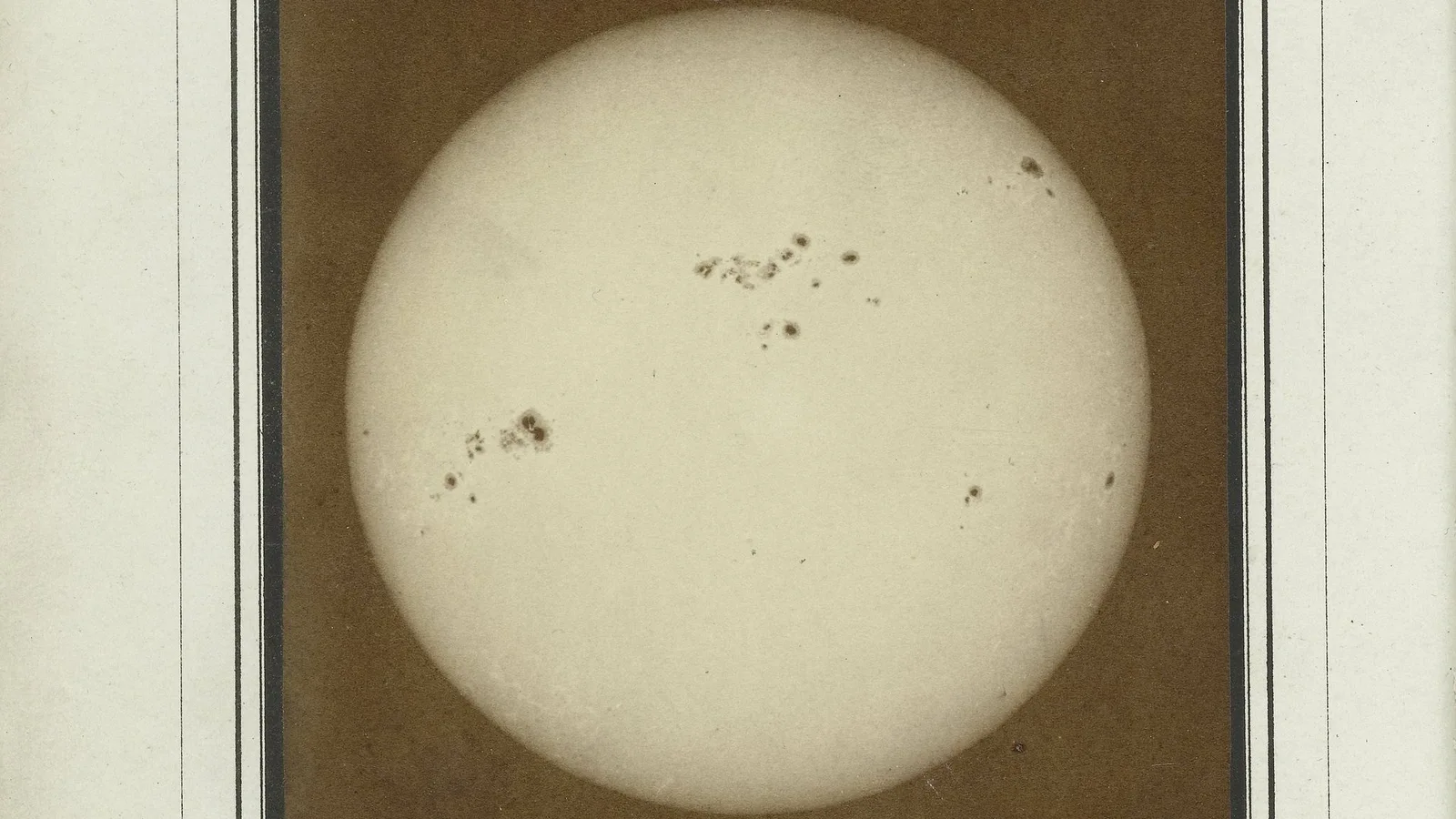
The Sun and its sunspots, photographed by Lewis M. Rutherfurd in New York, with September 22, 1870, printed below the picture on the page. A sphere at 1 AU would surround this star.
"Gezicht op de Maan. Photographie directe de la lune" by Lewis M. Rutherfurd — https://commons.wikimedia.org/wiki/File:Gezicht_op_de_Maan_Photographie_directe_de_la_lune_(titel_op_object),_RP-F-2001-7-30-1.jpg — Public domain in the US (published before 1931) and in the EU (author died 1892, life+70); modified: cropped from a photograph of the book page to 16:9, keeping the whole disk; the printed caption is outside the crop

Each step below carries a Seeing mark, a word borrowed from astronomy, where shaking air spreads the image of a star, and on this page it rates how much weight a step can bear: clear, hazy or overcast. Whether the sum itself holds is a separate check, in the table at the end.
What did Dyson propose?
His 1960 paper in Science started from growth: if a species' energy supply kept growing exponentially, he argued, it could end up occupying “an artificial biosphere which completely surrounds its parent star” (Wright, sec. 1.1). The waste heat from all that activity would likely show up at a wavelength of 10 microns, in the mid-infrared, so a search of the sky seemed worthwhile to him.
Readers wrote in. He answered later that year that he had not meant a shell or a ring, which he wrote would be “mechanically impossible.” He meant a “loose collection or swarm of objects traveling on independent orbits around the star” (sec. 1.1).
We could not read either Science piece, so his words here all come as Wright quotes them, and Wright's abstract calls the solid version the “popular imagining.” On the Kardashev scale, a civilization that commands the entire output of its star is Type II, and that output is the prize in Dyson's picture.
Where did the idea come from?
From a novel, by Dyson's own account: Wright reports that Dyson credited Olaf Stapledon's Star Maker (1937) with the original idea.
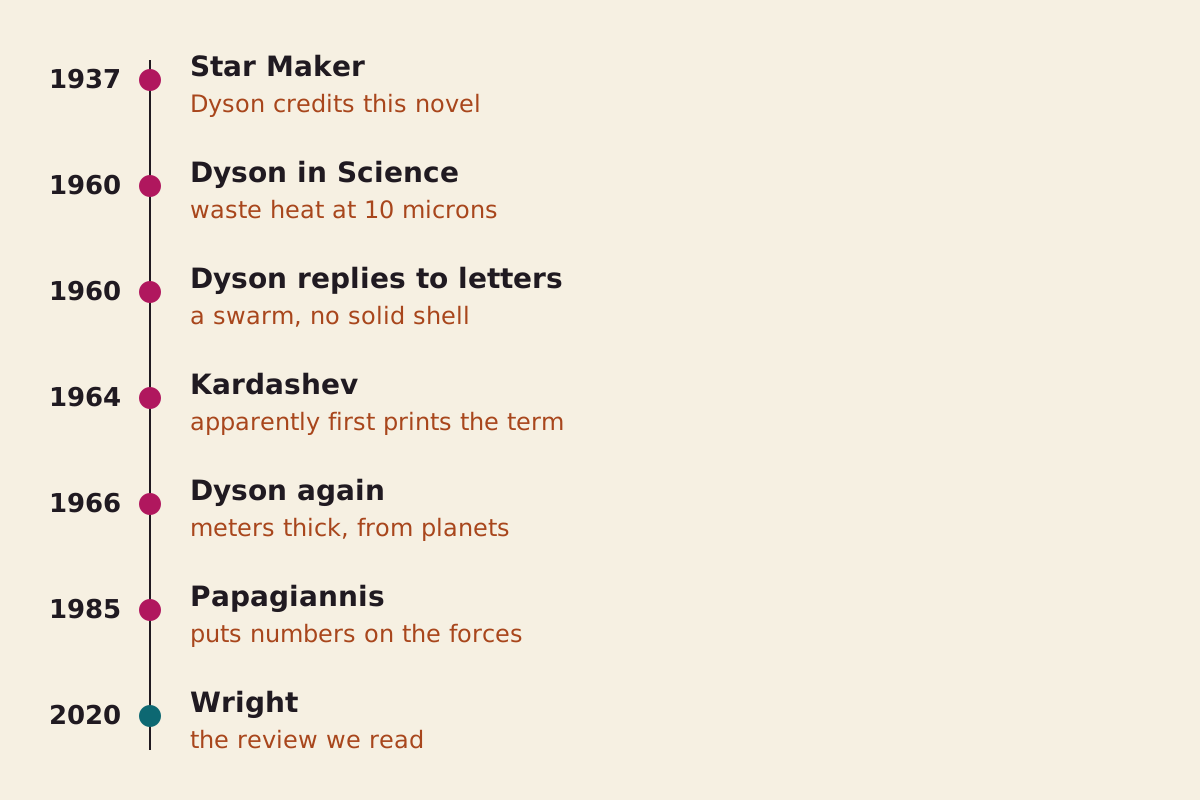
The idea from the novel to the review. Every entry but the last reaches us through Jason Wright's 2020 account.
"Where the Dyson sphere idea came from" by The What-If Observatory, https://whatifobservatory.com/estimates/dyson-sphere/, licensed under CC BY 4.0 (https://creativecommons.org/licenses/by/4.0/)
The name came next. Its first use in the literature is apparently Nikolai Kardashev's in 1964, Wright says. Later writers sometimes kept “Dyson sphere” for a complete shell and gave other shapes other names, such as “Dyson swarm,” while science fiction usually showed one object of planet size or larger.
In 1966, Dyson returned to the engineering. Wright's summary says he found no physical barrier to large rigid structures up to 10^6 kilometers, and that planets could in principle be taken apart for a sphere of useful thickness, “of order meters” (sec. 1.1). Earth's distance from the Sun is about 150 times that 10^6 kilometers, so the range falls well short of a shell out there.
How much material would it take?
About 6,749 kg for each square meter, if all of Jupiter goes into one layer at Earth's distance. Three steps get there, and a fourth asks whether Jupiter is even the right question.
Step 1: the sphere. An astronomical unit (AU) is about Earth's distance from the Sun. We use the rounded 1.496 × 10^11 meters in T. W. Murphy's 2013 review, the same figure as our Moon at half its distance page, and that gives a sphere of 2.81 × 10^23 square meters.
A sum should reproduce something known before it carries any weight. Spread the International Astronomical Union's nominal solar luminosity, 3.828 × 10^26 watts, over that area and you get 1,361.1 watts per square meter, a 0.009 percent miss against the union's nominal 1,361 for sunlight at Earth. The union derives its luminosity from that sunlight figure and the AU, so this tests our area and nothing more.
Wright's example of a shell 100 kilometers thick at 100 kg per cubic meter also comes out right: we get 1.41 solar masses, and he prints about 1.4. Seeing: hazy, because the AU is a rounded figure from a list of abbreviations.
Step 2: Jupiter. The union's 2015 resolution gives Jupiter's mass parameter as 1.2668653 × 10^17 cubic meters per second squared. Dividing by the 2014 value of the gravitational constant it prints, 6.67408 × 10^-11, gives 1.898 × 10^27 kg, or about 318 Earths. The uncertainty it prints for that constant moves the mass by about 0.005 percent. Seeing: clear.
Step 3: spread it. Mass over area comes to 6,749 kg per square meter. At our assumed 2,000 kg per cubic meter, the layer is 3.37 meters thick. That sits inside the “of order meters” of Wright's summary of Dyson, though Wright doesn't give the inputs behind that phrase, so we can't call it a check. Seeing: hazy, because the radius and the density are our picks.
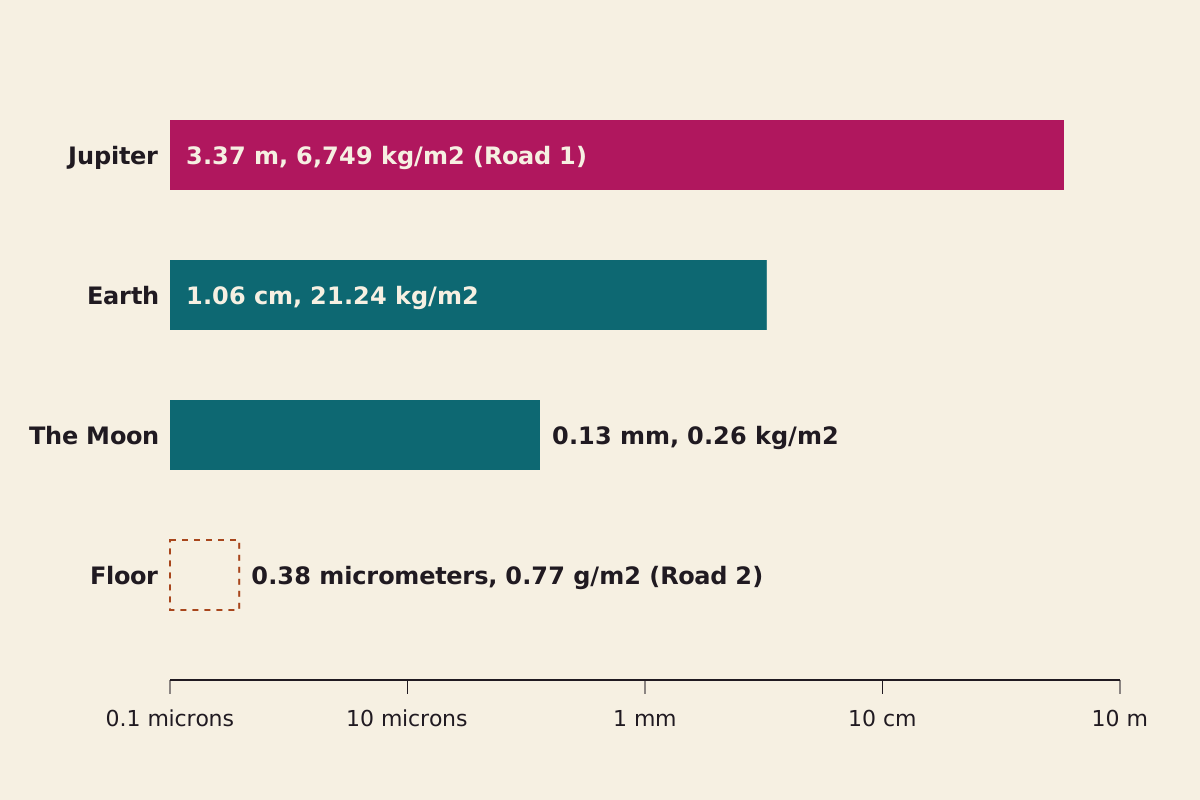
Four layers on one log scale, all at 1 AU and 2,000 kg per cubic meter. Jupiter is Road 1 and the floor is Road 2.
"Layer thickness at 1 AU from four amounts of material" by The What-If Observatory, https://whatifobservatory.com/estimates/dyson-sphere/, licensed under CC BY 4.0 (https://creativecommons.org/licenses/by/4.0/)
Data: Our sums from IAU 2015 Resolution B3 (mass parameters), Murphy 2013 (astronomical unit), Williams, Turyshev & Boggs (mass ratio); floor formula from Wright 2020
Step 4: a second road. Start from the other end and ask how thin material can get. Wright works out the surface density where starlight pushes on a patch as hard as gravity pulls, about 0.8 grams per square meter, comparable to the thinnest gold leaf, and he treats that as a lower limit for material bound to a star. Our rerun gives 0.77.
At that floor, a full sphere at 1 AU needs only 2.15 × 10^20 kg. The Moon's mass would cover 341 such spheres, and the layer would be 0.38 micrometers thick.
The two roads land 8.8 million times apart. We claim two-road agreement, our name for two independent estimates within 3 times of each other, only when the gap is smaller. These roads share the same AU and the union's constants, and they answer different questions: what one planet could supply, and, on Wright's figure, the least that can stay bound. So how much a Dyson sphere needs stays Seeing: overcast, since it depends on what each piece has to do.
Radius moves the first road by a simple rule. Double the radius and the layer gets four times thinner.
| Radius | Jupiter's mass per square meter | Layer at 2,000 kg per cubic meter |
|---|---|---|
| 0.5 AU | 26,998 kg | 13.50 m |
| 1 AU | 6,749 kg | 3.37 m |
| About 1.72 AU | 2,278 kg | 1.14 m |
| 2 AU | 1,687 kg | 0.84 m |
| 5 AU | 270 kg | 0.13 m |
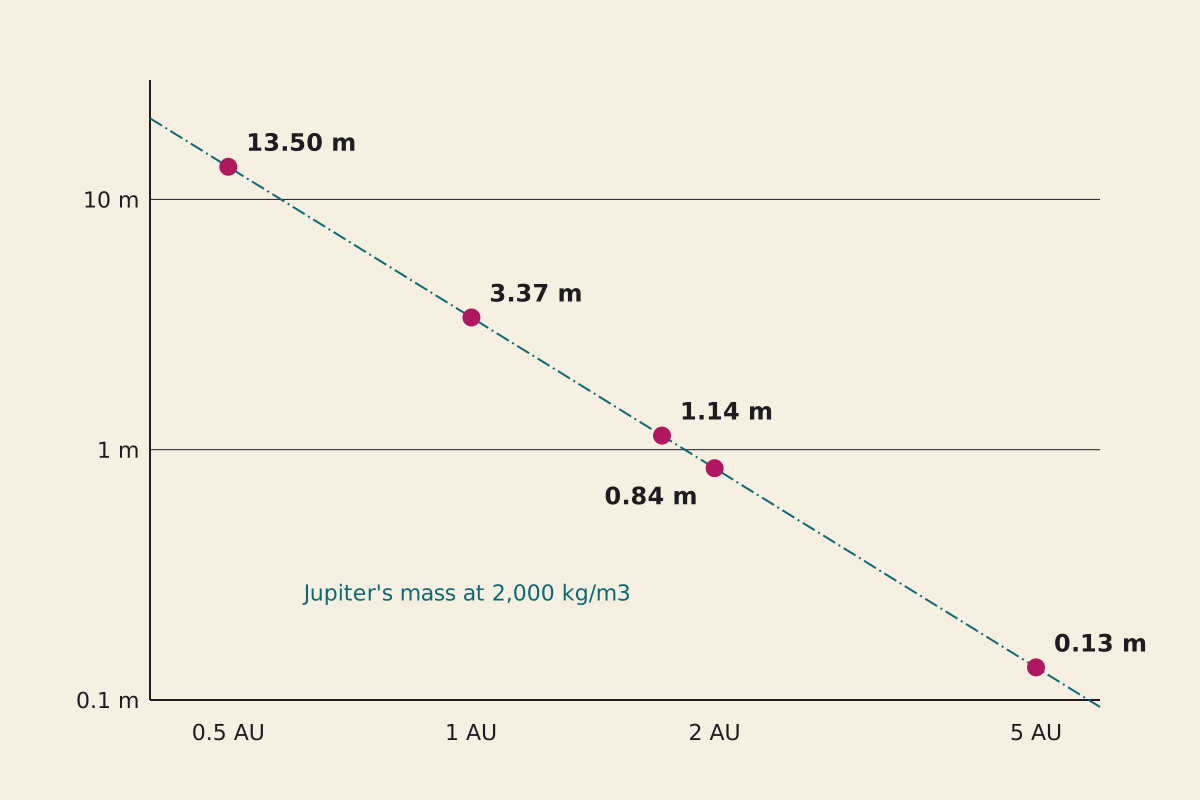
Jupiter's mass over five radii, on log axes. Double the radius and the layer gets four times thinner.
"Jupiter's mass as a layer at five radii" by The What-If Observatory, https://whatifobservatory.com/estimates/dyson-sphere/, licensed under CC BY 4.0 (https://creativecommons.org/licenses/by/4.0/)
Data: Our sums from IAU 2015 Resolution B3 (Jupiter's mass parameter) and Murphy 2013 (astronomical unit)
Why can't a solid shell hold together?
Because it would need a stiffness far beyond any known material. An orbiting object stays up because it keeps falling around the star, but a closed shell can't do that everywhere, since even a spinning one has poles. So each patch gets pulled inward and leans on its neighbors.
Step 5: the load and the wall. The load is small: on our Jupiter shell, the Sun's pull comes to about 40 pascals, or 40 newtons on every square meter. The trouble is the wall, 3.37 meters against a radius of 1 AU. Shrink the sphere to a 1-meter radius and that wall is 23 trillionths of a meter.
A wall that thin fails by buckling, the sudden crumpling you get when you press on a thin can, and Wright credits M. D. Papagiannis with showing the forces quantitatively in 1985.
Wright's formula, good to a factor of order unity, says the material then needs a stiffness of about 7.9 × 10^13 gigapascals. His own example, 10 meters at 1 gram per cubic centimeter, reruns at 1.3 × 10^13, and he prints about 10^13, which he puts nine orders of magnitude above the strongest known material. Our shell needs about 5.9 times that rerun.
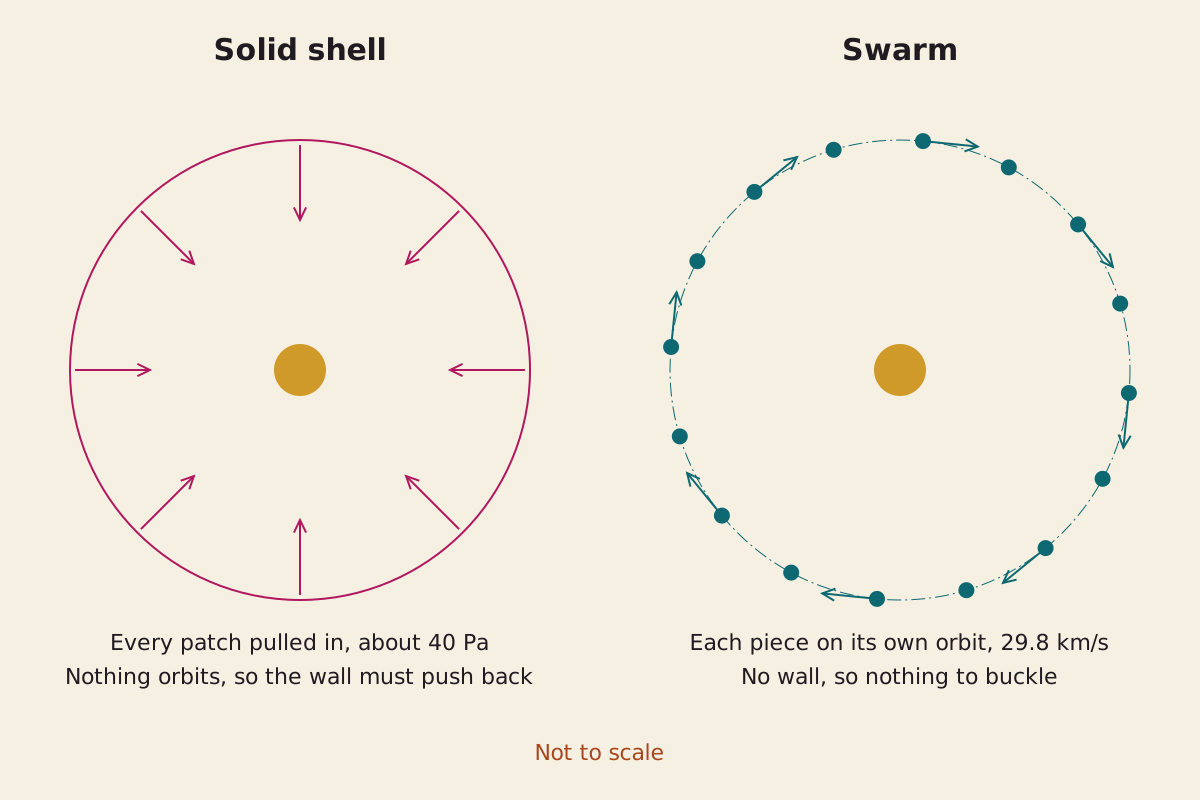
Why the two shapes behave differently. The figures are for Jupiter's mass at 1 AU. Not to scale.
"A solid shell against a swarm" by The What-If Observatory, https://whatifobservatory.com/estimates/dyson-sphere/, licensed under CC BY 4.0 (https://creativecommons.org/licenses/by/4.0/)
Stiffness is not the only problem. Gravity puts no net force on a perfect shell around its star, Wright shows, so nothing keeps it centered without constant correction. A shell at the 0.8-gram floor would not buckle, he adds, though it would still drift and its use is not obvious. He stops short of “impossible” for every design, allowing that magnets or electric charge might prop one up, but he sees no obvious mechanical gain over a swarm.
A swarm removes the wall. Cut Jupiter into pieces of 1 square kilometer and you get 2.81 × 10^17 pieces of about 6.7 billion kg each, every one circling at 29.8 kilometers per second, once in 1.00 year, with nothing leaning on it. We have not counted how they would miss each other, or how much light would get past. Seeing: hazy.
Would we see one?
Perhaps, as a warm spot in the infrared, though a warm spot wouldn't settle what it is. Absorbed sunlight has to leave again as heat, and that heat is the signal Dyson wanted astronomers to search for.
Step 6: the heat. Take Wright's simplest case, where all the heat leaves from the outer surface and the star doesn't change. With the Stefan-Boltzmann constant from NIST, a shell at 1 AU sits at 394 K, and its glow peaks at 7.36 microns.
To reach 300 K, about room temperature, the radius must grow to 1.72 AU, and the peak moves to 9.66 microns, next to Dyson's 10. Seeing: hazy, because we assume blackbodies, and Wright calls the star's response “still-unexplored” in his abstract.
| Radius | Outer temperature | Peak wavelength |
|---|---|---|
| 0.5 AU | 557 K | 5.21 microns |
| 1 AU | 394 K | 7.36 microns |
| About 1.72 AU | 300 K | 9.66 microns |
| 2 AU | 278 K | 10.4 microns |
| 5 AU | 176 K | 16.5 microns |
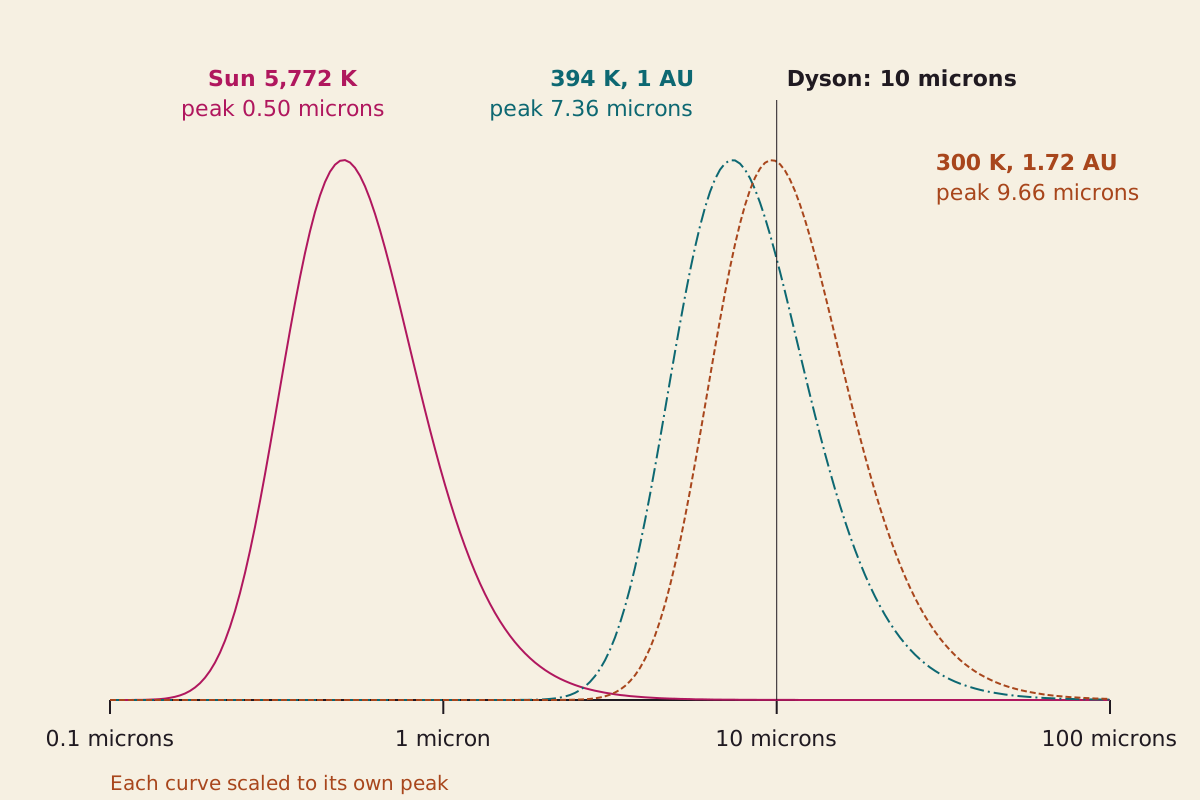
Where the light would come out, with each curve scaled to its own peak. We treat the Sun and both shells as blackbodies.
"Where the Sun and a shell give off their light" by The What-If Observatory, https://whatifobservatory.com/estimates/dyson-sphere/, licensed under CC BY 4.0 (https://creativecommons.org/licenses/by/4.0/)
Data: Our sums from IAU 2015 Resolution B3 (solar luminosity and temperature), NIST 2022 CODATA (radiation constants), Murphy 2013 (astronomical unit); 10 microns from Dyson 1960 as quoted in Wright 2020
Searches have looked, and Wright's 2020 review lists them. J. Jugaku and S. Nishimura found no good candidates among 384 nearby solar-type stars in 2004, and R. A. Carrigan concluded in 2009 that his four good candidates were likely distant red giants. Dyson himself warned in that 1960 reply, as Wright quotes it, that an infrared excess “would not by itself imply that extraterrestrial intelligence had been found” (sec. 1.1). Whether anyone is out there to build one belongs to the Fermi paradox.
Step 7: the prize. The Sun's nominal output is 3.828 × 10^26 watts, about 19 trillion times the world's primary energy use of 2.01 × 10^13 watts, by the US Energy Information Administration's 2022 figure. Kardashev's Type II, 4 × 10^26 watts as Milan Ćirković quotes it, is 1.04 times the Sun. Seeing: hazy.
Could anyone take Jupiter apart?
On a simple uniform-sphere estimate, just pulling it apart costs about 167 years of all the Sun's light.
Step 8: the bill. To pull a planet apart against its own gravity, the textbook uniform-sphere formula uses mass and radius, and with the union's nominal Jovian radius of 7.1492 × 10^7 meters it gives 2.02 × 10^36 joules. That is 167 years of the whole Sun, or about 3.2 quadrillion years at 2022 world use. A real planet is denser toward its center and costs more, and we have not counted moving the pieces. Seeing: hazy.
The dotted line falls after step 8, because up to there each reading has a named source or a stated assumption. Step 9 assumes that every atom of a gas giant can become a working collector and that someone keeps paying for it. Nothing we read pins that down. From here on, we are guessing.
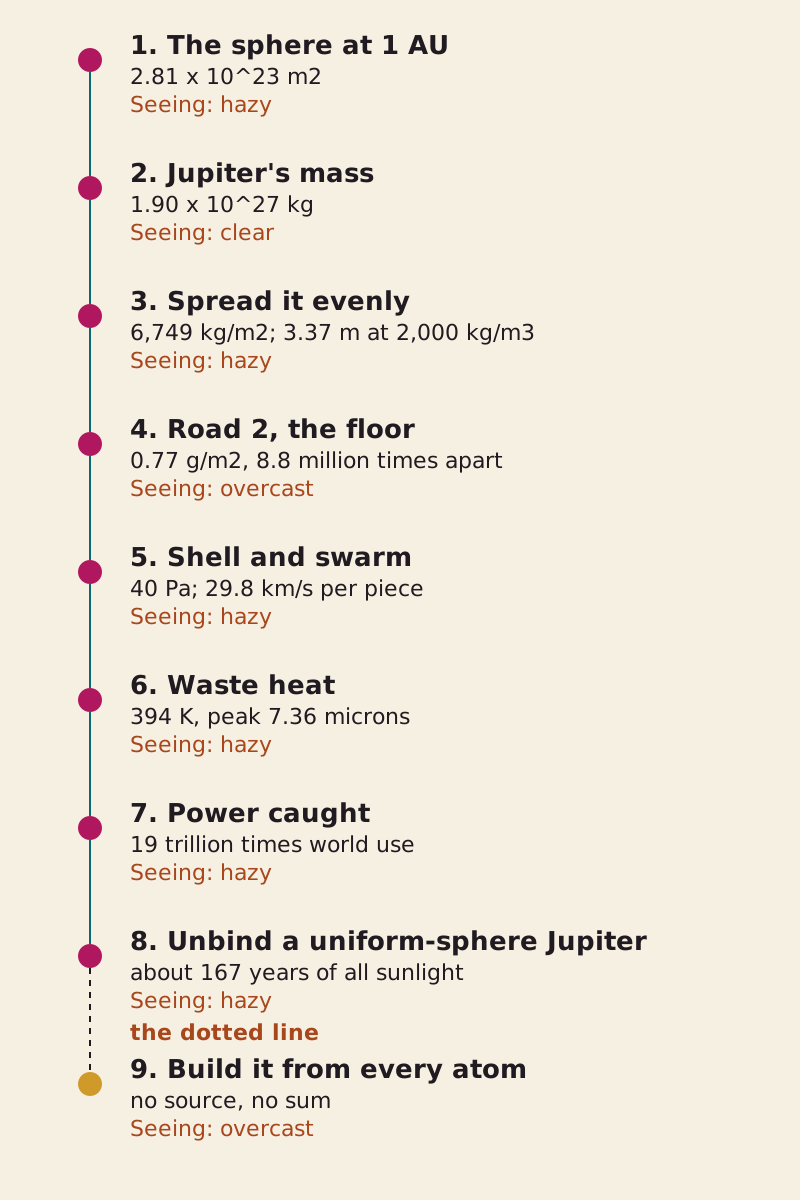
The chain behind this page. Steps 1 to 8 rest on published inputs and our stated assumptions. Step 9 sits past the dotted line.
"Dyson sphere chain" by The What-If Observatory, https://whatifobservatory.com/estimates/dyson-sphere/, licensed under CC BY 4.0 (https://creativecommons.org/licenses/by/4.0/)
So the mass sits above that line, and the building of it sits below. Seeing: overcast.
Check my math:
| Step | Input | Value | Unit | Source no. | Source | Recomputed | Seeing |
|---|---|---|---|---|---|---|---|
| 1 | Astronomical unit, rounded | 1.496 × 10¹¹ | m | 8 | secondary | no | hazy |
| 1 | Sphere area at 1 AU | 2.8124 × 10²³ | m2 | 8 | secondary | yes | hazy |
| 1 | Nominal solar luminosity | 3.828 × 10²⁶ | W | 9 | primary | no | clear |
| 1 | Sunlight per square meter at 1 AU | 1,361.1 | W/m2 | 8, 9 | secondary | yes | hazy |
| 1 | Shell mass for 100 km at 100 kg/m3 | 1.41 | solar masses | 4, 8, 9 | secondary | yes | hazy |
| 2 | Jovian mass parameter | 1.2668653 × 10¹⁷ | m3/s2 | 9 | primary | no | clear |
| 2 | Newtonian constant G | 6.67408 × 10⁻¹¹ | m3/kg/s2 | 9 | primary | no | clear |
| 2 | Jupiter's mass | 1.8982 × 10²⁷ | kg | 9 | primary | yes | clear |
| 3 | Jupiter spread over 1 AU | 6,749.4 | kg/m2 | 8, 9 | site assumption | yes | hazy |
| 3 | Material density | 2,000 | kg/m3 | — | site assumption | no | hazy |
| 3 | Layer thickness from Jupiter at 2,000 kg/m3 | 3.3747 | m | 8, 9 | site assumption | yes | hazy |
| 3 | Layer thickness from Earth at 2,000 kg/m3 | 0.010618 | m | 8, 9 | site assumption | yes | hazy |
| 3 | Layer thickness from the Moon at 2,000 kg/m3 | 1.306 × 10⁻⁴ | m | 8, 9, 10 | site assumption | yes | hazy |
| 4 | Floor density from radiation balance | 7.6565 × 10⁻⁴ | kg/m2 | 4, 9, 13 | secondary | yes | overcast |
| 4 | Mass at the floor, 1 AU | 2.1533 × 10²⁰ | kg | 4, 8, 9, 13 | site assumption | yes | overcast |
| 4 | Moon mass in floor spheres | 341 | spheres | 4, 8, 9, 10, 13 | site assumption | yes | overcast |
| 4 | Road gap, Road 1 over Road 2 | 8.82 × 10⁶ | times | 4, 8, 9, 13 | site assumption | yes | overcast |
| 5 | Load on a Jupiter shell at 1 AU | 40 | Pa | 4, 8, 9 | site assumption | yes | hazy |
| 5 | Stiffness a Jupiter shell needs at 2,000 kg/m3 | 7.87 × 10¹³ | GPa | 4, 8, 9 | site assumption | yes | hazy |
| 5 | Same sum on Wright's inputs | 1.33 × 10¹³ | GPa | 4, 9 | secondary | yes | hazy |
| 5 | Our shell over his example | 5.93 | times | 4, 8, 9 | site assumption | yes | hazy |
| 5 | Wall over radius, Jupiter shell at 2,000 kg/m3 | 2.26 × 10⁻¹¹ | ratio | 8, 9 | site assumption | yes | hazy |
| 5 | Orbital speed at 1 AU | 29.78 | km/s | 8, 9 | secondary | yes | hazy |
| 5 | Orbital period at 1 AU | 1 | Julian years | 8, 9 | secondary | yes | hazy |
| 5 | Pieces of 1 square kilometer | 2.81 × 10¹⁷ | pieces | 8 | site assumption | yes | hazy |
| 5 | Mass of one piece | 6.75 × 10⁹ | kg | 8, 9 | site assumption | yes | hazy |
| 6 | Stefan-Boltzmann constant | 5.6703744 × 10⁻⁸ | W/m2/K4 | 11 | primary | no | clear |
| 6 | Wien displacement constant | 2.897772 × 10⁻³ | m K | 11 | primary | no | clear |
| 6 | Outer temperature at 1 AU | 393.6 | K | 4, 8, 9, 11 | secondary | yes | hazy |
| 6 | Peak wavelength at 1 AU | 7.36 | micrometers | 8, 9, 11 | secondary | yes | hazy |
| 6 | Radius for a 300 K exterior | 1.72 | AU | 8, 9, 11 | site assumption | yes | hazy |
| 6 | Peak wavelength at 300 K | 9.66 | micrometers | 11 | site assumption | yes | hazy |
| 7 | Kardashev Type II | 4 × 10²⁶ | W | 6, 7 | secondary | yes | hazy |
| 7 | Type II over the Sun | 1.04 | times | 6, 7, 9 | secondary | yes | hazy |
| 7 | World primary energy, 2022 | 2.01 × 10¹³ | W | 12 | primary | yes | hazy |
| 7 | The Sun over 2022 world use | 1.91 × 10¹³ | times | 9, 12 | secondary | yes | hazy |
| 8 | Uniform-sphere energy to unbind Jupiter | 2.02 × 10³⁶ | J | 9 | site assumption | yes | hazy |
| 8 | Uniform-sphere energy in years of all sunlight | 167 | Julian years | 9 | site assumption | yes | hazy |
| 8 | Uniform-sphere energy at 2022 world use | 3.19 × 10¹⁵ | Julian years | 9, 12 | site assumption | yes | hazy |
| 9 | Every atom becomes a collector, and someone pays for it | — | — | — | site assumption | no | overcast |
Download dyson-sphere-check-my-math.csv (where its values come from)
Download dyson-sphere-radius-table.csv (where its values come from)
The computed numbers in the text were compared with the same recalculation behind the CSVs, and units were checked. Dates and search counts reported from Wright's review were not recomputed.
Next question:
- What if ships had all that time? The Fermi paradox, on Voyager's clock
- How many watts is Type I? The Kardashev scale, in watts
Sources
- Freeman J. Dyson (1960). “Search for Artificial Stellar Sources of Infrared Radiation.” Science 131:1667–1668. Original Read: bibliography only; quoted through Wright 2020, section 1.1.
- Freeman J. Dyson (1960). Reply to letters to the editor. Science 132:250. Original Read: bibliography only; quoted through Wright 2020, section 1.1.
- Freeman J. Dyson (1966). In Perspectives in Modern Physics: Essays in Honor of Hans A. Bethe on the Occasion of His 60th Birthday, ed. R. Marshak et al. Original Read: bibliography only; summarized by Wright 2020, section 1.1.
- Jason T. Wright (2020). “Dyson Spheres.” Invited review, arXiv:2006.16734. Original Read: preprint, sections 1 to 3 and references.
- Olaf Stapledon (1937). Star Maker. Methuen. Original Read: bibliography only; named by Wright 2020, section 1.2.
- Nikolai S. Kardashev (1964). “Transmission of Information by Extraterrestrial Civilizations.” Soviet Astronomy 8:217. Original Read: bibliography only; quoted through Ćirković 2015.
- Milan M. Ćirković (2015). “Kardashev's Classification at 50+: A Fine Vehicle with Room for Improvement.” Serbian Astronomical Journal 191:1–15. arXiv:1601.05112. Original Read: preprint, sections 1 and 2 and references.
- T. W. Murphy Jr. (2013). “Lunar laser ranging: the millimeter challenge.” arXiv:1309.6294. Original Read: preprint, introduction, list of abbreviations and the sentence on tidal locking.
- E. E. Mamajek, A. Prša, G. Torres et al. (2015). “IAU 2015 Resolution B3 on Recommended Nominal Conversion Constants for Selected Solar and Planetary Properties.” arXiv:1510.07674. Original Read: full text of the resolution.
- James G. Williams, Slava G. Turyshev, Dale H. Boggs. “Lunar Laser Ranging Tests of the Equivalence Principle with the Earth and Moon.” arXiv:gr-qc/0507083. Original Read: preprint, one value, quoted there from Konopliv et al..
- National Institute of Standards and Technology. “2022 CODATA adjustment: physico-chemical constants.” Original Read: values from the 2022 physico-chemical constants list.
- US Energy Information Administration. “What is the United States' share of world energy consumption?” Frequently Asked Questions, last updated April 11, 2024. Original Read: full FAQ answer.
- National Institute of Standards and Technology. “CODATA Value: speed of light in vacuum” (2022 CODATA recommended values). Original Read: value page, last read 2026-10-07.
Cite this page
The What-If Observatory. "Dyson Sphere: Dyson Meant a Swarm, by Wright’s Account." Published 2026-11-09. https://whatifobservatory.com/estimates/dyson-sphere/. Add the date you read it.
Corrections
None so far.